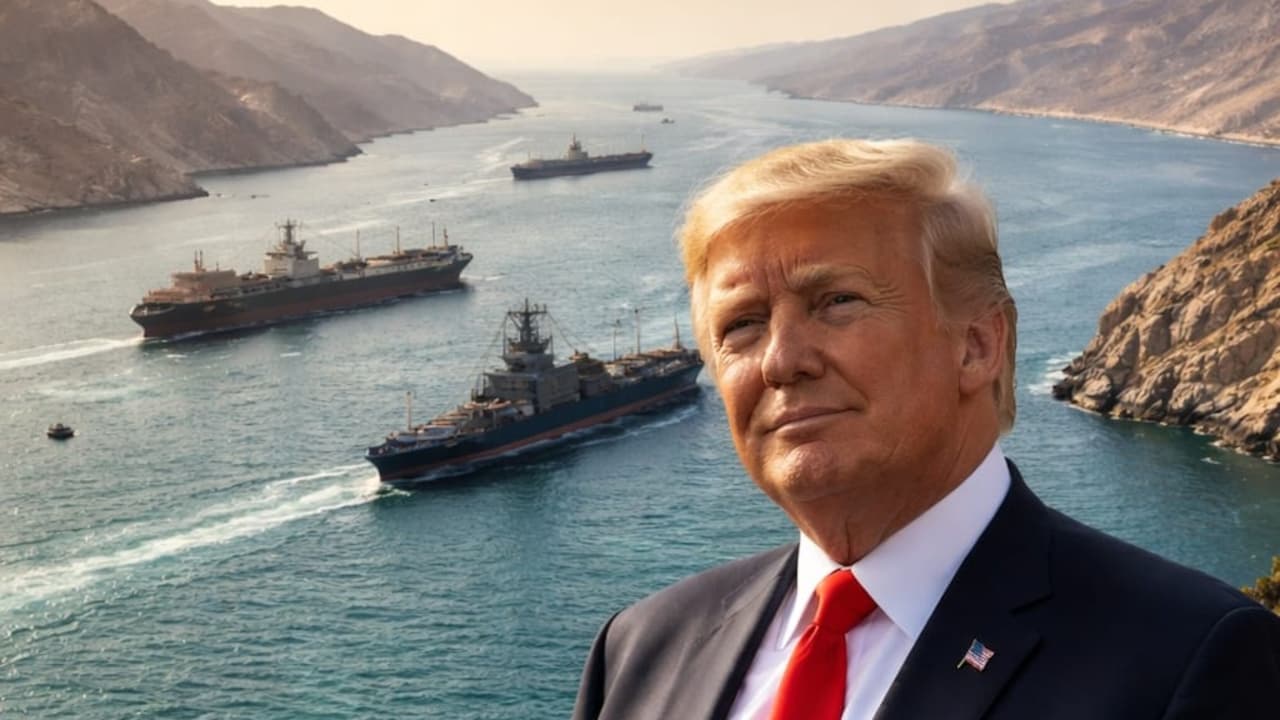
The sea does not care about tickers, nor does it check the trading screens in London or Singapore before it swells against the iron hull of a tanker. At night, the waters of the Strait of Hormuz turn the color of hammered lead. It is a narrow throat of blue and green, barely twenty-one miles wide at its absolute tightest squeeze, through which a staggering chunk of the planet's daily petroleum pulse must force itself. If you stand on the bridge of a vessel creeping through those shipping lanes at three in the morning, the silence is not peaceful. It is loaded. It feels less like an ocean and more like a crowded hallway where everyone is holding a match.
Right now, that hallway is echoing with conflicting shouts.
A flash crosses the wire from the region. The Islamic Revolutionary Guard Corps claims a supertanker has been struck, damaged, caught in the friction of an undeclared, creeping maritime conflict. Thousands of miles away, in the air-conditioned, humming bunker of CENTCOM, officers look at radar sweeps, infrared telemetry, and satellite passes, and they issue a quiet, flat denial. No hit. No strike. Just the ghost of an incident or perhaps the early, jagged static of a propaganda war designed to move markets before a single shell has even cleared the horizon.
Let us step off the bridge for a moment and consider what this actually means for the clerk in Ohio paying seven dollars to fill a gas tank, or the fisherman in Bushehr watching the horizon for gray hulls.
War in the modern era rarely begins with a cinematic explosion that shakes the earth. It begins with narrative shrapnel. It starts with two sides staring at the exact same patch of dark water and telling completely incompatible truths. One side needs a strike to signal leverage, defiance, or retaliation; the other needs the strike to be a phantom, a ghost story told in smoke to prevent panic from seizing the global economy.
Imagine, hypothetically, a chief engineer named Mateo standing down in the bowels of a ULCC—an Ultra Large Crude Carrier—holding a steaming mug of instant coffee that has gone cold. He has sailed these waters for thirty years. He has seen the tankers grow larger and the rhetoric grow sharper, until the two seem locked in a strange race to see which will collapse first. When a low, metallic shudder reverberates through the steel plating of the ship—a shudder caused perhaps by a shifting wave, a mechanical hiccup in the massive two-stroke diesel engine, or something far more deliberate—Mateo does not immediately reach for a rifle. He reaches for the fuel pressure gauges. He looks at the bulkhead to see if there is a breach. His universe shrinks to inches of welded steel and pounds per square inch.
Above him, miles up in the stratosphere or sitting on desks in regional command centers, men and women in uniforms are treating Mateo’s floating city as a chess piece.
The claim by the IRGC and the swift rebuttal by CENTCOM represent a dangerous choreography. When tensions settle into this particular gray zone, the truth becomes the first casualty of maritime posture. Every wave is suspect. Every radar blip is an argument. If a supertanker is struck, the global price of crude spikes instantly, supply chains constrict, insurance rates for every vessel transiting the Persian Gulf skyrocket into the stratosphere, and ordinary citizens thousands of miles away find themselves paying an invisible tax levied by fear.
Conversely, if a claim is manufactured or grossly exaggerated, it serves as a psychological weapon. It tests the nerves of adversaries. It measures response times. It gauges how jittery the international community is willing to be on any given Tuesday.
We have lived through this before, though we often forget the rhythm of it until the drumbeat speeds up. The Strait of Hormuz has always been a choke point of human anxiety. Centuries ago, dhows sailed past these exact same limestone cliffs carrying spices and silks, dodging pirates who knew every hidden cove. Today, the pirates wear state uniforms, and the dhows have been replaced by steel behemoths longer than three football fields, carrying enough crude oil to power a continent's winter.
Consider the sheer fragility of it. A single blocked channel, a single sustained campaign of harassment against commercial shipping, and the interconnected architecture of modern civilization begins to wobble. We take for granted that when we flip a light switch, power flows. We take for granted that the goods on our shelves arrived on a ship that crossed an ocean unmolested. We treat the global logistics network as an eternal law of nature, forgetting that it is actually a very fragile, very tense agreement negotiated daily by diplomats, sailors, and deterrence.
When CENTCOM disputes a claim of a strike, they are not just engaging in a semantic debate over radar tracks. They are trying to hold a line against escalation. They are saying: Do not let the ghost story become real.
Yet the danger of a ghost story is that people start acting as though the monsters are already in the room. When crews are terrified, mistakes happen. A misidentified fishing boat can look like an attack craft. A radar anomaly can trigger a defensive posture that spirals out of control before anyone in a uniform can check the logs. History is littered with accidental escalations—sparks that caught because someone left the oil-soaked rags of rhetoric lying around too long.
Mateo finishes his cold coffee and sets the mug down on the steel workbench. Down here, deep in the hull, the rhythmic thrum of the engine is the only constant. He does not know what the headlines say in Washington. He does not know what communiques are being tapped out in Tehran. He only knows that the water outside is dark, the passage is narrow, and somewhere out there in the electronic haze, the world is arguing about whether his ship is still whole or already broken.
The tanker moves forward, pushing tons of dark water aside, cutting a lonely line through the center of a storm that hasn't quite broken, but refuses to pass.