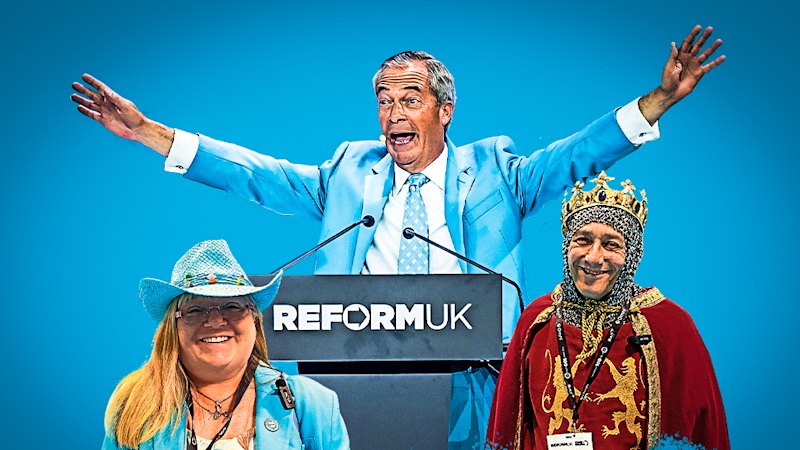
Every political commentator in Westminster is currently peddling the same lazy narrative. Nigel Farage stands on a stage, points at a pothole, a delayed train, or an immigration statistic, and declares that Britain is fundamentally broken. Then, the mainstream punditocracy hyperventilates, claiming Reform UK is about to rewrite the political map, and demands to know if Farage can actually deliver.
It is a comfortable script. It allows everyone to play their assigned roles.
It is also complete rubbish.
Britain is not broken. Britain is performing precisely as a nation designed by its electorate to avoid hard choices should perform. The machinery of the state works; the infrastructure responds to the incentives we built; the economic stagnation is the exact mathematical outcome of decades of democratic demand for high public services and zero taxation. To buy into the narrative that a single populist insurgent can swoop in with a clipboard and fix this mess is to misunderstand the mechanics of modern decline. We are not suffering from a lack of political will. We are suffering from a collective refusal to accept reality.
I have spent years watching political campaigns promise voters the moon while quietly adjusting the tax code to pick their pockets. I have sat in rooms where consultants map out focus groups, tailoring messages not to solve structural deficits, but to massage the delicate sensibilities of middle-class homeowners who want the NHS of Sweden paired with the tax burden of the Bahamas.
Let us clear away the fog right now. When a politician tells you the country is broken, they are usually selling you a fairy tale where you bear zero responsibility for the fracture.
The Fallacy of the Quick Fix
Reform UK’s entire value proposition rests on a dangerous sleight of hand. The pitch is simple: cut the fat, stop the boats, slash net zero, and watch the economic engine roar back to life. It sounds wonderful over a pint. It fails basic arithmetic.
Let us define terms. When we talk about a broken country, what are we actually measuring? GDP per capita? Public sector productivity? NHS waiting lists?
Economists like Nicholas Bloom and various departments at the London School of Economics have pointed out repeatedly that Britain's productivity crisis is not a bureaucratic accident. It is structural. We have an economy hooked on cheap, low-skill labor on one hand, and a protected property-owning class on the other that treats housing like a financial asset rather than shelter.
If you slash immigration overnight without fundamentally redesigning how British capital invests in automation, workforce training, and infrastructure, the care sector collapses, hospitality implodes, and tax receipts shrink faster than a cheap suit in a tumble dryer. You do not fix a chronic condition by severing the limb. You just bleed out slower.
Farage’s appeal is emotional, not operational. He diagnoses the anger correctly. He bottles the profound, justified frustration of people who watch their high streets rot, their purchasing power evaporate, and their public services turn into third-world car parks. But identifying a symptom is not the same as curing the disease.
Imagine a scenario where Reform actually captures thirty percent of the vote and forces a coalition or a parliamentary earthquake. What happens on day one? The civil service—that immovable, self-preserving blob of institutional inertia—does not suddenly roll over and implement nationalist dogma. It buries them in red tape, leaks their memos to the Guardian, and waits them out. Populism meets procedure, and procedure wins every single time unless you are willing to break the constitutional glass. And breaking that glass carries a cost nobody in the Reform manifesto is brave enough to price.
Why the Electorate Deserves the Blame
We love to blame politicians. It is the national sport. Every four or five years, we toss the rascals out, bring in a new batch of rascals, and express profound shock when they turn out to be self-serving careerists.
This is intellectually dishonest. Politicians are lagging indicators of public cowardice.
No major political party in Britain can tell the truth about the Triple Lock on pensions because pensioners vote in droves and working-age people scroll through TikTok on election day. No party can tell homeowners that their house prices need to drop by thirty percent for young people to have a future, because the median voter owns a home and treats it as their personal retirement fund.
We want European-style public services with American-style tax rates, funded by borrowing from our grandchildren. When reality inevitably bites, we throw a tantrum and demand a populist savior.
Farage is brilliant at riding this wave. He channels the populist energy precisely because it requires zero sacrifice from the listener. Vote for us, he says, and someone else will pay the bill. The foreigners, the bureaucrats, the elites in Islington.
Let us look at the data on public spending. The state consumes nearly forty-five percent of GDP. The National Health Service eats up an astronomical share of public resources while ranking near the bottom of European health outcomes for efficiency and cancer survival rates. Throwing more money at it is like pouring water into a bucket with a massive hole in the bottom. Yet, try suggesting that the model itself is obsolete—that we need an insurance-based hybrid system like the French or the Germans—and watch both the left and right lose their minds.
The left screams about Americanization. The right screams about big government. Meanwhile, millions of people wait twelve hours in accident and emergency departments because nobody has the political courage to tell the public that free at the point of use cannot mean free from all rationing and personal accountability.
The Counter-Intuitive Truth About National Renewal
If you want to fix Britain, you have to do the exact opposite of what every populist and establishment politician is selling.
Stop looking for a savior. Start embracing friction.
Real national renewal does not come from a charismatic leader standing on a soapbox shouting slogans about sovereignty. It comes from radical, localized deregulation, the kind that makes the political class break out in hives.
- Abolish planning restrictions entirely around major transit hubs. If you want to solve the housing crisis, let people build. Strip local NIMBY committees of their veto power. A nation where young people spend sixty percent of their income on rent is a nation that cannot innovate, cannot start businesses, and cannot have children.
- Shift the tax burden away from labor and onto land and consumption. Punishing work while rewarding property speculation is an economic suicide pact. Tax the unearned wealth sitting in suburban semi-detached homes and let workers keep what they earn.
- Decentralize power ruthlessly. Westminster is a rotting corpse of central planning. Give regional mayors the actual authority to raise their own taxes and spend them on local transport and education, then let them fail or succeed on their own merits.
These ideas are unpopular. They violate the sacred cows of both left and right. They cannot be packaged neatly into a thirty-second TikTok clip or shouted across a beer tent.
Reform UK wants you to believe that the system can be restored to some mythical 1950s golden age if we just close the borders and tell Brussels where to go. It is a comforting bedtime story for a country terrified of the future.
Britain is not broken. It is lazy, entitled, and addicted to the cheap dopamine hit of political protest. Until we are ready to look in the mirror, admit that we voted for every single one of our own chains, and accept that no amount of populist theater will replace hard, unglamorous reform, we will continue our slow, whinging descent into irrelevance.
Stop waiting for Farage to save you. Start demanding the right to build your own future.