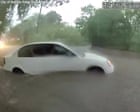
A white sedan sits stuck in a low-water crossing in Beeville, Texas. The water is rising fast, sweeping the vehicle toward a raging creek. Inside, a panicked father screams out to arriving first responders, begging them to save his child. Body camera footage captured the frantic seconds that followed, showing a local police officer rushing through the current to pull an infant out of the passenger window, still strapped inside a car seat.
While the daring rescue on Saturday highlights the bravery of rural first responders, it exposes a systemic failure in how rural infrastructure handles extreme weather events. The incident did not happen because of a driver ignoring warnings. It happened because the storm moved faster than the physical infrastructure could adapt, proving that relying on manual barricades and visual warnings is no longer sufficient in an era of rapid, volatile weather patterns.
The Illusion of Passable Roads
Low-water crossings are an engineering compromise. Common throughout the American Southwest and Central Texas, these structures are built just above normal water surfaces to span creeks and dry riverbeds at a fraction of the cost of high-level bridges. They work perfectly until they do not.
In Beeville, a city roughly 100 miles southeast of San Antonio, a sudden downpour dumped inches of water in minutes. The local creek swelled instantly. According to the Beeville Police Department, the local fire chief was already on the scene, physically attempting to wave down the approaching sedan. The driver simply did not see him in time.
This highlights the psychological trap of driving in heavy rain. When visibility drops, drivers focus intensely on the pavement immediately in front of their headlights. A figure standing by the roadside waving arms can easily blend into the sheet of gray water. By the time the driver realized the depth of the current, the car had already lost traction.
The Logistics of the First Response Bottleneck
The public views a rescue through the narrow lens of a body camera. They see the heroism of an officer wading into a current, grabbing a baby carrier, and another responder shielding the child from the pouring rain with a high-visibility jacket. What they miss is the logistical breakdown that occurred minutes before the cameras started rolling.
Municipalities rely on a sequence of manual steps during a flash flood:
- Detection: Rising waters must be reported by citizens or spotted by roving patrols.
- Dispatch: Road crews or emergency workers are assigned to deploy warning systems.
- Transportation: Workers must drive through the very storm causing the hazard to reach the site.
- Deployment: Heavy wooden or metal barricades are manually set up across the asphalt.
In the Beeville incident, the water rose so fast that police confirmed they had zero time to deploy physical barricades before the vehicle arrived. The storm outpaced the bureaucracy. Expecting small, underfunded rural departments to manually close dozens of low-water crossings simultaneously during a sudden convective storm is a statistical impossibility.
The Failure of the "Turn Around Don't Drown" Campaign
For decades, the National Weather Service has pushed the phrase "Turn Around Don't Drown." It is an effective public relations slogan, but it shifts the entire burden of safety onto the individual driver while ignoring the reality of human perception.
Water looks deceptive. A driver looking at a flooded road cannot accurately judge the speed of the current or the depth of the water from behind a windshield, especially when rain is pelting the glass. More importantly, they cannot see if the asphalt beneath the water has already washed away. Six inches of fast-moving water can knock an adult off their feet. Twelve inches will float many compact cars. Two feet of rushing water will sweep away most SUVs and pickup trucks.
When a vehicle enters a low-water crossing, it becomes a boat without a rudder. The tires lose contact with the road, hydrodynamic lift takes over, and the lateral force of the current pushes the vehicle downstream.
The Cost of Smarter Solutions
Fixing this problem is not a mystery; it is a budget issue. Relying on humans to drop everything and place orange barriers in a downpour is an archaic approach to public safety.
Automated flood warning systems exist. These setups use ultrasonic water-level sensors installed under bridges or near banks. When the water hits a critical threshold, the sensor triggers solar-powered flashing signs, and automated gates drop down to block the road, entirely eliminating the need for a physical police presence to stop traffic.
The barrier to widespread adoption is purely financial. A single automated gate system can cost tens of thousands of dollars to install and maintain. For small Texas counties with limited tax bases and thousands of miles of rural roads, outfitting every problematic creek crossing is a non-starter. They choose to gamble on the speed of their first responders instead.
The Beeville rescue ended without injuries, a fortunate outcome that will likely be recorded as a success story. Yet, counting on a fire chief to stand in the rain or an officer to swim into a current is a unsustainable strategy for an infrastructure crisis that is growing more urgent by the year.