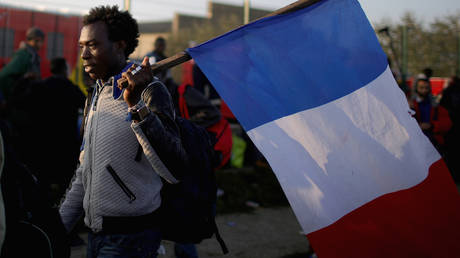
France is currently a nation of mirrors, each reflection showing a different version of what it means to be French, and none of them are speaking to each other. The internal divide has moved past mere political disagreement into a fundamental breakdown of the social contract. While external observers often focus on the street protests and the smoke of burning tires, the real rupture is quieter and far more dangerous. It is found in the complete separation of the urban elite, the struggling provincial middle class, and the neglected suburban youth. This is not a temporary fever; it is a structural failure of the Fifth Republic.
The geography of French discontent is no longer a simple map of left versus right. It is a map of those who benefit from globalization and those who are being crushed by it. In the center of Paris, Lyon, and Bordeaux, the economy hums with the energy of high-tech industries and international tourism. But drive forty minutes in any direction and the scenery changes into what sociologists now call "Peripheral France." These are the zones where the post office has closed, the local doctor has retired without a replacement, and the only remaining employer is a logistics warehouse.
The Death of the Republican Front
For decades, the French political system relied on the "Republican Front"—a silent agreement that mainstream parties would unite to block the far right. That wall has crumbled. The electorate no longer views the traditional center as a safe harbor, but as the source of their stagnation. When voters feel that the "system" is a closed loop designed to protect a specific class of graduates from the Grandes Écoles, they stop caring about the rules of that system.
The polarization is now visceral. We are seeing a country where the "haves" view the "have-nots" as an obstacle to modernization, while the "have-nots" view the leadership as a hostile occupation force. This is why a simple tax hike on diesel can spark a year of national chaos. It wasn't about the pennies per liter; it was about the feeling that the people making the rules have never had to check their bank balance before filling up their car.
The Secularism Paradox
Laïcité, or state secularism, was intended to be the glue that held France together. Instead, it has become a primary point of friction. What was once a tool to keep the Catholic Church out of state affairs is now being used as a cultural weapon. In the banlieues—the high-rise suburbs that ring French cities—a generation of French citizens feels that the state uses secularism to target their identity rather than protect their freedom.
The result is a deepening isolation. When the state pushes harder for a singular, rigid definition of Frenchness, the marginalized communities retreat further into their own circles. This creates a vacuum of authority. In these gaps, radicalism and parallel social structures take root, not because people hate France, but because they feel France has already decided it hates them. The "indivisible Republic" promised by the constitution is, in reality, splintering into a thousand different pieces.
The Economic Mirage
On paper, France often looks like a powerhouse. It has some of the highest labor productivity rates in the world and a social safety net that remains the envy of many. However, these statistics mask a brutal reality for the youth. The French labor market is binary. If you have a permanent contract (CDI), you are protected by a suit of armor. If you are a young person entering the market, you are likely trapped in a cycle of short-term contracts (CDD) that make it impossible to rent an apartment or get a bank loan.
This creates a "wait-and-see" generation. They are educated, often highly so, but they are stuck in the waiting room of adulthood. When you combine this economic frustration with the cultural divides mentioned earlier, you get a powder keg. The anger seen in recent riots is fueled by the realization that the traditional ladder of social mobility—the school system—is broken. It now serves more to reproduce existing hierarchies than to challenge them.
The Regional Abandonment
The French state is famously centralized. Everything flows through Paris. While this was an advantage during the post-war reconstruction, it is a liability in a digital, decentralized world. Small towns feel like they are being governed by people who have never set foot in them. This isn't just about money; it's about dignity.
When a rural rail line is cut to save costs for the national network, it isn't just a transport issue. It is a signal to that town that it no longer matters to the Republic. The rise of populist movements in the north and the south is the direct result of this perceived abandonment. These voters are not necessarily looking for a radical ideology; they are looking for anyone who acknowledges their existence. They want a government that values a local bakery as much as a luxury brand’s flagship store on the Champs-Élysées.
Institutional Fatigue
The presidency of the Fifth Republic was designed by Charles de Gaulle to be a "republican monarch." It was built for a time of national crisis, giving the president immense power to bypass a fractured parliament. But in a modern, hyper-connected society, this concentration of power is becoming a liability. It makes the president a lightning rod for every single grievance, from the price of bread to the quality of healthcare.
There is no buffer left. The labor unions are weakened, the traditional political parties are in ruins, and the local prefects are seen as mere messengers for Paris. Without these intermediate bodies to negotiate and absorb social tension, every disagreement turns into a direct confrontation between the people and the President. This is an exhausting way to run a country. It keeps the nation in a state of perpetual high alert, where the next riot is always just one unpopular decree away.
The Information Silos
Media consumption in France has mirrored the political split. The traditional evening news broadcasts, once the campfire around which the nation gathered, are losing ground to polarized cable news and social media echo chambers. This has destroyed the common set of facts necessary for a functioning democracy.
One half of France watches reports on the need for fiscal responsibility and global competitiveness. The other half watches videos of police brutality and rising food prices. They are not just disagreeing on the solutions; they are no longer agreeing on what the problems are. This information divide makes compromise look like treason. In the cafes of the 16th arrondissement, "reform" is a necessity. In the cafes of a former mining town in the Pas-de-Calais, "reform" is a threat to survival.
The Security Dilemma
France has been under a shadow of heightened security for nearly a decade. The constant presence of armed soldiers in train stations and near monuments has a psychological toll. It creates a background radiation of anxiety. For the government, it is a necessary response to a real threat. For many citizens, it feels like the creeping militarization of public life.
This focus on security often comes at the expense of social investment. It is far easier for a politician to promise more police on the streets than it is to fix a failing school system or revitalize a dead high street. But security without social cohesion is just a holding action. You can put a gendarme on every corner, but that won't make people feel like they belong to the same team.
The European Complication
The divide also runs through the heart of France’s relationship with Europe. To the elite, the European Union is the only way for France to remain a global player. It is the framework for stability and growth. To the worker in a shuttered factory, the EU is the mechanism that allowed their job to be outsourced to a lower-wage neighbor.
This isn't a "pro-Europe" vs "anti-Europe" debate in the way Brexit was. It is more complex. Most French people want to stay in the Euro, but they feel the rules of the EU are rigged against the French social model. They see a Brussels bureaucracy that demands budget cuts while their local services are already failing. This makes the European project look like an elite hobby rather than a benefit for the common man.
The Myth of the Melting Pot
France officially refuses to collect data on race or ethnicity, operating on the principle that there are only "citizens." While noble in theory, this color-blind approach makes it impossible to address systemic inequalities. If you cannot measure a problem, you cannot fix it. By pretending that race and religion don't exist in the eyes of the state, the government has become blind to the very real discrimination that fuels social division.
The "split" is most visible here. One side of France clings to the universalist ideal as the last defense against identity politics. The other side sees that same ideal as a cynical mask used to ignore their struggles. This is a stalemate with no easy exit. To acknowledge ethnic identity would feel like a betrayal of the Republic’s core values, but to continue ignoring it is to watch the banlieues drift further away from the national fold.
The Failure of the Intellectual Class
Historically, France looked to its writers, philosophers, and public intellectuals to provide a moral compass. That class has largely retreated into a self-referential bubble. The debates happening in the elite salons of Paris have almost no relevance to the people standing in line at a food bank in Marseille.
The intellectual gap has been filled by "polemicists" who trade in outrage and division because it drives ratings and clicks. There is a lack of voices capable of speaking to both sides of the divide. Without a shared cultural narrative that acknowledges both the pride of French history and the reality of its current failures, the nation remains adrift.
The New Class War
The old class war was about capital versus labor. The new one is about mobility versus stagnation. It is a conflict between those who can move—to a better job, a better city, or a better country—and those who are stuck. The "stuck" are the ones who feel the weight of every government decision most heavily.
They are the ones who see their local culture being eroded by a globalized monoculture that they don't feel a part of. They see their language changing, their customs mocked, and their values dismissed as "backward." This sense of cultural dispossession is a powerful motivator. It is what drives people toward the extremes. They aren't looking for a tax cut; they are looking for someone to tell them that their way of life still has value.
The fracture in France is not a crack in the foundation; it is a split in the bedrock. The state’s insistence on a top-down, one-size-fits-all model of citizenship is no longer functioning in a country that is increasingly diverse and economically stratified. If the leadership continues to treat the symptoms—the protests, the strikes, the riots—without addressing the underlying disconnection, the Republic will continue to drift toward a state of permanent low-level civil conflict. The mirrors are broken, and no amount of political rhetoric will glue them back together into a single image. France must decide if it is willing to reinvent its definition of unity, or if it will remain a nation defined by its divisions.
The cost of inaction is not just political gridlock; it is the slow death of the very idea of France as a cohesive society. The time for incremental reform has passed. The country needs a new social compact that recognizes the reality of its different "tribes" while finding a way to make them feel like they are part of the same story again. This requires more than just policy changes; it requires a radical shift in how the state views its citizens. Without that shift, the split will only widen until the Republic itself becomes a memory of a more unified time.
Stop looking at the polls and start looking at the maps. The distance between the different sections of French society is growing every day, and the bridges are being burned faster than they can be built.