Water does not care about your courage. At three hundred feet down, the ocean exerts a pressure of roughly one hundred and forty pounds upon every square inch of human skin. The cold is absolute, a physical weight that creeps through neoprene and bone alike, stealing the breath from your lungs before you even remember how to take one. For generations, deep-sea exploration and military salvage operated under a brutal biological tax. If you went down too far, you stayed down too long, dissolving nitrogen bubbles into your bloodstream like foam in a shaken soda. Coming back up meant hours, sometimes days, locked in decompression chambers, praying the bends would pass you by.
Then came the armored suits.
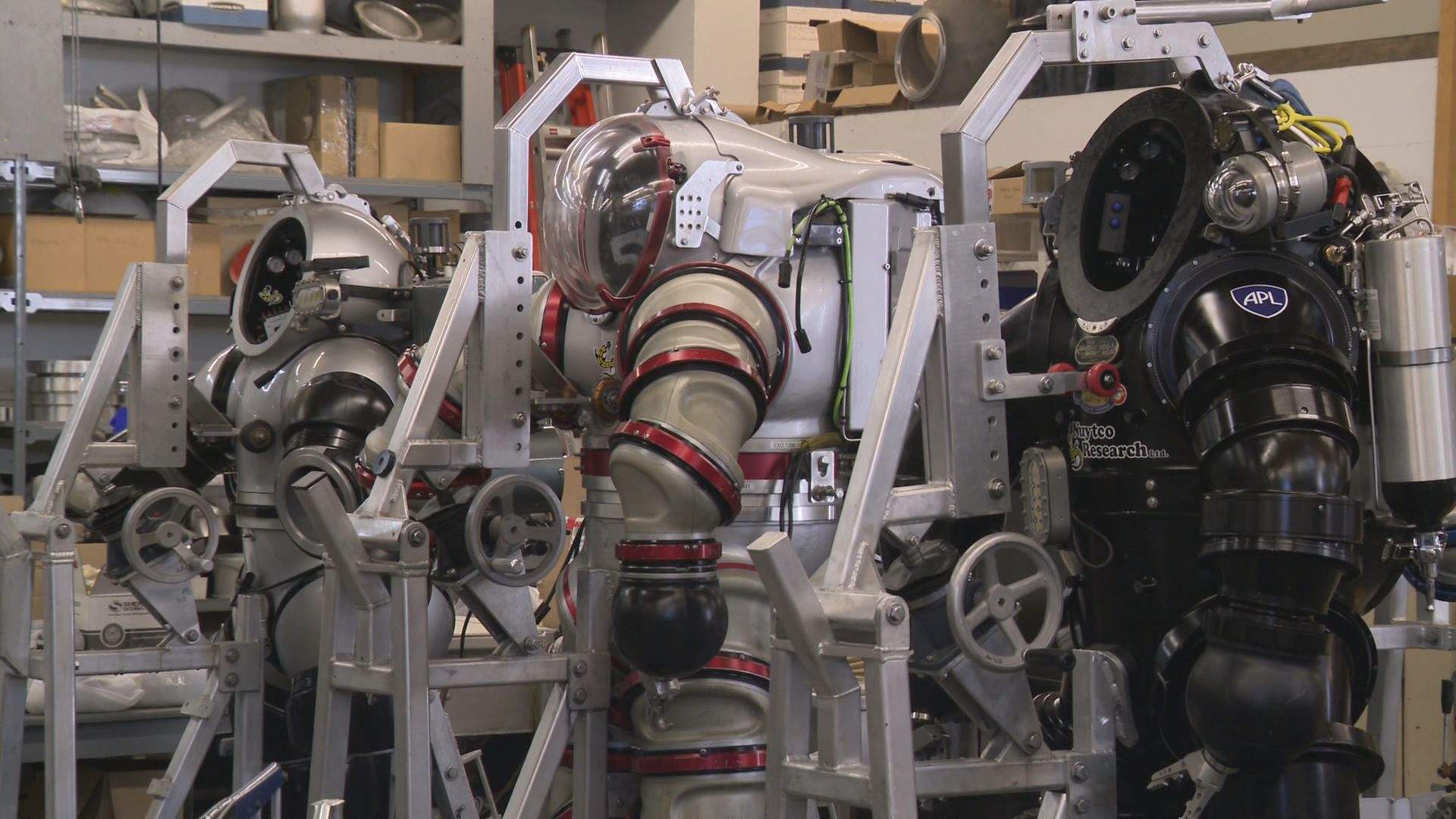
Imagine standing inside a metal cylinder barely larger than your own frame, peering through a thick acrylic dome while thousands of tons of black Atlantic water press against the hull. This is not scuba diving. This is wearing a submarine. Developed over four decades of meticulous engineering by British Columbia's Nuytco Research Ltd., the atmospheric dive suit redefines what it means to touch the ocean floor. Later this week, the United States Navy will showcase the latest evolution of this technology—known as the Deep Sea Expeditionary No-Decompression system, or DSEND suit—right inside the Pentagon.
To understand why a piece of marine engineering born on the rugged coast of British Columbia is making its way to the heart of American military power, you have to look at what military divers actually do. Popular culture paints a picture of high-octane underwater combat. The reality is far more grounded, and infinitely more grueling. Most Navy divers are not war fighters in the traditional sense; they are mechanics, rescuers, and salvagers. They are the ones who slip into the freezing murk to pull trapped sailors from sunken hulls, recover downed aircraft fragments, or clear vital shipping lanes of historic ordnance.
Their greatest enemy has never been the enemy. It is physics.
Traditional deep-sea operations require saturation diving systems, where divers live under high pressure for weeks inside underwater habitats or diving bells just to survive the transition. Every movement is tethered, calculated, and terrifyingly fragile. But the DSEND suit changes the geometry of survival. It maintains a constant, normal atmospheric pressure inside its hard shell regardless of how deep the operator descends. The water squeezes the suit, not the person inside it.
Consider what happens next on a dive. In older gear, reaching deep targets meant enduring agonizingly slow ascent schedules to purge dissolved gases from the body. With DSEND, those decompression limits vanish. A diver can drop to depths previously restricted to robotic submersibles, perform intricate mechanical work, and return to the surface immediately without waiting hours for their blood to stop boiling with nitrogen.
The engineering feat behind this mobility is startling. Phil Nuytco and his team spent decades solving a problem that baffled generations of inventors: how to make a heavy metal shell move like a human body. Early atmospheric suits were notoriously stiff, turning divers into clumsy statues trapped on the ocean floor. The DSEND system utilizes advanced rotating, fluid-filled joints that glide smoothly under crushing hydrostatic pressure.
You can walk in the suit. You can jump. You can lay down on the seabed, roll over on your back, and kick up your feet.
This dexterity transforms salvage operations. When an aircraft goes down in deep water, every minute counts. Search-and-rescue teams cannot afford the delays inherent in traditional deep-diving logistics. By combining the safety of a rigid atmospheric shell with the agility of a high-end mobile suit, the Navy has expanded its operational envelope into waters that were previously considered untouchable.
When officials walk the corridors of the Pentagon to inspect the gear this week, they will not just be looking at carbon-composite hulls and titanium bearings. They will be looking at an escape hatch from human limitation. Thousands of feet below the sunlit surface, where the pressure tries its hardest to crush the breath out of living things, a mechanical suit designed on the Canadian coast quietly stands its ground, keeping the dark at bay.
NAVSEA Develops Groundbreaking 'DSEND' Deep Dive Suit
This video provides an inside look at the mechanics and testing of the DSEND deep-sea dive suit used by the U.S. Navy.