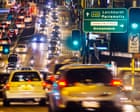
The morning air in the outer suburbs of Melbourne carries a specific, metallic scent. It is the smell of a million cold engines turning over at 6:30 AM. For Sarah, a mother of two who manages a retail store forty kilometers from her driveway, that sound has become a rhythmic countdown.
She watches the digital readout at the local service station. $2.14. $2.19. $2.25. Meanwhile, you can read other developments here: The Cold Truth About Russias Crumbling Power Grid.
The numbers climb with a predatory steadying. It is a slow-motion car crash of a household budget. You might expect, looking at those numbers, that the roads would suddenly clear. You might imagine the train platforms swelling with new commuters, or the bike lanes becoming a congested artery of sweat and Lycra.
But the data tells a different story. Australians are still driving. They are still queuing at the pumps. They are still gripping the steering wheel as the price of a full tank rivals a weekly grocery bill. To explore the bigger picture, check out the recent report by NBC News.
It feels like a paradox. If something becomes prohibitively expensive, we are told by every textbook in existence that demand should drop. Economics calls it price elasticity. If the steak costs too much, you buy the mince. If the cinema ticket is too high, you watch Netflix. Yet, when it comes to the pump, Australians are displaying a stubborn, almost defiant, rigidity.
Why?
Because for most people living outside the inner-city bubbles of Sydney and Brisbane, the car isn't a luxury. It isn't a choice. It is a prosthetic limb.
The Geography of No Choice
Australia is a nation built on the promise of the quarter-acre block, a dream that pushed the edges of our cities further and further into the scrub. We built outwards before we built upwards. We created "dormitory suburbs"—places where people sleep, but nothing else happens. To work, to learn, or to even buy a loaf of bread, you must travel.
Consider the "middle-ring" reality. If Sarah were to take public transport, her forty-minute commute would transform into a two-hour odyssey involving two buses and a train. That is four hours a day. Twenty hours a week. It is a part-time job's worth of time spent sitting on orange plastic seats, waiting for connections that might never arrive.
When the price of fuel rises, Sarah doesn't look at the train timetable. She looks at her pantry. She looks at the brand of cereal she buys. She looks at the heating bill.
The car stays. The lifestyle shrinks.
This is the hidden reality of the current fuel crisis. We aren't seeing a mass migration to the bus because the bus doesn't go where we need it to go. Our infrastructure is a legacy of the cheap-oil era, a time when we assumed the cost of moving from point A to point B would always be a negligible fraction of our income. That era is dead. But we are still living in its architecture.
The Psychology of the Threshold
There is a concept in behavioral science known as the "threshold of pain." It is the point at which a stimulus becomes so uncomfortable that it forces a change in behavior. For years, analysts predicted that two dollars a liter would be the breaking point. We hit it. We sailed past it. And the traffic jams on the M1 remained as thick as ever.
The reason for this inertia is rooted in the way we perceive "sunk costs." Once you have paid for the car, the registration, the insurance, and the maintenance, the incremental cost of the fuel—even at record highs—still feels cheaper than the perceived "cost" of changing your entire life.
Change is terrifying. Changing how you get to work involves re-negotiating childcare pickups, gym sessions, and grocery runs. It involves a mental load that many Australians, already stretched thin by a post-pandemic world and a housing crisis, simply cannot carry.
So, we absorb the blow. We grumble at the pump. We post photos of the price boards on social media with angry emojis. Then we tap our credit cards and drive away.
The Great Public Transport Myth
There is a common refrain among urban planners: "If you build it, they will come." But in the context of Australian fuel prices, the inverse is the haunting truth: "Since we didn't build it, they can't leave."
In the dense centers of European cities, a spike in fuel prices leads to an almost immediate surge in rail and tram usage. The infrastructure is a mesh, a safety net. In Australia, our public transport is often a series of spokes leading to a single hub. If you need to travel between the spokes—from one suburb to another without going through the city center—you are effectively stranded without an internal combustion engine.
This creates a class divide that is rarely discussed in the context of energy prices. Those who can afford to live in the "walkable" inner suburbs are insulated from the volatility of the global oil market. They can walk to the cafe. They can take a five-minute tram to the office.
The people bearing the brunt of the $2.30 liter are the ones who were forced to the fringes by the housing market. They are being hit twice: once by the mortgage, and once by the tank.
The Lag Effect
Does this mean the "breaking point" doesn't exist? Not necessarily.
History suggests that human behavior doesn't change in a linear fashion. It happens in "lags." We are currently in the lag.
People are currently using their savings or cutting back on discretionary spending to maintain their driving habits. They are choosing the car over the restaurant meal. They are choosing the car over the new clothes. But savings are finite.
If fuel prices stay at these levels for twelve, eighteen, or twenty-four months, we will start to see the structural shifts. It won't look like more people on buses. It will look like more people moving house. It will look like people switching jobs to find something closer to home. It will look like the rise of the "hyper-local" economy, where the cost of distance finally outweighs the benefits of the commute.
The "stickiness" of our driving habits isn't a sign of wealth or indifference. It is a sign of entrapment.
The Emotional Weight of the Needle
There is a specific kind of anxiety that comes with watching a fuel needle hover near the 'E'. It is a low-grade, constant hum of stress. It colors the way you plan your weekend. Do we go to the beach? That’s sixty kilometers. That’s fifteen dollars just in fuel. Maybe we stay home.
We are seeing a shrinking of the Australian horizon. The vast, open-road freedom that defined the national identity for a century is being hemmed in by the cold math of the pump. The road trip is becoming a luxury. The Sunday drive is a relic of a vanished age.
We are becoming a nation of mathematicians. Every trip is a calculation. Is this journey essential? Can I combine the school run with the pharmacy trip? Can I coast down this hill to save a fraction of a milliliter?
This isn't just about economics. It’s about the erosion of spontaneity. It’s about the way a rising cost of living narrows the boundaries of a life until all that is left is the commute and the chore.
The Invisible Stakes
While the politicians argue about fuel excise cuts and global supply chains, the real drama is playing out in silent kitchens across the country.
It is the sound of a calculator hitting a wooden table.
It is the sight of a man standing at a pump, looking at the total, and deciding not to fill it all the way. Just twenty dollars. Just enough to get through Tuesday.
We are waiting for a savior that might not come. We are waiting for electric vehicles to become affordable, yet the average price of an EV remains out of reach for the very people who need them most—the long-distance suburban commuters. We are waiting for better trains, yet the tracks take decades to lay.
Until then, we drive.
We drive because we have to. We drive because the alternative isn't a bus—it's a loss of income, a loss of time, or a loss of connection. We are tethered to the tank, captives of a geography we designed and a global market we cannot control.
The next time you see a line of cars snaking out of a petrol station because the price dropped by four cents, don't look at it as a quest for a bargain. Look at it as a desperate act of preservation.
The tank isn't just full of fuel. It’s full of the minutes and hours of a life, bought at a price that is becoming too high to pay, yet too vital to ignore.
The engine idles. The light turns green. We move forward, because staying still is the only thing we can't afford to do.
Would you like me to research the current average commute times in major Australian cities to provide more specific context for this narrative?