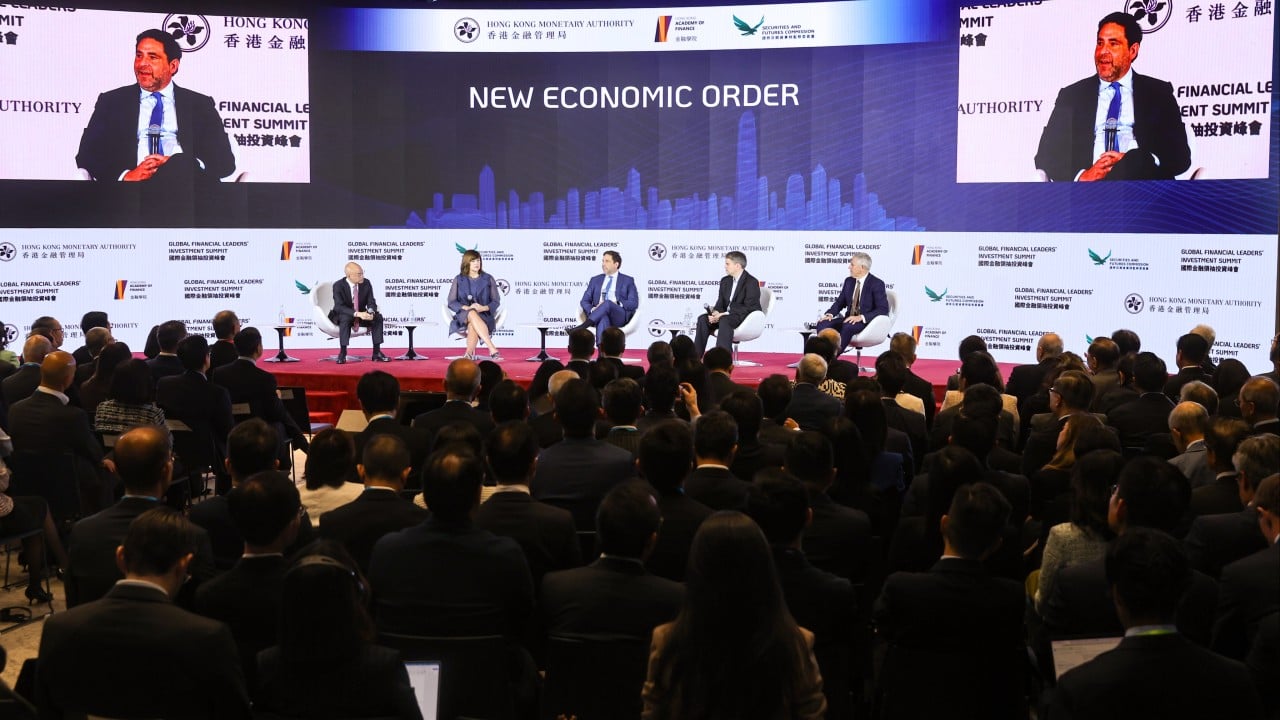
Wall Street’s biggest power brokers are flying into Hong Kong for the Global Financial Leaders' Investment Summit, and the stakes have never been higher. Beneath the polite applause and five-star banquets lies a brutal reality. American financial institutions are trapped between Washington’s aggressive national security mandates and Beijing’s desperate push to prove its premier financial hub is still open for business. As tech sector volatility rattles global portfolios and geopolitical friction hardens into permanent policy, this gathering is no longer a routine networking event. It is a stress test for the survival of cross-border capital.
For decades, the playbook for American banks in Asia was simple. You showed up, shook hands with regulators, underwrote massive mainland initial public offerings, and collected outsized fees. That era is dead. Today, every chief executive stepping off a private jet at Chek Lap Kok is walking a razor-thin tightrope. Stay too close to Beijing, and you risk congressional subpoenas, sanctions violations, and a furious backlash from domestic pension funds. Pull back too hard, and you forfeit access to the world’s second-largest economy just as competitors from the Middle East and Europe eagerly step into the vacuum.
The Illusion of Business as Usual
Publicly, the Hong Kong Monetary Authority designs this summit to project stability, liquidity, and uninterrupted global integration. The guest list reads like a who’s who of global finance, featuring the top brass from Goldman Sachs, Morgan Stanley, JPMorgan Chase, and Citigroup alongside sovereign wealth fund managers. Their presence gives local officials the exact photo opportunities they need to counter narratives of capital flight and declining relevance.
Privately, the mood among institutional investors is far more guarded. A massive disconnect exists between the optimistic rhetoric on stage and the actual capital allocation decisions happening behind closed doors. Global fund managers have spent the past several years systematically reducing their exposure to Chinese equities, driven by unpredictable regulatory crackdowns, property sector contagion, and sluggish domestic consumption.
Attending the summit is an exercise in reputational risk management. If a major Wall Street bank skips the event, Beijing interprets the absence as a hostile political statement, which can instantly freeze local licensing approvals and joint venture operations. Conversely, showing up and offering overly enthusiastic praise for the local market triggers immediate scrutiny from lawmakers in Washington who view Hong Kong’s autonomy as fundamentally compromised.
How Tech Volatility Complicates the Pitch
The timing of the summit coincides with severe turbulence in the global technology sector, which has traditionally been the primary engine of Hong Kong’s capital markets. For years, mainland tech giants relied on the Hong Kong Stock Exchange to raise billions from Western institutional investors. That pipeline has been severely disrupted by two overlapping forces.
First, the valuation of artificial intelligence and semiconductor firms has swung wildly as investors question whether massive capital expenditures will translate into near-term profits. Second, Washington’s outbound investment screening rules and export controls have effectively blacklisted huge swaths of the Chinese tech ecosystem from receiving American venture capital and private equity dollars.
Consider a hypothetical example to see how this plays out on a trading desk. Imagine a mid-sized U.S. endowment fund looking to invest in an emerging Asian robotics firm listed in Hong Kong. Five years ago, that trade took minutes. Today, the fund’s compliance team must spend weeks auditing the company’s supply chain to ensure none of its microchips or algorithms violate American dual-use technology restrictions. If there is even a five percent chance of a regulatory tripwire, the compliance officer kills the trade. Multiply that friction across thousands of institutional accounts, and you begin to understand why trading volumes in Hong Kong have struggled to reclaim their historic peaks.
The Regulatory Vise Tightens
The compliance burden is no longer just a back-office headache. It has become the central determinant of deal flow. Wall Street banks operating in Hong Kong now maintain separate, heavily ring-fenced technology infrastructures and compliance protocols for their mainland operations to prevent data leakage and regulatory cross-contamination.
- Data Localization Laws: Beijing’s strict rules governing cross-border data transfers make it increasingly difficult for foreign banks to conduct routine due diligence on mainland corporate clients.
- Sanctions Compliance: Secondary sanctions threats mean that even non-U.S. subsidiaries of global banks must carefully screen every counterparty for ties to restricted entities.
- Audit Inspections: Despite fragile agreements between American and Chinese accounting watchdogs, the underlying threat of forced delistings continues to hang over dual-listed technology companies.
These structural barriers cannot be solved by a keynote speech or a banquet toast. They are baked into the legal architecture of both superpowers.
The Quiet Pivot to Alternative Asian Hubs
While Hong Kong officials work overtime to retain Wall Street’s affection, a quiet migration of talent and capital has reshaped the regional map. Singapore has captured a massive share of family offices, wealth management desks, and regional headquarters that previously defaulted to Hong Kong. Tokyo has experienced a renaissance in equity trading and corporate governance reforms, attracting billions in foreign inflows seeking exposure to Asian growth without the geopolitical baggage.
Even within the realm of private credit and alternative assets, global firms are diversifying their footprints. Capital allocation follows the path of least resistance. When legal certainty, transparent rule of law, and frictionless capital movement are compromised in one jurisdiction, money inevitably flows to another.
Yet, writing off Hong Kong entirely is a mistake that veteran analysts refuse to make. Geography and deep liquidity pools still matter. Hong Kong remains the undisputed gateway for international capital entering mainland China via the Stock Connect and Bond Connect programs. No other financial center possesses the sheer density of legal, accounting, and banking expertise tailored specifically to mainland corporate structures. If Beijing eventually unleashes a massive, sustained fiscal stimulus that revives corporate earnings, Hong Kong will be the immediate beneficiary, and Wall Street wants to ensure its seat at the table remains warm.
What Institutional Investors Are Actually Watching
Ignore the prepared remarks from the podium. Seasoned market participants are paying attention to subtle behavioral cues during the summit to gauge where Wall Street truly stands.
The seniority of the delegations tells the real story. When a bank sends its sitting global CEO, it signals a continued commitment to defending its franchise in Greater China. When a firm quietly downgrades its representation to a regional head or a vice chairman, it signals a strategic retreat, regardless of what the press release says.
Deal pipelines are another critical metric. Bankers will spend their evenings pitching cross-border mergers, restructuring advisory services, and debt issuances. If the conversations center around helping Chinese companies expand into Southeast Asia and the Middle East—rather than raising money from American investors—it confirms that Hong Kong’s role has fundamentally shifted from an East-West bridge to an intra-Asian connector.
Wall Street is famously unsentimental. Loyalty on the trading floor lasts only as long as the risk-adjusted returns justify the headaches. As the summit unfolds, the world’s largest financial institutions are not making a moral judgment on geopolitics; they are running a cold, hard math equation on whether the shrinking fees in Hong Kong are still worth the escalating political blowback back home.