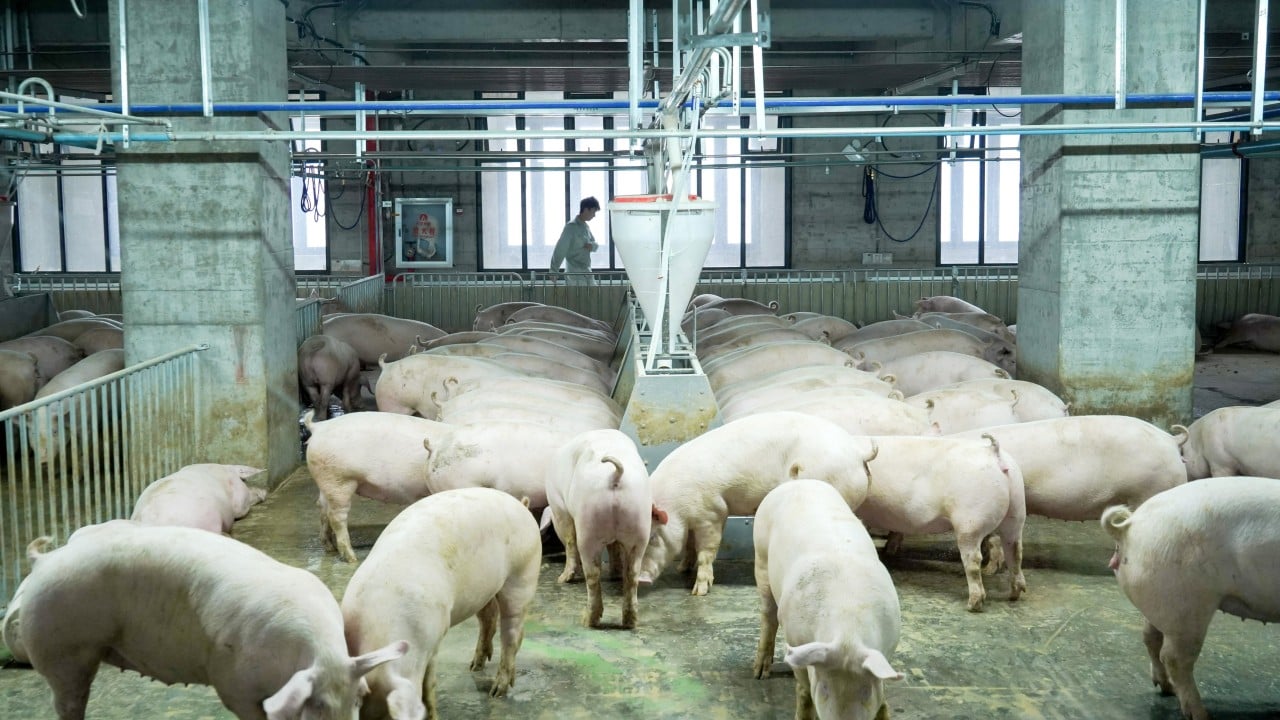
The collapse of Chinese hog prices to eight-year lows is not a transient market correction but the structural byproduct of a massive, debt-fueled transition from fragmented backyard farming to high-density industrial "pig hotels." While traditional commodity cycles are driven by biological lag, the current glut is defined by a capital-expenditure trap. Large-scale producers, having invested billions in multi-story breeding facilities, now face a marginal cost of production that incentivizes maintaining high output even during deep loss cycles. This creates a "sticky supply" phenomenon where price signals fail to trigger the traditional contraction of the herd.
The Mechanism of Supply Inelasticity
In a fragmented market, smallholders exit the industry when prices drop below the cost of feed. This "bottom-up" liquidation traditionally cleared the market. The shift toward corporate consolidation has replaced this flexible capacity with rigid, high-overhead operations.
The current supply glut is governed by three primary structural drivers:
- Asset Specificity and Debt Service: Modern Chinese hog farms are high-tech assets with significant fixed costs. Unlike a backyard pen, a 13-story "hog hotel" cannot be easily repurposed. Large producers like Muyuan Foods and Wens Foodstuff must maintain high throughput to service the massive debt incurred during the 2019-2021 expansion phase.
- The Biological Lag of Sows: The decision to cull a breeding sow represents a long-term reduction in capacity. Because it takes roughly 11 months from breeding a sow to bringing a hog to market, producers often gamble on a price recovery during that window rather than liquidating their primary "productive machinery."
- Efficiency as a Double-Edged Sword: Improved genetics and professionalized management have increased the number of piglets per sow per year (PSY). Even as the total number of sows marginally decreases, the total volume of pork hitting the market remains high due to higher survival rates and faster weight gain.
The Capital-Efficiency Paradox
The drive for efficiency has paradoxically increased the financial fragility of the entire sector. When the industry was dominated by small players, the "Hog-to-Corn Ratio" was the primary metric for survival. If the ratio fell below 6:1, farmers stopped feeding pigs.
Now, the metric of importance is the Cash Break-Even Point. Industrial players can survive as long as the market price covers their variable costs (feed and labor), even if it fails to cover depreciation and interest. This allows loss-making operations to persist for years, extending the duration of the price trough.
The cost structure of a modern Chinese hog operation breaks down into four quadrants:
- Feed Costs (50-60%): Primarily imported soybeans and corn, making the industry sensitive to global trade dynamics and currency fluctuations.
- Biological Assets (15-20%): The cost of maintaining the breeding herd and the genetic pipeline.
- Labor and Biosecurity (10-15%): Intensified since the African Swine Fever (ASF) outbreaks, requiring high-tech filtration and strictly controlled environments.
- Fixed Overhead (10-15%): Depreciation on massive concrete facilities and automated feeding systems.
The Role of State Intervention and Food Security
The Chinese government views pork prices as a critical component of the Consumer Price Index (CPI) and social stability. This leads to a feedback loop of intervention that often exacerbates volatility.
When prices spike, the state releases frozen reserves and encourages expansion. When prices crash, the state initiates "level-one" alerts and purchases pork for reserves. However, the scale of the current industrial capacity dwarfs the state’s ability to move the needle through purchasing alone. The reserve system is designed to handle temporary shortages, not a fundamental overbuild of national infrastructure.
Strategic national interests also prevent a natural market clearing. China’s goal of "Self-Sufficiency in Protein" means that authorities are hesitant to let large players go bankrupt, as their liquidation could lead to a massive, sudden supply vacuum and a subsequent price explosion. This creates a "Moral Hazard" where producers expect a floor to be placed under the market, discouraging the very production cuts needed to restore equilibrium.
The Biosecurity Barrier to Market Entry
African Swine Fever fundamentally changed the cost of doing business. Smaller players cannot afford the laboratory-grade biosecurity required to prevent total herd loss. This has created a moat for the giants, but it is a moat filled with operational risk.
In an industrial setting, a single breach in biosecurity can wipe out 10,000 animals in a week. To mitigate this, companies have integrated vertically, controlling everything from grain processing to slaughterhouses. While this reduces transaction costs, it increases "Total System Risk." A failure at any point in the chain—be it a diseased feed shipment or a logistical bottleneck—impacts the entire balance sheet.
Quantifying the Glut: The Sow Inventory Problem
The Ministry of Agriculture and Rural Affairs (MARA) monitors the national sow inventory as the lead indicator for future supply. The "target" level for national stability has historically hovered around 41 million sows. When the inventory exceeds this, the market enters a state of structural oversupply.
The current dilemma is that "Sow Quality" has increased. A sow in 2026 produces significantly more meat than a sow in 2016. Therefore, maintaining the same numerical inventory actually results in a higher net tonnage of pork. The market is currently adjusting to a reality where fewer sows are needed to feed the population, yet the physical capacity to house those sows has already been built and financed.
Tactical Reversion and the Path to Equilibrium
Restoring profitability to the Chinese hog sector requires a three-phase contraction that the industry is currently resisting:
- Phase 1: Financial Attrition. Smaller-to-mid-sized corporate players with weak balance sheets must be forced into consolidation or liquidation. We are currently in the late stages of this phase, evidenced by the fire sale of assets among second-tier producers.
- Phase 2: Genetic Downscaling. Producers must move beyond culling "weak" sows and start culling high-productivity "GGP" (Great-Grandparent) and "GP" (Grandparent) stock. This is the only way to reduce the inherent "growth engine" of the national herd.
- Phase 3: Operational De-leveraging. The surviving giants must pivot from "Volume at All Costs" to "Return on Invested Capital (ROIC)." This involves decommissioning high-cost facilities rather than just idling them.
The immediate strategic priority for any entity exposed to the Chinese protein market is to monitor the Dressed Weight of hogs arriving at slaughterhouses. When prices are low, farmers often "hold back" pigs in hopes of a price rebound, leading to heavier hogs and even more pork entering the market later. A simultaneous drop in both hog prices and average slaughter weights is the first true signal that a supply contraction has begun in earnest. Until that alignment occurs, any price "rally" is merely a bear-market trap driven by short-term sentiment rather than fundamental rebalancing.
The industry is moving toward a "New Normal" characterized by lower average margins and higher capital intensity. The era of the "backyard windfall" is over; the era of the "industrial grind" has arrived.