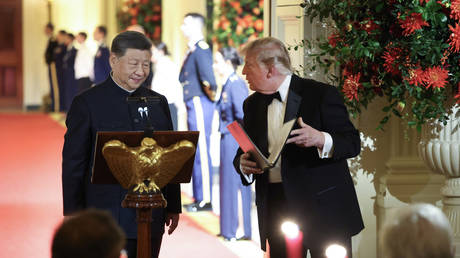
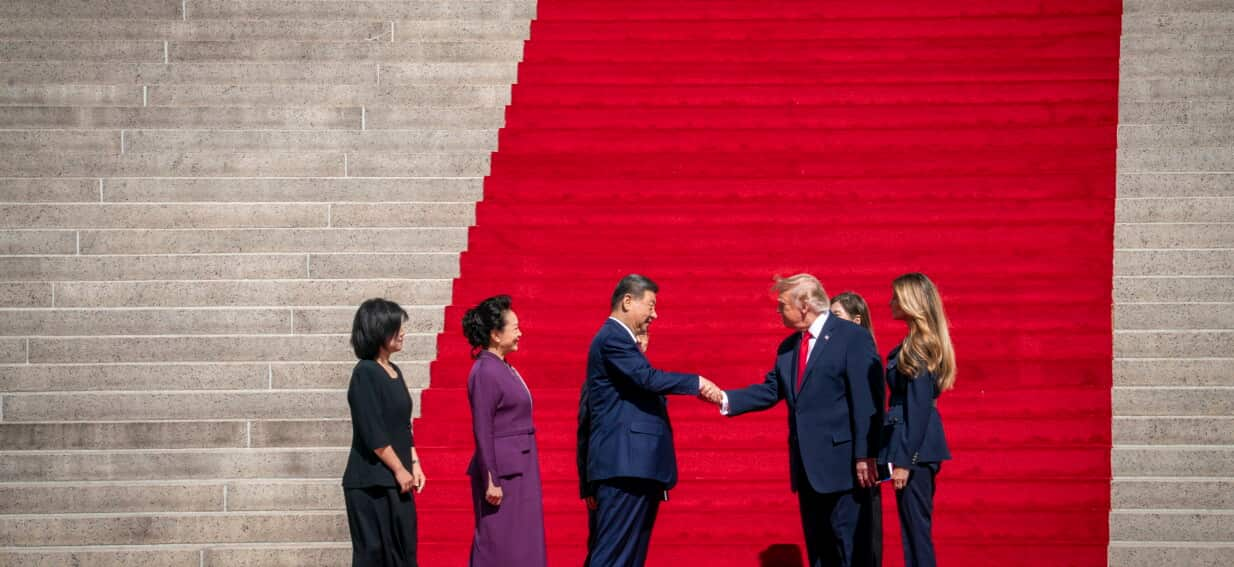
Two men sit across a polished mahogany table, separated by translators, centuries of statecraft, and the invisible weight of tomorrow. On one side stands Donald Trump, recently returned to the machinery of American power, fresh from high-stakes conversations with Xi Jinping. On the other side sits the leader of the world's other reigning superpower. The subject of their dialogue is not tariffs, trade deficits, or territorial borders. It is something far more volatile. Super intelligence.
The air in the room is heavy. Every word is calculated.
When the doors close and the readouts are filtered through the press, a single stark reality emerges from the diplomatic fog. There will be no partnership. There will be no shared laboratory. There will be no joint treaty to govern the birth of artificial minds that may soon outpace human cognition.
Instead, the path ahead is clear. A race.
History teaches us that when two rival empires gaze at the same apex, they do not hold hands to climb the final ridge. They sprint. And in the arena of artificial intelligence, a sprint without guardrails changes the physics of human civilization.
Consider what happens inside a server farm in Northern Virginia or Shenzhen at three in the morning. Millions of GPUs hum with a quiet, furious intensity, consuming enough electricity to power a small city. Inside these silicon cathedrals, neural networks ingest petabytes of human history, poetry, code, and conflict. They are learning to reason. They are learning to predict. They are learning to outthink their creators.
For years, optimists whispered about a grand coalition. They imagined Washington and Beijing signing historic pacts, pooling their scientific brilliance to ensure that artificial general intelligence arrived safely, managed by a bipartisan, binational council of ethicists and engineers. It was a comforting dream. It was also an illusion.
Geopolitics does not bend easily to utopian ideals. Trust is a scarce commodity between superpowers locked in a zero-sum contest for global dominance. When Trump officially slammed the door on a joint US-China effort, he was acknowledging a hard, unyielding truth. Control of artificial intelligence means control of the twenty-first century. Whoever holds the ultimate cognitive engine holds the keys to economic supremacy, military hegemony, and scientific discovery.
You do not share the keys to the kingdom with your chief rival. You build a stronger lock.
To understand why cooperation failed, look at the incentives. Every nation state operates on a primal directive of self-preservation and competitive advantage. If the United States slows down its research to accommodate international treaties, its adversaries will accelerate theirs. If China pauses its domestic algorithmic breakthroughs to satisfy Western oversight, its technological sovereignty is compromised.
Fear drives the machinery.
Imagine a hypothetical researcher named Dr. Elena Vance, working in a sterile laboratory funded by the Department of Energy. She is staring at a terminal screen, watching a model simulate molecular structures at a speed that defies human comprehension. She knows that within months, this exact software could discover cures for currently incurable diseases. She also knows that the exact same architecture could be weaponized to design novel pathogens or crack military encryption in seconds.
Elena feels a cold knot in her stomach every time she walks into work. She is not thinking about stock prices or geopolitical posturing. She is thinking about margin of error. A razor-thin margin.
When leaders in Beijing and Washington talk about artificial intelligence, they are not discussing software updates. They are discussing the final invention that humanity will ever need to make, because after that invention, the machine will make everything else. Xi Jinping understands this deeply. State-directed capital, massive infrastructure projects, and national directives have positioned China as a formidable titan in the race for algorithmic supremacy. American private enterprise, fueled by venture capital, raw ambition, and fierce corporate rivalry, pushes forward with its own relentless momentum.
Two distinct philosophies. Two distinct systems. Colliding at the speed of light.
By rejecting a joint effort, Trump has formalized a great bifurcation. The world is splitting into two technological spheres of influence. Standards will diverge. Hardware supply chains will decouple. Protocols for safety, alignment, and ethical oversight will be written in different languages, quite literally and figuratively.
Some will call this reckless. They will argue that without shared safety protocols, the world stumbles blindly toward an uncontrolled intelligence explosion. They will point to the Cold War nuclear arms race as a terrifying precedent, noting that even bitter ideological enemies eventually found common ground to sign non-proliferation treaties.
They have a point. The stakes are existential.
Yet, others will argue that cooperation with an authoritarian rival on artificial intelligence is a fool's errand. How do you verify compliance when the underlying code can be hidden, replicated, or obfuscated in encrypted clusters overnight? How do you trust an adversary whose strategic goals directly oppose your own democratic values? Transparency in artificial intelligence is nearly impossible to enforce. A joint pact would likely become a paper tiger, honored in public and ignored in secret by whichever party felt the sting of falling behind.
So the race is on.
Strip away the diplomatic rhetoric, the press briefings, and the political posturing, and you are left with a raw human drama. Millions of ordinary people go about their daily lives—paying mortgages, raising children, worrying about grocery prices—while a handful of engineers and politicians chart a course toward a post-human intelligence era.
Most people do not feel the shift. Not yet.
It feels invisible. It feels like just another news cycle about computer chips, venture capital funding rounds, and silicon breakthroughs. But every time a model's capabilities double, the horizon shifts just a little closer.
We are standing at the edge of a precipice.
The decision to rule out a joint US-China effort ensures that the race will be messy, chaotic, and fiercely competitive. It means that safety may sometimes take a backseat to speed. It means that the psychological pressure on researchers, policymakers, and corporate leaders will reach unprecedented heights.
Every breakthrough becomes a defensive maneuver. Every setback feels like a potential defeat.
Consider the alternative. A world of forced collaboration, choked by bureaucracy, crippled by mutual suspicion, and ultimately collapsing under the weight of its own ideological contradictions. That path had its champions, but it was fundamentally disconnected from the reality of global power dynamics.
Power respects power. And right now, power is measured in flops, parameters, and training runs.
As the geopolitical lines harden, the real test will not be whether America or China crosses the finish line first. The real test will be whether humanity can retain agency over a creation that is fundamentally alien to our biological nature.
We are building gods out of math and electricity.
We are doing it without a safety net.
And as the door closes on international collaboration, the echo of that conversation between Washington and Beijing reverberates across the globe. A reminder that when the ultimate prize is on the table, mankind prefers the terrifying thrill of the race to the quiet comfort of the shared table.
The silicon minds are waking up.
And we are running alone.