The television cameras outside the conference hall captured the performance down to the millimeter. Suits were adjusted. Hands shook with practiced firmness. Microphones recorded the predictable cadence of diplomatic triumph: a trade truce extended, tariffs temporarily shelved, soybean shipments secured for another fiscal quarter. To the press corps stationed behind velvet ropes, it looked like a classic rerun of geopolitical theater—the old world order haggling over cargo ships, steel mills, and currency bands.
Yet behind the closed oak doors of the inner chamber, past the advisors whispering into encrypted devices and the note-takers tracking every inflection, the conversation had long since abandoned balance sheets.
It was about silicon. It was about who would write the foundational syntax of the coming century.
While reporters parsed press releases for percentage points, the real negotiation hinged on a quiet, subterranean struggle over computation. Trade wars are loud. They produce headlines about dockworkers, farmers, and factory lines. But the silent war over artificial intelligence is fought in clean rooms where air is filtered to remove particles a thousand times smaller than a human hair, and in server farms that drink rivers dry for cooling.
To understand why a summit ostensibly convened to discuss customs duties and trade balances actually turned on the axis of artificial intelligence, one must look past the paperwork and into the human imagination of statecraft.
The Weight of Sand and Glass
Consider the physical reality of a microchip. To the untrained eye, it is a small, dark square of processed sand, smaller than a postage stamp. To a strategist in Beijing or Washington, it is the modern equivalent of enriched uranium.
In a hypothetical manufacturing plant tucked into the foothills outside Shenzhen, a twenty-eight-year-old etching engineer named Lin stares through a microscope at a silicon wafer. Her fingers are gloved in heavy white nitrile, her movements slow and deliberate. A single stray dust mote can ruin a pattern measuring nanometers across—a scale so small that individual viruses look like boulders by comparison. Lin does not care about tariff schedules or retaliatory quotas on pork. She cares about yield rates. She cares about whether the extreme ultraviolet lithography machines, smuggled or stockpiled through labyrinthine supply chains, will keep spinning tomorrow.
Thousands of miles away, in a sprawling, nondescript data center in northern Virginia, millions of high-performance GPUs hum in synchronized darkness. The air smells faintly of ozone and heated plastic. The engineers here do not think about soybeans either. They think about parameters, weights, training runs, and token windows. They watch the power meters spin upward, tracking the immense electrical appetite of models that learn faster than human beings can document them.
These two worlds—the microscopic precision of fabrication and the boundless hunger of neural networks—are connected by an invisible umbilical cord. When leaders meet across mahogany tables, they are not merely balancing ledgers of import and export. They are negotiating the terms of cognitive sovereignty.
Two Men and a Switchboard
The modern state is built on the myth of rational control, but diplomacy is deeply, painfully human. It is driven by ego, legacy, paranoia, and the terrifying realization that technology is accelerating faster than human institutions can metabolize it.
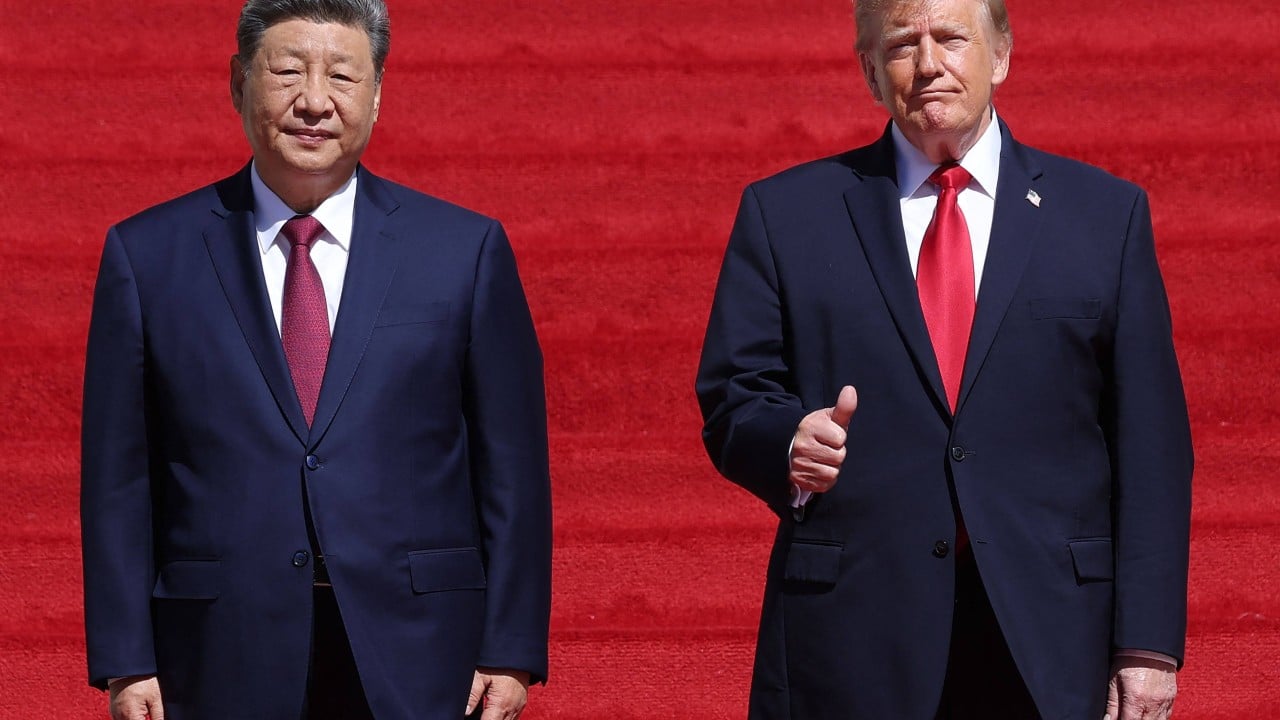
When Donald Trump and Xi Jinping sat down across from each other during these high-stakes summits, they embodied two distinct philosophies of power. One viewed national strength through the transactional lens of ledgers, deficits, and sovereign dignity won through hard bargaining. The other viewed national strength through the generational lens of grand strategy, civilizational destiny, and the patient accumulation of industrial might.
Yet both men faced the same unsettling truth: the old metrics of empire were dying. Aircraft carriers and oil tankers still matter, but they are increasingly governed by software that decides targets in milliseconds. Economic output is no longer just a function of how much steel you pour, but how many tokens your neural networks can process per second.
In the private transcripts of these meetings—pieced together later by leaks, memoirs, and the subtle shifts in subsequent export control regulations—the trade truce was often the appetizer. The main course was the architecture of control. Who gets the advanced processors? Who sets the safety boundaries for autonomous systems? What happens when a model trained in one hemisphere becomes smarter than the regulators trying to govern it?
Tariffs can be reversed with the stroke of a pen. A ten percent levy can be raised or lowered depending on the political winds of an election cycle. But technological divergence is sticky. Once a nation builds its own indigenous supply chain for advanced computation, once its universities and laboratories stop sharing a common digital language with their rivals, the break becomes permanent. It is a tectonic shift, silent and irreversible.
The Mirage of the Truce
Why did the public narrative focus so heavily on the trade truce while burying the technological subtext? Because trade is legible. A billion-dollar subsidy or a tariff reduction makes for a neat, comprehensible story. It fits into the traditional grammar of international relations that journalists have used for centuries.
Artificial intelligence, by contrast, resists easy storytelling. It is slippery, abstract, and terrifyingly fast. When politicians talk about trade, they are speaking a language their grandfathers understood. When they talk about AI, they are grappling with a force that threatens to render human labor, military doctrine, and governance models obsolete within a generation.
By dressing up a technological truce as a traditional trade agreement, both administrations achieved a subtle political alchemy. They gave the markets the illusion of normalcy while quietly locking horns over the future of global intelligence.
Consider what actually happened in the months following these summits. Even as trade negotiators patted themselves on the back for lowering barriers on agricultural goods, export restrictions on advanced semiconductors tightened into a tourniquet. Software restrictions grew more precise. Venture capital flows between the two superpowers were subjected to intense national security reviews. The right hand signed documents about commercial parity, while the left hand built digital walls designed to ensure absolute asymmetry in computational power.
It was a truce built on mutual apprehension. Both sides recognized that a full-scale economic and technological rupture would trigger a global depression. Yet both sides also knew that stopping the race for AI supremacy was equivalent to surrendering the future.
The Engineer and the Politician
To grasp the human cost of this high-level poker game, one must return to the ground level, far from the red carpets and the press briefings.
In a university laboratory in Shanghai, a doctoral student named Chen deletes weeks of simulation code because a newly enacted compliance rule blocks his access to a foreign cloud provider. He does not weep; he simply recalibrates. He turns to open-source architectures, pooling older, less efficient GPUs with his peers, finding workarounds through sheer stubbornness. Necessity, as always, mothers invention. The sanctions meant to hobble his research instead force an ecosystem to mature in isolation, growing hardened and self-reliant in the dark.
Meanwhile, in a venture capital office in Silicon Valley, a partner looks at a pitch deck for a new defense-tech startup. The founders are former defense contractors who talk effortlessly about neural network integration, automated drone swarms, and predictive logistics. The venture capitalist hesitates—not out of moral hesitation, but out of regulatory anxiety. Will the next executive order permit this software to be sold overseas? Will the compliance costs eat the margins? The speed of innovation is colliding with the gravity of geopolitics.
These individuals are the true constituents of the Xi-Trump summits. They do not sit at the negotiating table, but every word uttered in that room alters the trajectory of their daily work. They are caught between two gravitational fields, forced to navigate a world where a line of code can be treated like a weapon of mass destruction.
The Architecture of Tomorrow
History will not remember these summits for the soybean quotas or the temporary suspension of import duties. Those are footnotes, bureaucratic housekeeping performed while the real architecture of the twenty-first century was being poured.
The breakthrough—if one can call a mutual recognition of limits a breakthrough—was the tacit agreement to compartmentalize. The two superpowers discovered that they could engage in a bitter, unyielding struggle for technological dominance while still maintaining a commercial floor beneath their feet to prevent total catastrophe. They learned to fight a cold war in high definition, where the battlefields are not trenches or islands, but algorithms, talent pools, and silicon wafers.
When we look back at the photographs of those meetings, the handshakes will look quaint. We will see two leaders posing for the history books, completely unaware—or perhaps acutely aware—of the invisible ghosts in the room: the neural networks training in secret, the models learning to reason, the algorithms quietly shifting the balance of global power while the cameras flashed outside.
The truce was never the story. The truce was merely the silence between the thunderclaps.