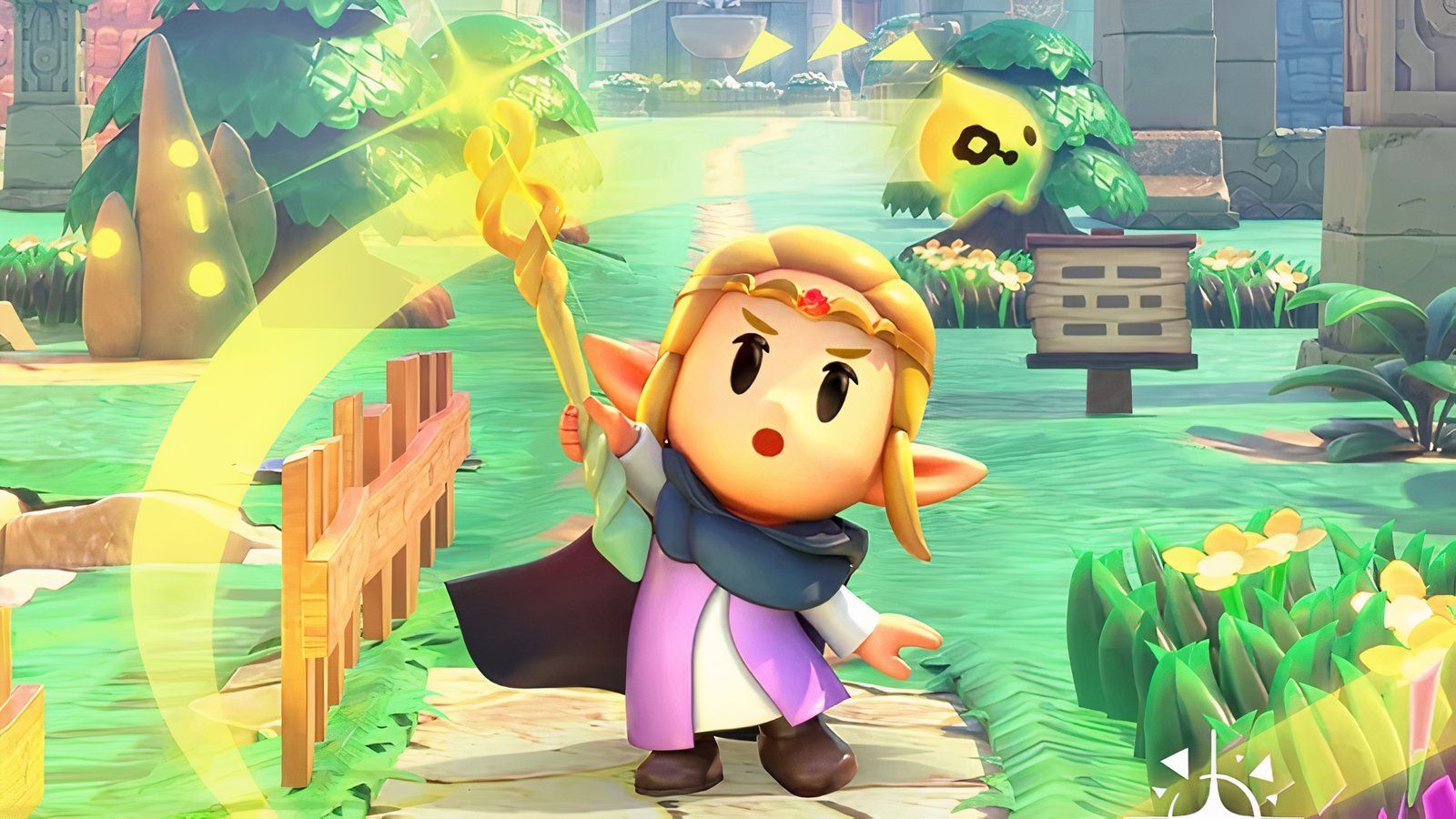
So, it finally happened. After nearly four decades of watching from the sidelines or getting trapped in crystals, Princess Zelda finally took the lead. Honestly, it’s about time. The Legend of Zelda: Echoes of Wisdom isn't just another top-down adventure to keep the Switch warm while we wait for the next big console; it's a massive mechanical shift that basically tells you to forget everything you know about hitting things with a sword.
Well, mostly.
I spent a lot of time wandering through this toy-box version of Hyrule, and the vibe is strange but brilliant. It uses that same "tilt-shift" diorama art style from the Link’s Awakening remake, but the gameplay? It’s pure chaos in the best way possible. You aren't Link. You don't have a bottomless quiver of arrows or a boomerang that defies physics. Instead, you have Tri, a glowing floaty friend, and a stick that lets you "copy-paste" the world.
How the Tri Rod Actually Works (And Why It’s Breaking Minds)
The core of the Zelda Echoes of Wisdom experience is the Tri Rod. Basically, you walk up to an object—say, a wooden table or a decorative shrub—and you "learn" it. From that point on, you can spawn an "Echo" of that item whenever you want.
It sounds simple. It is not.
Early on, I found myself stuck in front of a tall ledge. In a normal Zelda game, you’d look for a ladder or a hookshot point. Here? I just spawned three old beds, stacked them like a makeshift staircase, and hopped right up. It feels like "legal cheating." You can do this with almost anything. Need to cross water? Spawn a floating bed. Need to block a laser? Throw down a heavy boulder.
But the real magic happens with the monsters. When you defeat an enemy, you can often collect its Echo. This turns the game into a sort of tactical Pokémon-lite. Instead of Zelda swinging a blade, she summons a pack of Spear Moblins to do the dirty work while she hides behind a pot. It changes the rhythm of combat entirely. You’re constantly measuring your "Tri Energy"—those little triangles following you around. You might only have enough energy to summon one powerful Darknut or four tiny, annoying Keese. Decisions, decisions.
Solving the Swordfighter Problem
One of the biggest questions people had before launch was: "Is Zelda just going to be a mage forever?" The answer is "Swordfighter Form."
Throughout the game, you find "Might Crystals" that power up a mysterious sword. By hitting up on the D-pad, Zelda transforms. She gets the green glow, the classic stance, and yes, she can finally slash through tall grass and enemies directly.
There’s a catch, though. It’s on a timer.
It’s basically your "Limit Break." You use it when a boss is stunned or when you’re cornered by too many Peahats. You can't rely on it for the whole game, which is a smart move by Nintendo. If they let us use the sword 24/7, we’d all just play it like a standard Link game and ignore the 127 different Echoes available. By limiting the sword, the game forces you to be creative. It forces you to be wise.
The Performance Elephant in the Room
We have to talk about it because everyone else is. The game is beautiful, but the Nintendo Switch is definitely showing its age here.
When you’re inside a dungeon, everything is silky smooth—we’re talking 60 frames per second. The controls feel tight, and the lighting is crisp. But the second you step out into the massive Hyrule overworld, the frame rate starts doing a yo-yo act. It constantly jumps between 60 and 30 fps. If you're sensitive to that kind of stutter, it can be jarring.
Is it a dealbreaker? No. It’s mostly an issue when the game is loading new areas while you’re running. If you stand still and rotate the camera, it usually snaps back to being smooth. It’s a bit of a bummer that Grezzo (the developers) didn't just lock it at a stable 30 fps like Breath of the Wild, but the sheer joy of the mechanics usually outweighs the technical hiccups.
What Most Players Miss in the Still World
The "Still World" is where the game gets really weird. These are the rifts tearing Hyrule apart, and they’re essentially floating, gravity-defying platforming challenges. People often rush through these to get to the boss, but that’s a mistake.
The Still World contains some of the best environmental puzzles in the game because the "rules" are looser. You’ll find water blocks floating in mid-air that you can swim through, or trees growing sideways. This is where you should be testing out your more obscure Echoes. For instance, the "Flying Tile" Echo is a godsend here. It ignores wind and moves in a straight line, making it the perfect bridge for gaps that look impossible to cross.
A Few Quick Tips for Your Journey:
- The Bed Trick: Seriously, beds are the most versatile item in the game. Use them for bridges, stairs, and even healing. Zelda’s Bed (unlocked later) heals two hearts per second.
- Targeting Matters: Use ZL to lock onto enemies. If you don't, your summoned monsters will just wander around aimlessly like they're looking for a snack.
- Juice is King: Don't ignore the smoothie shops. Mixing ingredients like Refreshing Grapes and Floral Nectar can give you energy buffs that make the Swordfighter Form last way longer.
- Think Vertically: Unlike the original 2D games, Zelda can climb trees and rooftops if you build the right steps. There are tons of Heart Pieces hidden on top of things you’d normally walk past.
The Verdict on Zelda's Big Debut
By the time the credits roll, The Legend of Zelda: Echoes of Wisdom leaves you with a very different feeling than a traditional Zelda game. It’s less about "I survived that fight" and more about "I can't believe that stupid plan actually worked."
It’s a game that respects your intelligence. It doesn't care if you "cheese" a puzzle by stacking ten trampolines. If it works, it works. While it might not have the epic scale of Tears of the Kingdom, it carries that same spirit of "let the player break the game."
If you're looking for your next adventure, start by hunting down every rift you see. Don't just follow the main quest to the Eldin Volcano or the Faron Wetlands immediately. Take the time to explore the nooks and crannies of Suthorn Forest first. There’s almost always a chest or a weird new monster Echo waiting for someone brave enough to try a new combination of items.
Go out there and start copying everything. Just maybe avoid spawning a hundred pots in the middle of Castle Town—the guards aren't as big a fan of the "creative chaos" as you might be.