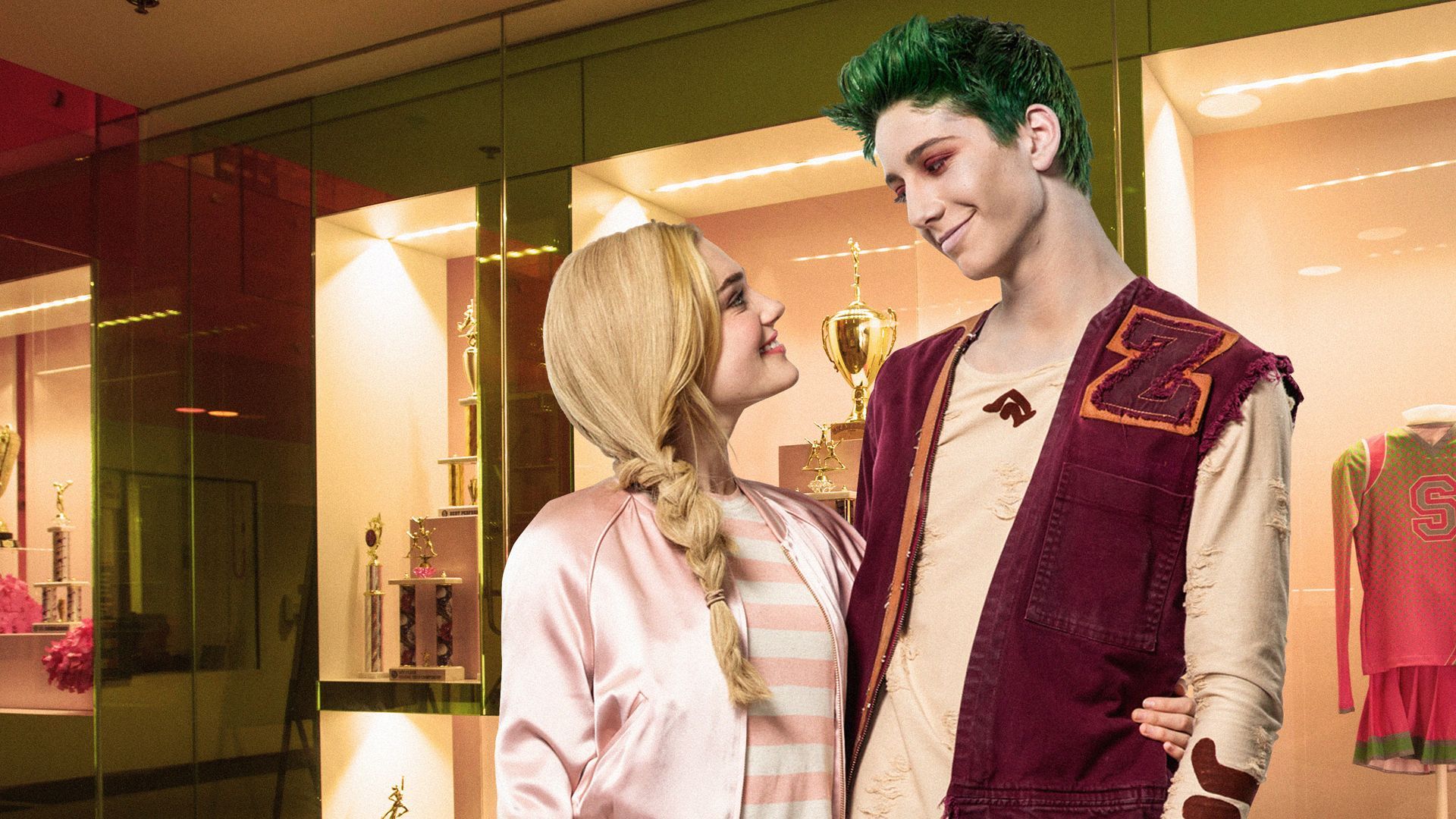
He isn't your typical flesh-eater. Not even close. When Disney Channel dropped Z-O-M-B-I-E-S back in 2018, people expected a neon-soaked High School Musical clone with some green face paint. What they actually got was Zed. Portrayed by Milo Manheim, Zed Necrodopolis isn't just a "zombie movie" lead; he’s the guy who flipped the script on what a monster is allowed to be in a PG-Universe.
Most zombie films are about survival. Night of the Living Dead? Survival. 28 Days Later? Pure adrenaline and dread. But for Zed, the movie isn't about avoiding a bite—it’s about avoiding a stereotype. He lives in Zombietown, wears a "Z-Band" to keep his cravings in check, and just wants to play football. It sounds goofy. Honestly, it is. But the character became a cultural touchstone for a generation of younger viewers because he represents the "other" in a way that’s weirdly relatable.
The Z-Band Paradox and Zed’s Identity
The whole premise of Zed from the Zombies movie hinges on the Z-Band. It’s this tech-heavy bracelet that delivers electromagnetic pulses to keep zombies from going "full brain-eater."
Think about that for a second.
It’s a heavy metaphor for assimilation. Zed spends the first movie trying to prove he’s "one of the good ones" by suppressing his true nature. He literally hacks his Z-Band to be more athletic, risking his sanity to win a game and impress a cheerleader named Addison. It’s a desperate move. We see this play out in the sequels too, where the struggle shifts from "fitting in" to "changing the system."
The nuance here is that Zed isn't perfect. He’s charismatic, sure, but he’s also deeply insecure about his status in Seabrook. Unlike the shambling corpses in The Walking Dead, Zed has a pulse—well, sort of—and a massive amount of ambition. He wants to be the first zombie to attend college. He wants to be a leader. He’s a monster who refuses to act like one, which is exactly why the character stuck the landing.
Why Milo Manheim’s Performance Worked
Casting is everything. If you put a wooden actor in green makeup, the movie flops. Milo Manheim brought a theater-kid energy to the role that made the singing and dancing feel... well, not exactly "natural," but definitely earnest.
His chemistry with Meg Donnelly (Addison) is the engine of the franchise. It’s the classic Star-Crossed Lovers trope, but with a supernatural twist. What’s interesting is how Manheim plays the physical comedy of being a zombie. He’s lanky. He’s got this weird, jerky grace. He manages to make the "zombie" part of Zed feel like a physical trait rather than a costume.
Critics often dismiss Disney movies as fluff. That’s a mistake here. If you look at the fan metrics on platforms like TikTok or the ratings for the sequels, Zed’s influence is massive. He’s the reason "Zombie Prom" became a legitimate aesthetic for a few years.
Breaking Down the Seabrook Social Hierarchy
Seabrook is a pastel nightmare. It’s a town obsessed with perfection.
- The Cheerleaders: They represent the status quo.
- The Zombies: The marginalized group living behind a literal fence.
- The Werewolves: (Introduced in the sequel) The wilder, less "civilized" outsiders.
- The Aliens: (The third movie) The ultimate observers.
Zed sits right in the middle of this chaos. He’s the bridge. In the second film, we see him get jealous of the werewolves. It’s a very human reaction. He finally felt like he was becoming "normal," and then these new cool kids show up and suddenly he’s the "boring" monster. That’s a great bit of character writing. It shows that Zed isn't a saint; he’s a teenager with an ego.
The Evolution of the Zombie Mythos
Historically, zombies are a blank slate. George A. Romero used them to talk about consumerism. Train to Busan used them to talk about class struggle and sacrifice. Zed from the Zombies movie uses them to talk about integration and prejudice.
It’s a sanitized version, obviously. Nobody is getting their guts ripped out on Disney Channel. But the core idea—that the "monster" is actually just a person we haven't bothered to understand—is a direct descendant of those earlier, grittier films.
The movie actually addresses the "Great Limeade" incident, which is the fictional event that turned people into zombies. It wasn't a virus or a curse; it was an industrial accident. This makes the zombies victims of a system rather than inherently evil creatures. Zed is the first generation to grow up after the chaos, and he’s tired of paying for his ancestors' "mistakes."
Social Impact and the "Zed" Effect
You can't talk about Zed without talking about the fans. The Z-O-M-B-I-E-S franchise has some of the highest engagement numbers for any Disney Channel Original Movie (DCOM) of the last decade.
Why?
Because Zed is an underdog who wins. He doesn't just survive the movie; he changes the laws of his town. He gets the girl, he wins the game, and he keeps his identity. For kids who feel like they don't fit into the "Seabrook" mold of their own schools, Zed is a bit of a hero.
It’s also worth noting the musical aspect. Songs like "BAMM" and "Someday" aren't just catchy; they’re manifestos for the characters. When Zed sings, he’s claiming space. It’s a loud, proud declaration of existence that resonates with anyone who’s ever felt invisible.
Common Misconceptions About the Character
People often get confused about the "rules" of Zed’s world.
- Can he die? He’s already technically dead, but the movies treat it more like a chronic condition. He can be "destroyed," but he doesn't age the same way humans do.
- Does he eat brains? Only if his Z-Band fails. The movies show a "zombie haze" where they lose their personality and become predatory.
- Is he a vampire? No. This happens surprisingly often in search queries. He’s 100% zombie, despite the lack of decaying skin.
The design choice to keep the zombies looking relatively "human" (just with green hair and pale skin) was a deliberate move to make them sympathetic. It’s hard to root for a protagonist whose nose is falling off. By keeping Zed "cute," Disney allowed the audience to focus on his personality rather than his pathology.
Actionable Insights for Fans and Creators
If you’re looking to dive deeper into the world of Zed or if you’re a creator looking to understand why this character worked, consider these points:
- Study the "Othering" Narrative: Zed is a masterclass in how to use a monster as a proxy for real-world social issues without being too "on the nose" for a younger audience.
- Watch the Physicality: If you're an actor, study how Manheim transitions from "normal teenager" to "glitchy zombie" when his Z-Band malfunctions. It’s all in the shoulders and the vacant eyes.
- Look at the Color Theory: Notice how Zed’s green hair clashes with the pinks and blues of Seabrook. The visual storytelling is just as important as the dialogue.
- Analyze the Soundtrack: The lyrics often provide more character depth than the script. "Stand" and "I'm Finally Me" are essential for understanding Zed's arc.
Zed isn't just a character in a kids' movie. He’s a reimagining of a century-old horror trope. By stripping away the gore and replacing it with heart (even if it’s a non-beating one), the Z-O-M-B-I-E-S franchise created a protagonist who actually has something to say.
To really understand the impact, go back and watch the first film’s ending. It’s not about the zombies becoming human. It’s about the humans realizing that being a "zombie" isn't a bad thing. That’s the real legacy of Zed. He didn't change himself to fit the world; he forced the world to expand to include him.
Check out the official Disney Music VEVO channel for the full "BAMM" choreography if you want to see the character's physical peak. Also, keep an eye on the upcoming animated series, as it's set to expand Zed's backstory beyond the three live-action films. Exploring the lore through the "Zombietown" lens gives a much darker, more interesting perspective on the Seabrook universe.



