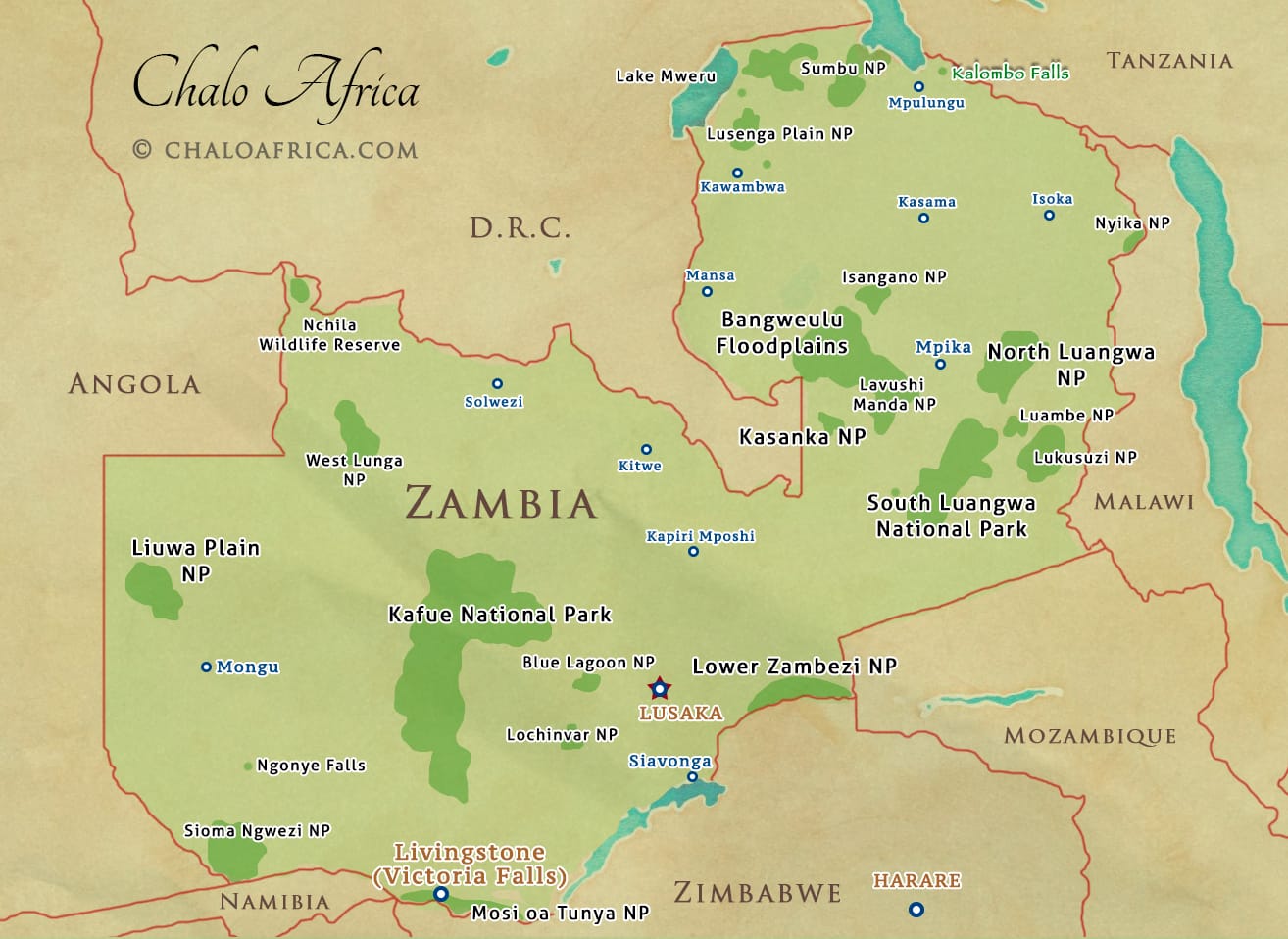
If you pull up a chair and look at Zambia on Africa map, you’ll notice something immediately. It looks like a giant, distorted butterfly or maybe a moth pinned right in the center of the sub-Saharan region. It’s got no coastline. No salty breeze. But honestly, calling it "landlocked" feels like a bit of an insult these days. In the local corridors of power in Lusaka, they’ve started calling it "land-linked."
It makes sense. Zambia shares borders with eight different countries. Eight. That’s a lot of neighbors to keep happy. You’ve got the Democratic Republic of the Congo (DRC) to the north, Tanzania to the northeast, Malawi to the east, Mozambique to the southeast, Zimbabwe and Botswana to the south, Namibia to the southwest, and Angola to the west. It’s basically the ultimate crossroads.
The Geography of the "Butterfly"
Most people think of Africa as either desert or jungle. Zambia is neither. It sits on a massive, undulating plateau that keeps the heat from being too murderous. Most of the country lounged between 900 and 1,500 meters above sea level. This elevation is the secret sauce for the climate. It means that even though you’re in the tropics, you aren't always sweating through your shirt.
The "wings" of the Zambian map are defined by water, ironically for a country with no ocean. To the south, the mighty Zambezi River carves out the border with Zimbabwe. This is where you find the big one—Victoria Falls. Locally, it’s Mosi-oa-Tunya, "The Smoke That Thunders." It’s not just a tourist trap; it’s a geological monster that defines the entire southern frontier.
To the north, the map is shaped by the deep waters of Lake Tanganyika and the sprawling wetlands of Lake Bangweulu. It's a weirdly wet country for being in the middle of a dry continent.
Why Zambia on Africa Map is Changing the Regional Game
For decades, being stuck in the middle was a headache. If you wanted to sell copper—Zambia’s lifeblood—you had to beg neighbors for port access. You were at the mercy of whoever owned the tracks to the sea. But in 2026, the script has flipped.
The Lobito Corridor is the project everyone is talking about right now. It’s a massive rail rehabilitation that connects Zambia’s Copperbelt directly to the Atlantic port of Lobito in Angola. Before this, getting minerals out took weeks of trucking through congested routes toward South Africa or Tanzania. Now? It’s a straight shot west.
Then there’s the Kazungula Bridge. If you zoom in on the map where Zambia, Botswana, Namibia, and Zimbabwe almost touch, you’ll see a tiny sliver of a border with Botswana. It used to be a nightmare of a ferry crossing. Now, there's a world-class bridge that has turned Zambia into the primary transit hub for goods moving from South Africa into the heart of the DRC.
Breaking Down the Borders
Let’s look at the neighbors. Each border tells a different story:
- The DRC Border: This is the longest one, stretching over 1,900 kilometers. It’s shaped like a pedicle—a weird finger of land that pokes into Zambia. It’s the reason why traveling from the Copperbelt to Luapula Province feels like a massive detour unless you cross through Congolese territory.
- The Malawi-Mozambique Side: The eastern border is rugged. Here you find the Muchinga Escarpment and the Mafinga Hills. Mafinga Central is the highest point in the country at 2,339 meters. It’s not Everest, but the views into the Luangwa Valley from up there are something else.
- The "Point" with Botswana: This is a geographic trivia favorite. The border with Botswana is one of the shortest in the world, less than a kilometer long. It’s basically a single point in the middle of the Zambezi River.
The Misconception of the "Empty" Interior
Looking at Zambia on Africa map, you might see vast green spaces and assume it's all empty wilderness. That’s a mistake. While the population density is lower than in places like Nigeria or Ethiopia, the land is working.
The Copperbelt, located in the north-central "waist" of the country, is one of the most urbanized areas in Africa. It’s a string of cities—Kitwe, Ndola, Chingola—built entirely on the back of the world’s demand for electric vehicle batteries and wiring. If the world wants to go green, it has to look at this specific spot on the Zambian map.
But then you have the valleys. The Luangwa and the Kafue. These aren't just "parks." They are massive drainage systems that dictate where people live and where the lions roam. The Luangwa Valley is part of the Great Rift Valley system, and it's one of the few places left where you can see Africa exactly as it was ten thousand years ago.
Navigating the Terrain
If you're planning to actually traverse this map, you need to know the rhythm of the seasons.
- The Dry Season (May to August): Cool and crisp. You’ll need a jacket at night. The map is easy to navigate because the roads are hard and dry.
- The Hot Season (September to November): This is "suicide month" in the valleys. Temperatures can hit 40°C. But the wildlife viewing is peak because the animals are desperate for water.
- The Emerald Season (December to April): The rains. The map turns vibrant green. Some roads in the remote west or north become literal rivers.
Actionable Insights for the Curious Explorer
If you’re studying Zambia’s position or planning a trip, keep these logistics in mind:
- The Hub Strategy: Use Lusaka as your base. Because of the "butterfly" shape, the capital is almost perfectly centered. Flights and buses radiate out from here to every corner.
- Border Crossings: The Chirundu border with Zimbabwe and the Nakonde border with Tanzania are notoriously busy. If you’re driving, budget a full day for paperwork.
- Digital Connectivity: Don't let the "remote" look of the map fool you. Starlink has rolled out heavily across Zambia, meaning you can be in the middle of the Kafue floodplains and still have better internet than some European suburbs.
- Trade Corridors: Keep an eye on the TAZARA railway. It’s currently undergoing a massive $1 billion-plus upgrade with Chinese investment to link the Zambian mines back to Dar es Salaam more efficiently.
Zambia isn't just a space between more famous countries. It’s the glue holding Southern Africa together. Whether you're looking at it for trade, travel, or geology, its central position on the map is no longer a geographical hurdle—it's the country's greatest asset.
To understand the region's future, start by looking at the rail lines and road networks currently snaking out from this land-linked giant. They are the new arteries of African trade.
Next Steps:
- Analyze the Lobito Corridor: Research how the new rail link to Angola is cutting transit times for exports.
- Check Visa Requirements: Look into the KAZA Univisa, which allows easy movement between Zambia and Zimbabwe for those visiting the Victoria Falls area.
- Review Topographical Maps: Study the Muchinga Escarpment if you are planning any high-altitude trekking or research in the northeast.