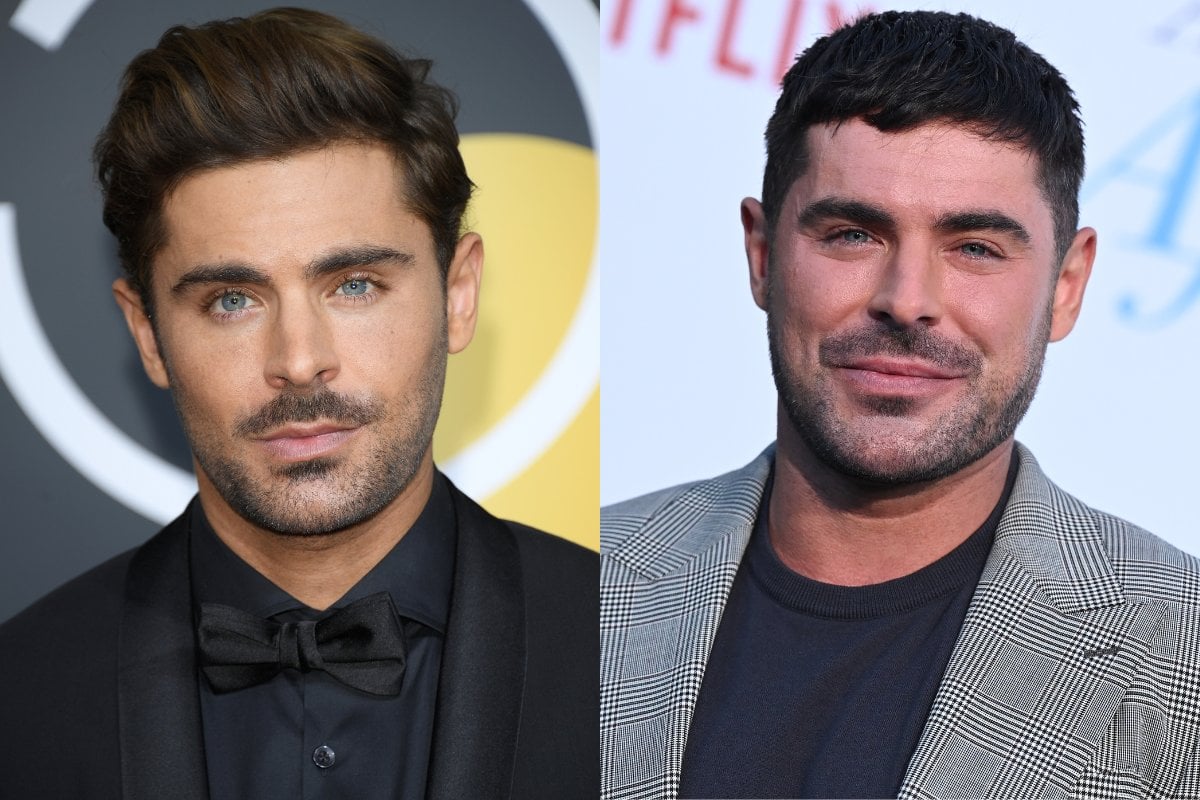
You remember the 2021 Earth Day video. We all do. Zac Efron appeared on screen for a few seconds to promote a Bill Nye special, and the internet basically imploded. Within minutes, "Zac Efron face before and after" was trending everywhere. His jaw looked massive. His cheeks seemed fuller. The "Handsome Squidward" memes were relentless, and honestly, they were kinda mean.
People love a good plastic surgery scandal. It’s easy to look at a celebrity whose face has changed and yell "fillers!" or "implants!" but with Zac, the reality is a lot more intense—and a lot more painful—than a simple trip to a Beverly Hills surgeon.
The Day Everything Changed (Literally)
Most people think the change happened in 2021. It didn't. The catalyst for the Zac Efron face before and after saga actually dates back to November 2013.
Zac was running through his house in socks. He slipped. He hit his chin against the granite corner of a fountain. Hard. He was knocked unconscious, and when he woke up, he told Men’s Health that his "chin bone was hanging off his face."
That is not a minor "oops." That is a life-altering trauma. He had to have his jaw wired shut. He had to undergo reconstructive surgery. For years, he worked with a specialist and did intensive physical therapy to make sure his facial muscles were functioning correctly.
Why the jaw suddenly looked different
So, if the accident was in 2013, why did he look so different in 2021? This is where the biology gets interesting.
The human face has masseter muscles. These are the big muscles used for chewing. In a healthy face, all the muscles work together like a "symphony," as Zac put it. After his injury, his masseters had to overcompensate for the damaged parts of his jaw.
During the pandemic, Zac took a break from his regular physical therapy while living in Australia. Without that constant "mediation" from a specialist, those muscles just... grew. They got huge.
"The masseters just grew," he said in his 2022 cover story. "They just got really, really big."
Basically, the "new" jaw wasn't plastic surgery. It was muscle hypertrophy. It’s the same way your biceps get bigger if you lift heavy weights—his face was "lifting weights" just to function.
Addressing the Plastic Surgery Rumors
Honestly, Zac didn't even know people were talking about his face until his mom called him. She asked him point-blank if he’d had plastic surgery. When your own mother is checking in on your chin, you know the rumors have reached a fever pitch.
The common theories vs. reality
- Theory: Jaw Implants. People thought he’d gone for a hyper-masculine, squared-off look.
- Reality: The "implants" were actually his own overgrown muscles.
- Theory: Cheek Fillers. Critics pointed to the fullness in his mid-face as evidence of "pillow face."
- Reality: When the lower jaw widens significantly, it changes how the skin and fat pads sit on the rest of the face.
- Theory: Growth Hormones. Some suggested he was using substances for movie roles that caused bone growth.
- Reality: While Zac has been open about the "fake" and "unattainable" look he had to achieve for Baywatch, he attributes the jaw specifically to the fountain accident.
The Physical Toll of Being Zac Efron
We see the Zac Efron face before and after photos and focus on the aesthetics, but we rarely talk about the physical cost. For Baywatch, Zac was using powerful diuretics like Lasix to shed water weight. He wasn't sleeping. He was overtraining.
He eventually fell into a deep depression and suffered from insomnia because of that "perfect" body. By the time The Iron Claw came around in 2023, he was bulking up again to play wrestler Kevin Von Erich, but he was doing it differently. He was focusing on health rather than just looking like a CGI character.
He’s 38 now. He’s not the 17-year-old kid from High School Musical anymore. Faces change. Bones settle. Muscles react to trauma.
What We Can Learn From "Jaw-Gate"
It’s easy to judge a thumbnail on a YouTube video. It’s harder to realize that the person in that thumbnail might be dealing with the long-term effects of a near-fatal accident.
If you’re looking at your own "before and after" and feeling the pressure to look a certain way, remember:
- Muscle compensation is real. If you have jaw pain or clicking (TMJ), your masseters might be doing too much work. Seeing a specialist or a physical therapist can help balance your facial "symphony" before it leads to permanent changes.
- Diuretics are dangerous. Zac’s experience with Lasix is a warning. Chasing a "shredded" look at the expense of your kidneys and mental health isn't worth it.
- Social media is a lie. Lighting, angles, and even the "swelling" from a break in physical therapy can make someone look unrecognizable.
The most actionable thing you can do? Stop scrolling through celebrity transformation photos and start focusing on your own functional health. If you have jaw issues, don't ignore them. If you're overtraining, take a rest day. Zac Efron survived a shattered jaw and the world's most aggressive "glow-down" memes—you can survive a bad angle.
Check your own habits: Are you clenching your jaw when stressed? That’s your masseter working overtime. Try some simple jaw release exercises tonight to avoid the "compensatory growth" Zac dealt with.