You just landed at Toronto Pearson International Airport. You’re tired. Maybe the flight was bumpy, or the person in 3B wouldn’t stop talking about their cat. Now you’ve got to figure out how to get from YYZ to Union Station. It sounds simple on paper. In reality, Toronto traffic is a beast that eats schedules for breakfast. If you walk out those sliding glass doors and just hope for the best, you might end up sitting on the 401 highway for an hour watching the meter climb while your soul slowly leaves your body.
Don't do that.
Most people think a taxi is the "premium" choice. It’s not. In Toronto, the "premium" choice is whatever gets you to Front Street the fastest. Sometimes that's a train. Sometimes it’s a black car. Occasionally, it’s a bus if you’re trying to save every nickel for a $15 cocktail at the Royal York.
Let’s break down how this actually works. No fluff. Just the ground truth.
The UP Express: Why Most People Choose It (And a Few Reasons They Don't)
The Union Pearson (UP) Express is basically the gold standard for getting from YYZ to Union Station. It’s a dedicated rail link. It doesn't care about accidents on the Gardiner Expressway. It doesn't care about snowstorms. It just goes.
The trains leave every 15 minutes. Usually.
The ride takes exactly 25 minutes. You get on at Terminal 1. If you landed at Terminal 3, you have to take the free Terminal Link train first. It adds maybe five or ten minutes to your journey, so factor that in if you're sprinting for a dinner reservation. The seats are comfortable enough, there’s Wi-Fi that actually works most of the time, and there are luggage racks so you aren't hugging your suitcase the whole way.
The Cost Reality
A one-way adult fare is $12.35. If you have a PRESTO card—the green plastic card we use for everything transit-related here—it drops to $9.25. You can also just tap your credit card or phone on the green pillars. It’s seamless.
But here is the catch. If you are traveling with a family of four, the UP Express starts looking expensive. $50 for a 25-minute ride? That’s Uber XL territory. For a solo traveler, it’s a no-brainer. For a group? You have to do the math.
The Ride-Share Gamble: Uber, Lyft, and the 401
If you want a car, follow the signs for "Ride Share." At Terminal 1, it’s on the Ground Level at Door Q. At Terminal 3, go to the Arrivals Level at Door G.
Getting from YYZ to Union Station by car is a roll of the dice. If it’s 2:00 PM on a Tuesday, you might make it in 30 minutes. If it’s 5:00 PM on a Friday? God help you. You are looking at 60 to 90 minutes of brake lights.
The price fluctuates wildly. I’ve seen it as low as $45 and as high as $110 during a surge.
- Pros: Door-to-door service. No carrying bags up station escalators.
- Cons: Unpredictable pricing. Traffic. The "aroma" of whatever the previous passenger left behind.
The Old School Way: City Taxis and Limos
Toronto has a flat-rate zone system for airport taxis. This is actually pretty great because you know exactly what you’re paying before you sit down. A taxi to the downtown core (where Union Station is) usually sits around $60 to $65 CAD plus tip.
Airport Limos are just nicer taxis. They aren't stretch Hummers; they are usually black sedans like a Lexus or a Chevy Suburban. They cost about 10% more than a taxi. If you want to feel like a high-roller or just want a driver who definitely knows where they’re going without a GPS, grab a limo.
The Budget Route: The 900 Airport Rocket
If you are a student or just really, really frugal, there is the TTC (Toronto Transit Commission). You take the 900 Airport Rocket bus to Kipling Station, then get on the Line 2 subway, transfer at St. George, and head south to Union.
It costs $3.30.
It also takes over an hour. You will be lugging your bags through crowded subway stations. It is not "vacation vibes." But hey, you saved $40.
What Most People Get Wrong About Union Station
When you finally arrive at Union Station, don't just wander out the first door you see. Union is a labyrinth. It’s currently undergoing—well, it’s always undergoing—renovations.
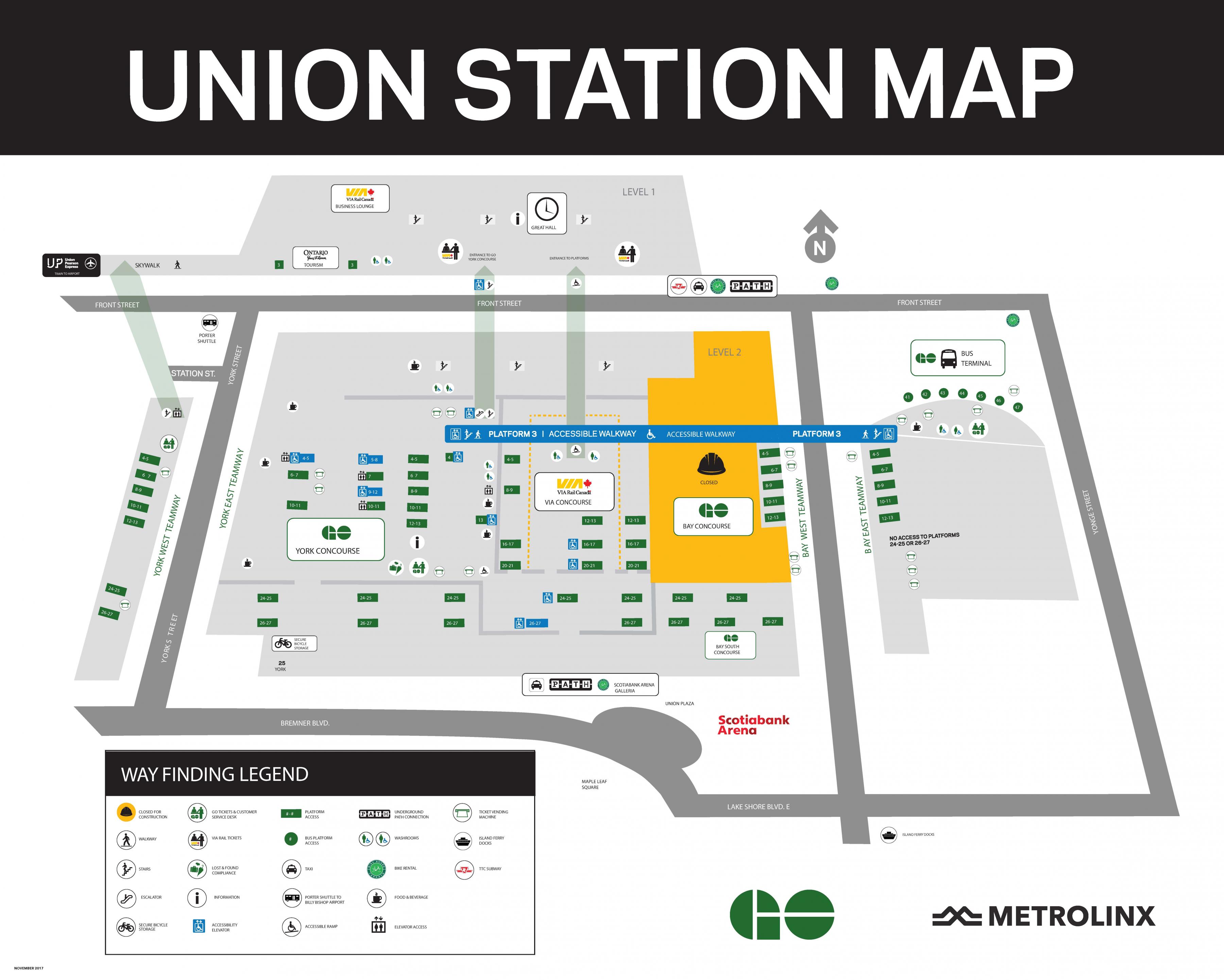
If you took the UP Express, you arrive at the western end of the station. If you need the Fairmont Royal York hotel, it’s right across the street. If you’re heading to the Scotiabank Arena for a Raptors or Leafs game, follow the signs for the "PATH" or the "South Teamway."
Pro tip: Do not try to hail a cab inside the station. Walk out to Front Street. There is a designated taxi stand. If you try to call an Uber to Union Station, the GPS often gets confused by the different levels. Walk a block away to a hotel or a coffee shop and call it from there. It will save you ten minutes of circling.
Nuance and Real Talk: When to Skip the Train
While the UP Express is great, it isn't perfect.
Sometimes the tracks have issues. In the winter, signal problems can cause delays. If the train is down, the station gets chaotic fast. Always check the UP Express website or Twitter (X) feed before you buy your ticket.
Also, if you are staying in the East End—like Leslieville or the Distillery District—taking the train from YYZ to Union Station only gets you halfway there. You’ll still have to grab a streetcar or a cab from Union. In that specific case, a direct Uber from the airport might actually be faster and cheaper than two separate transit fares.
The Security and Safety Factor
Toronto is generally very safe. Union Station has plenty of security and transit staff. However, like any major hub, keep your eyes on your bags. The "Bay Street" side of the station is usually a bit quieter than the "York Street" side.
If you’re arriving late at night, the UP Express runs until about 11:00 PM or midnight depending on the day. After that, you are limited to taxis or the "Blue Night" buses, which I wouldn't recommend unless you are an experienced local.
Essential Action Steps for a Smooth Arrival
To make your trip from the airport to downtown as painless as possible, follow these steps:
- Check the time: If it's rush hour (7–9 AM or 3:30–6:30 PM), take the UP Express. Period.
- Download the PRESTO app: Or just make sure your mobile wallet (Apple Pay/Google Pay) is set up. Tapping your phone at the station is way faster than standing in line at a kiosk.
- Terminal Check: Ensure you know if you're landing at T1 or T3. If T3, give yourself an extra 15 minutes to ride the terminal link train to the UP Express station.
- The "Front Street" Rule: If you take a car, tell the driver to drop you at the "Front Street entrance" of Union Station if you need the subway, or the "Bremner Boulevard" side if you are going to the CN Tower or a game.
- Offline Maps: Download a map of the Union Station PATH system. It’s an underground city. Once you lose GPS signal down there, you’re on your own.
Getting downtown doesn't have to be a headache. If you value your time, use the rail link. If you have four people and a mountain of luggage, grab a flat-rate limo. Avoid the bus unless your bank account is truly crying. Toronto is a great city, but the 401 highway is a parking lot—plan accordingly.
Next Steps for Your Trip: Once you arrive at Union Station, the city is at your feet. Head to the lower level to connect to the TTC Subway (Line 1) to reach North Toronto or Midtown. If you're staying nearby, use the PATH underground walkway system to reach major office towers and hotels without ever stepping out into the cold. For those heading to the harborfront, look for the 509 or 510 Queens Quay streetcars located in the underground loop at the south end of the station.
.png)