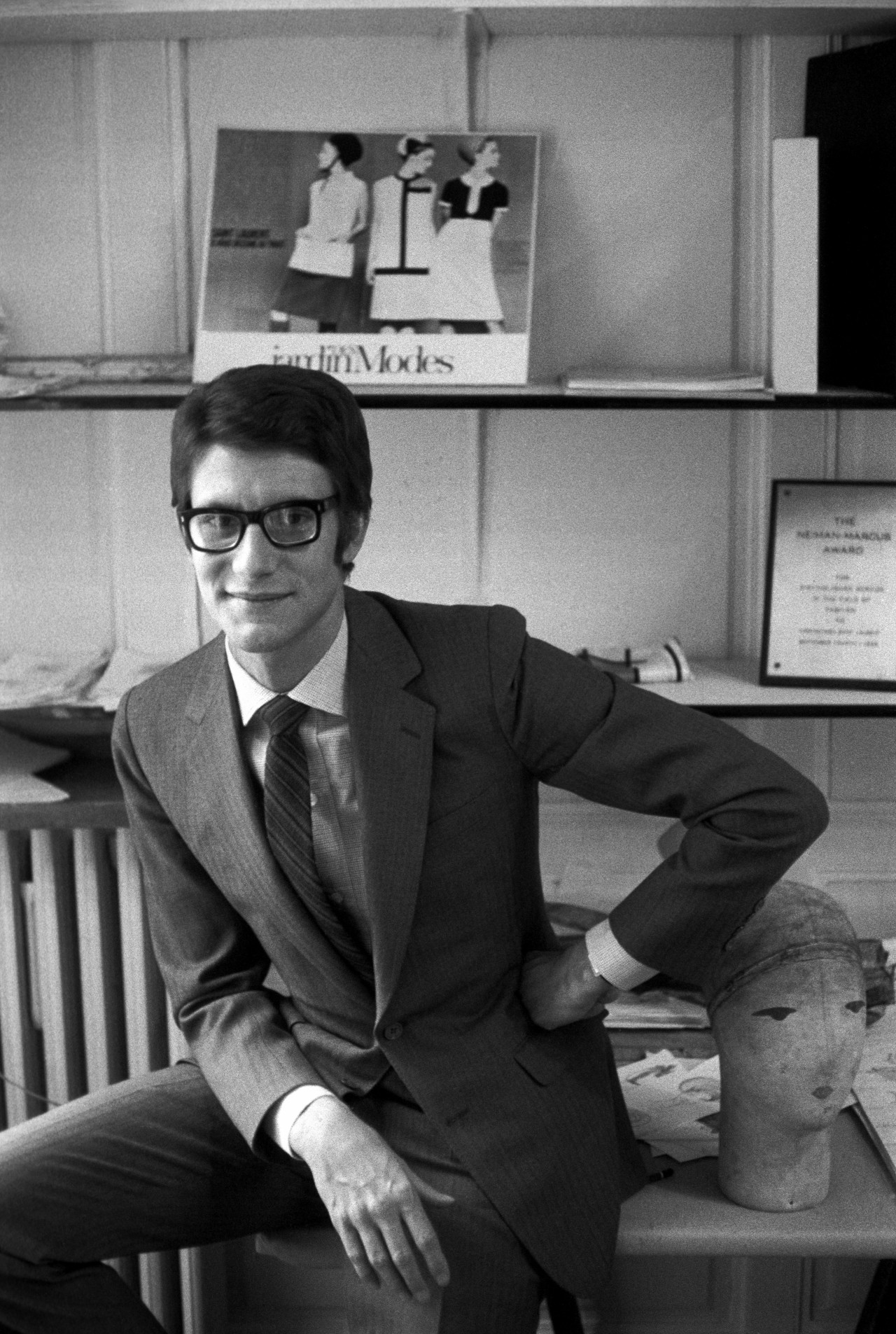
If you open your closet right now, there is a very high probability that something inside it exists because of Yves Saint Laurent. No, seriously. Whether it’s a blazer, a sheer blouse, or even a basic trench coat styled a certain way, the DNA of this man is everywhere. It’s kinda wild when you think about it. Most people know the name from the glossy bags or the "YSL" logo on a lipstick tube, but the actual human being—the fashion designer Saint Laurent—was a beautiful, chaotic, and revolutionary mess who basically invented the modern woman’s wardrobe.
He didn't just make pretty dresses. He gave women power when they weren't supposed to have it.
The Dior Prodigy Who Got Fired
Yves was born in Oran, Algeria. He wasn't a "tough" kid. He was sensitive, obsessed with paper dolls, and had a talent that was honestly intimidating. By 21, he was the head of Christian Dior. Think about that for a second. Twenty-one years old and running the biggest couture house in the world. He saved Dior from financial ruin with his "Trapeze" line, but the relationship didn't last.
The French army drafted him in 1960 during the Algerian War of Independence. It was a disaster. He lasted 20 days before having a nervous breakdown. While he was in the hospital being treated with sedatives and electroshock therapy, Dior fired him. It felt like the end. Instead, it was the start of the "Saint Laurent" we know today. With his partner Pierre Bergé—who was the business brain and the emotional anchor—he sued Dior, won, and used the money to start his own house.
Why Le Smoking Changed Everything
In 1966, fashion designer Saint Laurent debuted "Le Smoking." It was a tuxedo designed for women. Today, that sounds like a Tuesday at the office. In 1966? It was a scandal. It was actually banned in certain restaurants. There’s a famous story about socialite Nan Kempner being turned away from Le Côte Basque in New York because she was wearing the tuxedo. Her response? She took off the trousers and walked in wearing just the jacket as a mini-dress.
That was the vibe Yves tapped into.
He understood that femininity wasn't just about cinched waists and floral prints. It was about confidence. He took the masculine codes of power—the suit, the safari jacket, the pea coat—and re-cut them for the female body. He wasn't trying to make women look like men. He was giving them the "uniform" of the street, but elevated to high art.
The Rive Gauche Revolution
Before Yves, "Ready-to-Wear" was kinda seen as cheap. Serious designers did Haute Couture for the 1%. Saint Laurent hated that exclusivity. He opened Saint Laurent Rive Gauche in 1966, becoming the first couturier to launch a full-scale boutique line that wasn't just "watered down" couture. He wanted to dress the young people who were protesting in the streets of Paris. He wanted his clothes to be worn, not just displayed.
The Art and the Darkness
If you look at his 1965 Mondrian collection, you see his obsession with art. Those primary color shift dresses are legendary. But being a genius came with a heavy price tag for Yves. He struggled with addiction, depression, and a crushing fear of his own fame.
He was famously shy. He would hide backstage, shaking, before his shows. He once said, "I have known all the terrors of the mind." This wasn't just dramatic designer talk; he lived in a constant state of emotional high-wire walking.
His inspirations were global at a time when fashion was very Eurocentric.
- The 1976 Russian Collection (pure opulence, fur, and embroidery).
- The African Queen collection (wood beads and raffia).
- The Chinese collection.
He used Black models on the runway long before it was "trending" or mandated by a corporate diversity board. Mounia and Katoucha Niane weren't just models to him; they were muses. He saw beauty in a way that was far ahead of the industry's rigid standards.
The Misconceptions About the Brand Today
People often get confused between "Yves Saint Laurent" and "Saint Laurent." When Hedi Slimane took over as creative director in 2012, he dropped the "Yves" from the ready-to-wear line. People freaked out. They thought it was disrespectful.
But honestly? It was a callback to the Rive Gauche days.
The brand has gone through many iterations—Tom Ford brought a hyper-sexualized glamour, Stefano Pilati brought a sophisticated chic, and Anthony Vaccarello today brings a leggy, rock-and-roll edge. But the core remains the same: it’s about a woman who knows exactly who she is. She’s not hiding. She’s definitely not "dainty."
What Most People Miss About His Legacy
It wasn't just about the clothes. It was about the attitude. Yves Saint Laurent was one of the first designers to be a celebrity in his own right. He posed nude for his own perfume ad (Pour Homme) in 1971. A designer doing that today would be a viral TikTok moment, but back then, it was a seismic shift in how we viewed the "creator."
He also democratized fashion. He believed that a woman could look just as elegant in a pair of well-cut trousers and a navy sweater as she could in a ballgown. That’s a very modern concept that we take for granted now.
Taking Inspiration from the Master
If you want to channel the energy of fashion designer Saint Laurent in your own life, you don't need a $5,000 blazer. You need the philosophy.
Invest in "the bones" of a wardrobe. Stop buying micro-trends that die in three weeks. Yves believed in the trench coat, the blazer, the button-down, and the trouser. If these fit you perfectly, you can do anything.
Contrast is your best friend. Mix the masculine with the feminine. Wear a structured jacket over something soft. Wear heavy boots with a silk dress. That tension is where the "Saint Laurent" look lives.
Confidence is the primary accessory. The clothes are meant to support you, not wear you. Yves famously said, "The most beautiful clothes that can dress a woman are the arms of the man she loves. But for those who haven't had the fortune of finding this happiness, I am there." He wanted his clothes to be a suit of armor.
Your Saint Laurent Style Checklist:
- The Sharp Blazer: Look for strong shoulders. It should make you feel like you're heading into a boardroom even if you're just going to coffee.
- The Sheer Element: Yves loved the "naked" look long before it was a red carpet staple. A hint of transparency adds mystery.
- Black is Never Boring: He proved that black isn't a lack of color; it's a statement of intent.
- Gold Accents: Whether it's a chunky chain or a vintage-style earring, gold adds the Rive Gauche luxury to a simple outfit.
The man himself passed away in 2008, but his impact is permanent. Every time you see a woman feeling powerful in a suit, or a designer looking to art for inspiration, or a brand trying to bridge the gap between "high" and "low" culture, you're seeing the ghost of Yves. He didn't just design for a season; he designed for the way we actually live.
To truly appreciate his work, look at vintage runway footage from the 70s. The way the models walk—fast, purposeful, smoking cigarettes—that’s the energy. It wasn't about being a mannequin. It was about being a woman in the world.
Next Steps for the Fashion Obsessed
- Visit the Musée Yves Saint Laurent: If you find yourself in Paris or Marrakech, these museums are non-negotiable. They house the archives and the actual studio where he worked.
- Watch the Documentaries: "L'Amour Fou" gives the best insight into his relationship with Pierre Bergé and the insane collection of art they built together.
- Audit Your Closet: Look for pieces that have lasted you more than three years. Those are your "Saint Laurent" pieces. Focus on quality over quantity from here on out.
- Study the 1966 Rive Gauche Launch: It’s a masterclass in brand expansion and understanding your audience before "data analytics" even existed.