You're staring at a YouTube screen. The creator just dropped a knowledge bomb that perfectly supports your thesis, but now you’re stuck with the headache of the YouTube video citation APA format. It feels like trying to fit a square peg into a round hole. Traditional citations were built for dusty library books, not for a 12-minute video essay by a guy in his basement or a high-production lecture from Stanford.
APA 7th Edition changed things. Honestly, it made life easier, but people still mess it up constantly. They forget the timestamps. They mangle the channel name. They treat the uploader like a book author.
Stop. It's not that deep, but it does require precision.
If you’re citing a video, you aren't just pointing to a URL. You’re documenting a specific moment in digital time. Let's get into the weeds of how this actually works without the academic fluff.
The Basic Anatomy of a YouTube Video Citation APA Style
The American Psychological Association is pretty specific about the order of operations. You need the person or entity who uploaded the video, the date it went live, the title, the platform, and the link.
Here is what the skeletal structure looks like:
Author, A. A. [Username]. (Year, Month Day). Title of video [Video]. YouTube. http://youtube.com/url
But wait. Real life is messier.
Often, you don’t have a "Real Name." If you are citing a video by MKBHD, you don't hunt down his birth certificate to find Marques Brownlee unless he explicitly lists it as the author. If only the screen name is available, you use that. If both are available, the real name comes first, followed by the bracketed username.
Example: Brownlee, M. [MKBHD]. (2024, March 12). The Apple Vision Pro Review [Video]. YouTube. https://www.youtube.com/watch?v=xyz
Notice the brackets? They are vital. They tell the reader, "Hey, this is the digital handle."
Why the Date Matters More Than You Think
YouTube is a graveyard of re-uploads.
You might find a clip of a 1960s interview uploaded in 2023. Which date do you use for your YouTube video citation APA? You use the date the specific video you watched was uploaded. If you need to reference the original air date for historical context, you can mention that in your prose, but the citation itself tracks the source you actually touched.
Accuracy counts. If a video was edited or re-uploaded, the URL changes. APA wants the reader to find exactly what you saw.
The In-Text Citation Trap
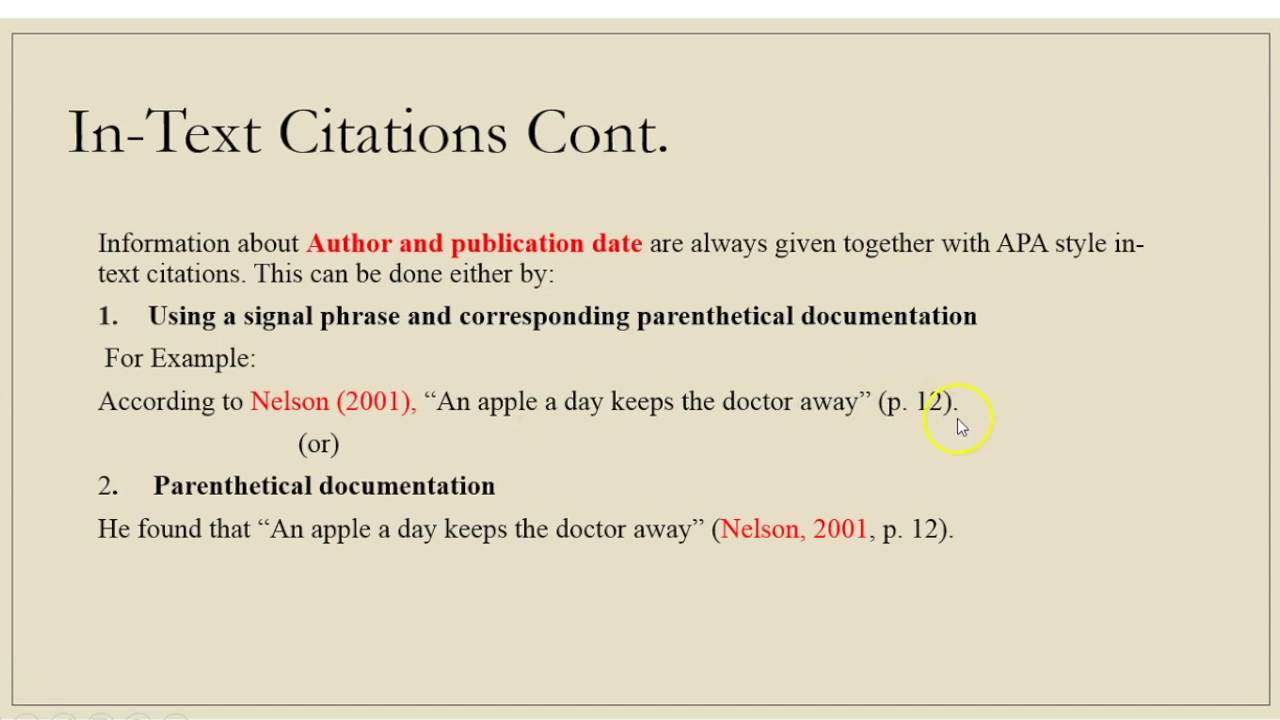
This is where students and researchers lose points. Most people think (Brownlee, 2024) is enough. It's not. Not if you are quoting.
If you are paraphrasing a general idea from a 20-minute video, sure, the year is fine. But if you are quoting a specific line, you need a timestamp.
Think of a timestamp as a page number. Since videos don't have pages, the timestamp is the only way a peer reviewer or professor can verify your claim without watching the whole thing.
Correct in-text format: (Brownlee, 2024, 5:12).
That "5:12" tells the reader exactly where the quote starts. If the quote spans a range, use (Brownlee, 2024, 5:12-5:45). Simple. Effective. It shows you actually watched the thing.
Dealing with "Channel" vs. "Individual"
Sometimes a company owns the content.
Take Kurzgesagt – In a Nutshell. There isn't one "Author." In this case, the name of the channel acts as the author. You don't need to put it in brackets again because the channel is the author.
Kurzgesagt – In a Nutshell. (2023, December 1). The Last Human - A Glimpse Into the Far Future [Video]. YouTube. https://www.youtube.com/watch?v=xyz
It looks a bit redundant to see the name and then "YouTube" later in the citation, but that’s the rule. Don’t skip it.
The "Video" Bracket is Non-Negotiable
People often ask if they can leave out the [Video] part. No.
APA uses those square brackets to describe the format. This is huge for accessibility and for researchers sorting through a bibliography. It distinguishes a video from a podcast, a tweet, or a blog post. If you're citing a TED Talk that you found on YouTube, you still label it as [Video].
What About YouTube Shorts?
Shorts are the wild west of citations.
Technically, the rules for a YouTube video citation APA apply to Shorts exactly the same way they apply to a two-hour documentary. However, since Shorts are often ephemeral or part of a trend, make sure the link you provide is the "permanent" link.
Pro tip: If you right-click a Short, you can sometimes "Copy video URL" to get the standard link format rather than the /shorts/ URL prefix, though either typically works for APA as long as it's functional.
Handling Missing Information
What if there's no date? (Rare on YouTube, but happens on other platforms). You use (n.d.).
What if the uploader deleted their account? This is the nightmare of digital archiving. If you are writing a high-stakes paper, it is always a good idea to archive the video using the Wayback Machine. If you have an archived link, you can provide that to ensure your evidence doesn't turn into a 404 error six months from now.
Common Mistakes That Kill Credibility
- Capitalization Errors: In APA, the title of the video should be in sentence case. Only the first word and proper nouns are capitalized. Most YouTube titles are ALL CAPS or Title Case to grab clicks. Do not copy the creator's clickbait formatting. "THE BEST CAMERA EVER" becomes "The best camera ever."
- Missing the "Retrieved from" text: Actually, in APA 7th edition, you don't need "Retrieved from" unless a retrieval date is necessary because the content changes frequently (like a live-updating map). For a static YouTube video, just the URL is fine.
- Using the shortened "youtu.be" link: While these work, the full "youtube.com/watch?v=" link is generally preferred for formal academic work. It's more stable.
Nuance: Citing a Comment on a YouTube Video
Occasionally, the gold isn't in the video, but in the top comment. How do you cite a random user?
You use the commenter's name/handle. You use the date of the comment, not the video. You include the first 20 words of the comment as the title, and you add the notation [Comment on the video Title of video].
It looks like this: User123. (2024, January 5). I think the third point about the sensor size is actually wrong because of the crop factor [Comment on the video The Apple Vision Pro Review]. YouTube. https://www.youtube.com/watch?v=xyz&lc=12345
Finding the specific link to a comment (the "Permalink") is key here. You can usually get this by clicking the "time ago" text next to the commenter's name (e.g., "2 hours ago").
Actionable Steps for Your Reference List
To make sure your YouTube video citation APA is bulletproof, follow this workflow every time:
- Open a Notepad or Citation Manager: Do not rely on your memory. Copy the URL immediately.
- Identify the Author: Is it a person? A company? Both? Look at the "About" section of the channel.
- Find the Upload Date: Check below the video title. Click "more" if the full date is hidden.
- Format the Title: Convert that "CLICK ME" title into sentence case.
- Check the Timestamp: If you used a specific quote, go back and find the exact second it started.
- Verify the Link: Open the link in an Incognito/Private window to make sure it isn't behind a private playlist or age-gate that might block your reader.
Citing digital media doesn't have to be a mess. By treating YouTube as a legitimate archive of information—while applying the same rigor you would to a textbook—you elevate your work and keep the APA gods happy. Double-check your italics, mind your brackets, and always, always include those timestamps for quotes.