You’re standing on a grass field that smells like a mix of fertilizer and sweat. It’s a Saturday morning. You’ve got a group of eight-year-olds who can barely keep their helmets straight, and you’re trying to explain why the "Z" receiver needs to break at ten yards instead of five. Most coaches start by drawing a complex diagram on a whiteboard that looks like a bowl of spaghetti. Stop. Seriously. Using a youth football route tree isn't about mimicking the Kansas City Chiefs; it's about giving kids a universal language so they don't collide in the middle of the field.
Routes are basically just directions. North, south, east, west. But in the heat of a game, "run over there" doesn't work. For a closer look into this area, we recommend: this related article.
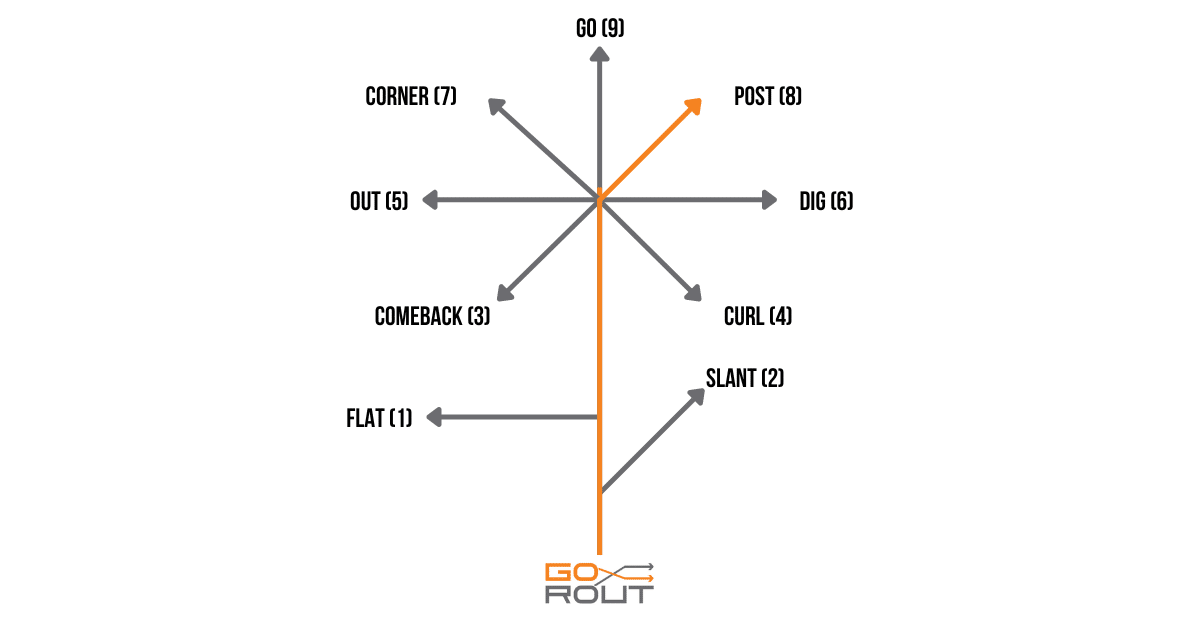
If you look at the standard numbering system used by everyone from Pop Warner to the NFL, odd numbers go toward the sideline and even numbers go toward the middle of the field. It’s a logic puzzle. Once a kid realizes that a "1" and a "3" are cousins, the game slows down for them. But here’s the thing: most youth coaches try to install all nine routes in the first week. That is a recipe for disaster. You’re better off mastering three things than being mediocre at nine.
The Reality of the Youth Football Route Tree
The numbering system is the backbone. It’s how quarterbacks and receivers communicate without talking. If the QB shouts "Tiger 3," the receiver knows exactly where to go. For broader information on this development, in-depth coverage can be read at Bleacher Report.
Let's break down the basic odd-numbered outside routes first. The 1-Route (Flat) is a quick three-step burst toward the sideline. It’s safe. It’s easy. For a 10-year-old quarterback who can’t throw a deep post, the flat route is a lifesaver. Then you have the 3-Route (Out). This is usually a 5-to-8 yard stem followed by a hard 90-degree cut to the boundary. It requires timing. If the kid rounds the break like a school bus taking a turn, the cornerback is going to take it for a pick-six.
Then comes the 5-Route (Comeback). Honestly? Most youth players shouldn't even try this until they are at least 12 or 13. It requires the receiver to sell the deep ball and then violently stop and come back toward the ball. It’s hard on the knees and harder on the QB’s arm.
Inside Breaks and the "Even" Logic
Now, look at the even numbers. The 2-Route (Slant) is arguably the most important play in youth sports. You take three steps, plant the outside foot, and angle toward the quarterback. It’s fast. It beats man coverage almost every time because kids at that age struggle to backpedal.
The 4-Route (Curl or Hitch) is the "stop" route. Run five yards, turn around, and show the numbers on your jersey to the QB. Simple, right? You'd be surprised how many kids forget to actually look for the ball. The 6-Route (In/Dig) is just a 3-route mirrored toward the middle. It’s great for clearing out space, but it’s dangerous because it leads the receiver right into the teeth of the linebackers.
And then there are the deep shots.
- The 7-Route (Corner): High-arc, corner of the endzone stuff.
- The 8-Route (Post): Aiming for the goalposts.
- The 9-Route (Go/Fly): Just run fast and don’t stop.
Kids love the 9-route. Coaches? Not so much, unless you have a kid with a cannon for an arm.
Why The "Pro" Way Usually Fails
I've seen coaches pull out Mike Martz’s old playbook and try to teach "Option Routes" to kids who still lose their mouthguards every five minutes. Don't do that. The youth football route tree needs to be compressed.
Expert coaches like Dave Cisar, who has written extensively on the "Winning Youth Football" system, often advocate for a limited menu. Why? Because repetition creates muscle memory. If a kid runs a Slant 500 times in practice, he can do it in his sleep. If he tries to learn a Post-Corner-Hitch-Nod-Whatever, he’s going to be thinking instead of playing. Thinking makes players slow.
In youth ball, the "tree" is often more of a "shrub."
You also have to consider the "Stem." That's the initial vertical part of the route. In the pros, receivers use hand-fighting and head-fakes. In youth ball, if the receiver can just run in a straight line for five yards without tripping over their own feet, you’re winning. Most youth defenders "peek" at the backfield. A good route tree takes advantage of that eye discipline—or lack thereof.
Teaching the Breaks: It’s All in the Hips
You can’t just tell a kid to "turn left." You have to teach the mechanics of the break. There are two main types of breaks you'll use in a standard route tree.
First, there’s the Square Break. This is for your 3s, 4s, and 6s. You want the player to "sink their hips." Imagine there’s a chair behind them and they’re trying to sit down mid-run. This lowers their center of gravity and allows them to change direction without sliding.
Second is the Speed Break. This is for Slants and Posts. You don't stop; you just plant and drive. We call it "shaving the corner." If a receiver rounds a slant, the linebacker is going to have a field day. It has to be sharp.
A common mistake? The "Drift." Receivers have a tendency to drift downfield after they make their cut. If it’s a 10-yard out, they end up at 12 yards by the time the ball gets there. This ruins the timing for the quarterback. Teach your players to "flat-line" their routes. If the break is at 5 yards, stay on the 5-yard line.
The Quarterback-Receiver Connection
The route tree isn't just for the guys catching the ball. The QB has to know the "drop" that matches the route.
- 1-step drop: Slants, Flats, Hitches.
- 3-step drop: Outs, Ins, Curls.
- 5-step drop: Posts, Corners, Goes.
In youth football, a 5-step drop is basically an invitation for the defensive end to record a sack. Most youth offensive lines can't hold a block for more than 2.5 seconds. Therefore, your youth football route tree usage should be heavily weighted toward the 1 and 3-step routes.
If you look at the research from organizations like USA Football, they emphasize "developmentally appropriate" play-calling. This means recognizing that a 9-year-old's hand size affects their ability to throw a deep "7" route with any velocity. If the ball flutters, it's a turnover. Stick to the high-percentage throws.
Drills That Actually Work
Forget the long lines. Lines are the death of productivity. Use "Station Work."
The Box Drill Set up four cones in a 5x5 yard square. Have the player sprint to the first cone, break to the second, backpedal to the third, and shuffle to the fourth. It teaches body control. You can’t run a good route if you can't control your feet.
The Mirror Drill Put a receiver and a defender face-to-face. The receiver tries to lose the defender using only the first three yards of the route tree stems. No touching. Just feet. It builds that explosive first step needed for the "2" and "9" routes.
The Gauntlet Line up two rows of players with bags. The receiver runs a "6" route (the In) across the middle while the players with bags give them a little bump. It’s not about getting leveled; it’s about maintaining the route line through contact.
Strategic Implementation
How do you actually call these in a game? Most youth teams use a "wristband" system. Each play has a name, and that name corresponds to a specific combination of routes from the tree.
Example Play: "Ace Left 246"
- The "2" is the inside receiver on a slant.
- The "4" is the middle receiver on a curl.
- The "6" is the outside receiver on an in-route.
This creates a "layered" effect. You have receivers at different depths. If the linebacker drops deep to cover the 6, the 2 is open underneath. If the linebacker stays shallow for the 2, the 6 is open behind him. This is "High-Low" stretching, and it’s the most effective way to move the chains in youth football.
Don't forget the "check down." This is usually a running back swinging out into the "1" (flat) area. In youth ball, the flat is almost always open. Why? Because every 11-year-old cornerback wants to be the hero who catches a deep interception, so they all run backward as soon as the ball is snapped.
Actionable Steps for This Week’s Practice
Stop drawing. Start doing. If you want a functional passing game, follow this progression:
- Monday: Master the stance and the first three steps. If they can’t start fast, the route is dead before the break. Focus on the "1," "2," and "9."
- Tuesday: Introduce the "break." Spend the entire session on sinking hips and planting the outside foot. Work on the "3" and "4."
- Wednesday: Timing. Get the QBs and WRs together. No defenders. Just throwing to a spot. The QB shouldn't throw to the player; they should throw to where the route will be.
- Thursday: Add "trash." Put defenders in the way, but tell them to only play at 50% speed. This lets the receivers feel the space without getting discouraged.
The goal isn't to have the prettiest playbook in the league. It's to have the team that knows their three favorite routes better than the opponent knows their defense. Keep the tree simple. Focus on the footwork. Let the kids play fast. That’s how you win on Saturdays.