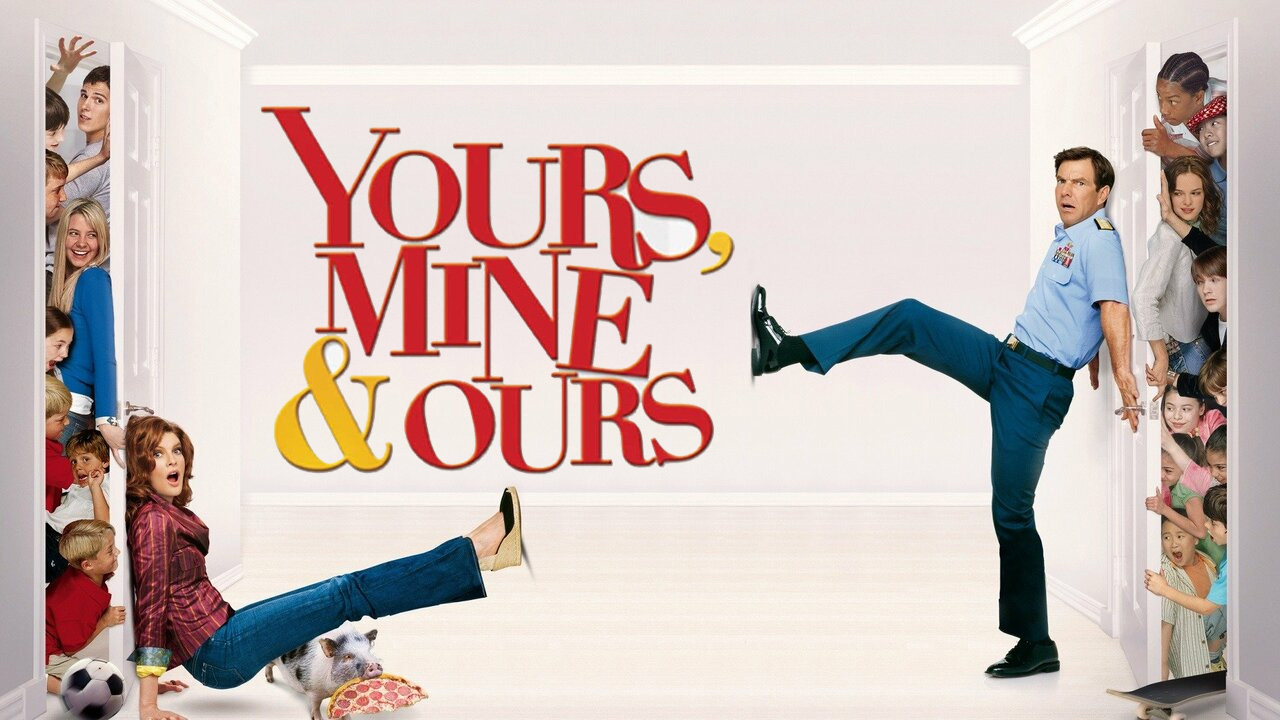
Blended families aren't exactly a new concept in Hollywood, but they usually feel a bit sanitized. You know the drill. A few arguments over bathroom space, a dramatic "you're not my real dad" moment, and then everyone hugs while the credits roll.
But Yours, Mine and Ours, the 1968 classic starring Lucille Ball and Henry Fonda, hit different. It wasn’t just a movie; it was a chaotic, slightly overwhelmed look at what happens when you smash two massive families together and hope they don't destroy the house. Honestly, it's one of those rare films that manages to be both a slapstick comedy and a semi-accurate portrayal of logistics-driven parenting.
If you grew up watching the 2005 remake with Dennis Quaid and Rene Russo, you might think you know the story. Two parents, a boatload of kids, and a whole lot of mess. But the original film—and the real-life story of the Beardsley family that inspired it—has a weight to it that the remake completely missed. We're talking about 18 children. Eighteen. Just let that sink in for a second.
The True Story Behind the Beardsley Family
Most people don't realize that Yours, Mine and Ours is based on a real book called Who Gets the Drumstick? written by Helen Beardsley.
Helen was a widow with eight children. Frank Beardsley was a widower with ten. When they married in 1961, they didn't just move into a house; they founded a small village. The movie simplifies things a bit for the sake of the runtime, but the reality was a logistical nightmare that would make a modern project manager weep.
Frank was a Navy officer. In the film, Henry Fonda plays him with this rigid, disciplined exterior that slowly cracks under the weight of teenage rebellion and spilled milk. It's great. Lucille Ball, meanwhile, was already a TV legend by 1968, but this role allowed her to play a more grounded, vulnerable version of the "Lucy" persona we all loved. She wasn't just getting into scrapes; she was a mother trying to find her place in a house where she was outnumbered by kids who weren't hers.
The screenplay, penned by Melville Shavelson and Mort Lachman, treats the marriage as a merger. It’s basically a corporate takeover but with more laundry.
Why the 1968 Version Still Works
There's a specific kind of chemistry between Ball and Fonda that you just don't see anymore. They represent two different eras of Hollywood. Fonda is the stoic, Golden Age leading man. Ball is the queen of physical comedy.
When they share the screen, the tension isn't just about the kids. It’s about two people who have already lived full lives, suffered immense loss, and are trying to figure out if there's room for a "second act."
One of the best scenes involves the first big family dinner. It's not a choreographed dance of jokes. It’s loud. People are talking over each other. It feels claustrophobic. That’s the magic of Yours, Mine and Ours. It captures the sensory overload of a large family without making it feel like a sitcom set.
The Logistics of 18 Children
You have to wonder how they actually did it. In the film, they use a color-coded system for everything. Socks, toothbrushes, chores.
Real life was even more intense. The Beardsleys lived in a house in Carmel, California, that they had to renovate extensively. They had two industrial-sized washing machines and dryers. They bought milk by the crate.
There's a nuance here that the 2005 remake ignored. The remake turned the kids into a unified front of "pranksters" who wanted to break their parents up. It felt fake. In the 1968 version, the conflict is more internal. The kids are grieving. They're territorial. They’re skeptical of this new adult in their space. It’s much more human.
Comparing the 1968 Original and the 2005 Remake
It’s tempting to say the remake is "bad," but that’s not quite fair. It’s just a different beast. It was made for an era of high-energy family comedies like Cheaper by the Dozen.
However, looking back, the 2005 Yours, Mine and Ours feels like it was designed by a committee. The 1968 version feels like it was designed by people who actually liked the characters.
- Tone: The original is a romantic comedy with dramatic undertones. The remake is a slapstick comedy for children.
- The Parents: Henry Fonda's Frank is a man trying to maintain order in a world he can no longer control. Dennis Quaid's Frank is... well, he's basically a cartoon character.
- The Stakes: In 1968, the stakes were emotional integration. In 2005, the stakes were mostly about whether someone was going to fall into a bucket of paint.
Honestly, the remake lacks the "mine" and "thine" philosophy that made the original so interesting. The 1968 film spends a lot of time on the legal and social hurdles of the time, including the Catholic Church's influence on their marriage and the adoption process. It’s grounded in a reality that 2005 Hollywood didn't think audiences cared about.
The Impact of Lucille Ball’s Performance
This was one of Lucy’s last great film roles. By 1968, I Love Lucy was a decade in the past, and she was transitionining into a different phase of her career.
In Yours, Mine and Ours, she gets to be funny, sure. The scene where she gets drunk on spiked punch at a dinner party is classic Ball. But she also has a quiet scene where she talks about her late husband. It’s heartbreaking. It reminds you that this whole "big happy family" started from two separate tragedies.
She wasn't just a comedian; she was an actress who understood the exhaustion of motherhood.
Technical Achievements and Production
Directing 18 children is a nightmare. Melville Shavelson allegedly had a tough time keeping the set organized, which is ironic considering the movie is about a man who can't keep his house organized.
The film used a lot of wide shots to emphasize the sheer volume of bodies in a room. When the family walks into a restaurant or a church, they look like an invading army. The cinematography by Charles Wheeler doesn't try to be fancy. It just tries to fit everyone in the frame.
The score, composed by Fred Karlin, has that jaunty 60s vibe that keeps things moving, but it never overshadows the dialogue.
Critical Reception and Legacy
When it was released, Yours, Mine and Ours was a massive hit. It grossed over $25 million in 1968, which was huge. People loved it because it felt relatable, even if they didn't have 18 kids. It tapped into the post-war domesticity that was starting to shift as the 70s approached.
Critics were a bit more mixed. Some felt it was too sugary. Roger Ebert gave it a middling review, noting that while Ball and Fonda were great, the plot was predictable.
But predictability isn't always a bad thing in a family film. Sometimes you just want to see people figure it out. You want to see the "ours" part of the title actually happen.
Common Misconceptions About the Movie
People often confuse this movie with With Six You Get Eggroll, which also came out in 1968 and starred Doris Day. That movie also deals with a blended family, but it’s much smaller in scale.
Another misconception is that the movie is a strictly faithful biography. It isn't. The real Beardsley children have said over the years that while the "spirit" of the movie was right, the Hollywood version made their life look a lot more organized than it actually was.
There was also a lot of controversy later on regarding the real family's dynamics, with some of the children coming forward decades later to talk about the difficulties of growing up in such a high-pressure, public environment. The movie stops before any of that reality sets in.
Lessons We Can Learn from Yours, Mine and Ours
So, why does this movie still matter? Aside from the nostalgia factor, it offers some pretty solid insights into human relationships.
- Logistics aren't love, but they help. You can't run a household of 20 people on "vibes" alone. You need a system.
- Grace is mandatory. Everyone in a blended family is going to mess up. The kids will be mean, the parents will be tired. Giving each other room to fail is the only way it works.
- The "Ours" is the hardest part. It’s easy to stay in your own camp. It’s hard to create a new, shared identity that doesn't erase where you came from.
If you’re going to watch Yours, Mine and Ours, skip the remake. Go back to the 1968 original. Watch it for Fonda’s deadpan delivery and Ball’s expressive face. Watch it to see a version of family life that, while stylized, feels much more honest than the glossy versions we get today.
Actionable Insights for Fans and Historians
If you want to dive deeper into the world of the Beardsleys and the film, start by reading Helen Beardsley's original book. It’s out of print but easy to find at used bookstores. It provides a much more granular look at the day-to-day survival of a 20-person household.
Next, compare the 1968 film to other "blended family" media of the era, like The Brady Bunch. You’ll notice that Yours, Mine and Ours is much more interested in the parents' relationship than the kids' shenanigans.
Finally, pay attention to the production design. The way the house is laid out in the film is a masterclass in 1960s functionalism. It’s a fascinating time capsule of how we thought about space, privacy, and community fifty years ago.
Don't just watch it as a comedy; watch it as a study of how we try to build something new out of the pieces of what we lost. That’s the real heart of the story.



