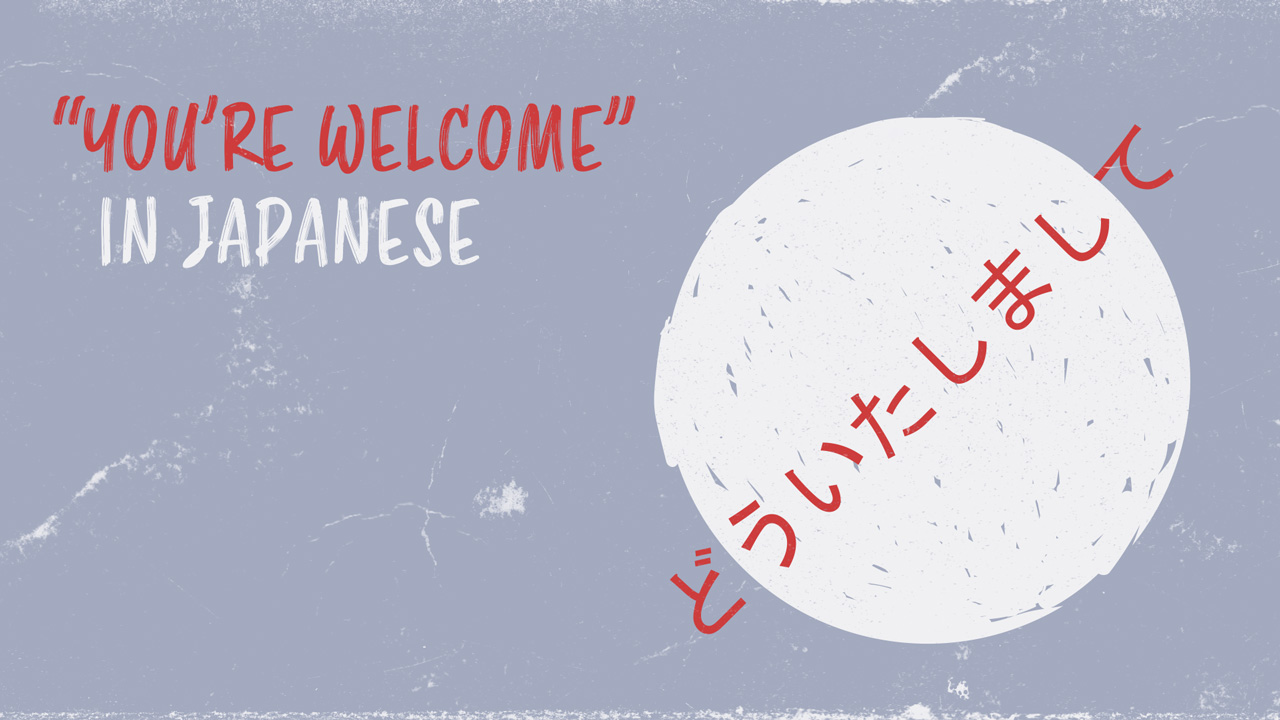
You've probably seen it in every textbook from Genki to Minna no Nihongo. You help a Japanese person, they say Arigatou, and you instinctively fire back with douitashimashite. It’s the "you’re welcome" we all learned in week one. But here is the thing: if you walk around Tokyo saying that every time someone thanks you, people will look at you like you’re reading from a dusty 1950s script. It’s stiff. It’s a bit formal. Honestly, it’s kinda rare in real life.
Language isn't a static set of rules; it's a living, breathing vibe. In modern Japan, saying "you're welcome" is less about a direct translation and more about managing social distance. You're constantly calculating. Am I talking to my boss? A stranger at a 7-Eleven? My best friend who just borrowed five bucks? The way you say you're welcome in Japanese changes entirely based on those split-second social reads.
The Douitashimashite Trap
Most students think douitashimashite is the safe bet. It isn't. While it technically means "don't mention it," it carries a certain weight that can feel slightly condescending if used incorrectly. It almost acknowledges that you did a big favor that deserved thanks. Because of this, many native speakers avoid it in casual settings altogether.
If you're at a bar in Shinjuku and a local thanks you for passing the soy sauce, hitting them with a full-blown douitashimashite feels weirdly heavy. It’s like wearing a tuxedo to a backyard BBQ. You’ll be understood, sure, but the flow of the conversation might hit a speed bump.
Japanese culture leans heavily into humility. The goal isn't usually to say "you are welcome," but rather to say "it was nothing" or "no, no, thank you." This shift in perspective is the biggest hurdle for English speakers who are used to the transactional nature of "thank you" and "you're welcome."
How People Actually Talk: The "Iie" Revolution
If you listen to real conversations on the Yamanote line or in a Kyoto cafe, you’ll hear one word more than any other: Iie.
Literally, it means "no."
In the context of being thanked, it functions as "No, no, don't worry about it." It’s short. It’s punchy. It’s the ultimate social lubricant. Usually, it’s doubled up—Iie, iie—while accompanied by a slight wave of the hand in front of the face. This gesture, the "hand-fan" move, is the universal Japanese sign for "not at all" or "it was nothing."
If you want to sound like you actually live there, start using iie, iie.
For something slightly more "polite-casual," you can go with tondemo nai desu. This is a fascinating phrase. It roughly translates to "it’s unthinkable" or "nothing of the sort." It’s a way of saying that the favor you did was so small that it shouldn't even be considered a favor. It’s a favorite among coworkers and people who want to show respect without the stiffness of textbook phrases.
The Workhorse Phrases
When you’re in a professional environment, the stakes change. You can't just "iie" your way out of a thank you from a client. Here, the language becomes a bit more structural.
Kochira koso is your best friend. It means "it is I who should be thanking you." It’s brilliant because it flips the gratitude back onto the other person. If a client says "Thank you for the meeting," and you say kochira koso, you’ve instantly leveled the playing field and shown immense respect. It’s elegant.
Then there’s the casual tier. If you’re with friends, you’ve got options that feel way more natural:
- Ki ni shinai de (Don't worry about it)
- Daijoubu yo (It’s okay!)
- Enryo shinaide (Don't hesitate/Don't feel bad)
Think about the nuance. If you buy a coffee for a friend and they thank you, douitashimashite sounds like you’re waiting for them to pay you back. Ki ni shinai de sounds like you’re a pal. That’s a massive difference in "vibe" for such a small change in vocabulary.
Why Social Hierarchy Still Rules
We can't talk about you're welcome in Japanese without mentioning Keigo (honorific speech). Japanese isn't just one language; it’s a ladder.
When a superior thanks you, the response needs to acknowledge their higher status. You might use O-yaku ni tatete kouei desu, which means "I am honored to have been of use." This is high-level stuff. You won't use this at the grocery store. But if you're an intern at a firm in Osaka and the CEO thanks you for a report? This phrase is gold.
On the flip side, if you're the one in the "power" position, you might use ki ni shinai de. It’s almost paternal. It signals that you are comfortable and that the other person doesn't need to stress.
The mistake most learners make is trying to find one "correct" word. There isn't one. There is only the word that fits the person standing in front of you.
The Silent Response
Sometimes, you don't say anything at all.
In many Western cultures, silence is awkward. If someone says "thank you" and you just nod, it looks like you're being a jerk. In Japan, a deep, respectful bow can often replace words entirely. If you’re in a situation where words feel too loud—like in a quiet temple or during a formal ceremony—a slow nod or a bow is a perfectly acceptable way to say "you're welcome."
It’s about kuuki wo yomu—reading the air. If the air is quiet, keep your response quiet.
Regional Flavors: Beyond Tokyo
If you head down to Osaka, the vibe shifts. People are generally considered "shorter" and more direct with their speech. While they still use standard Japanese, the intonation changes. You might hear ee yo (it’s fine/good) more often than the standard ii desu yo.
It’s a bit like the difference between a New Yorker saying "no problem" and a Southerner saying "it’s all good, sugar." The meaning is the same, but the soul of the phrase is different. Exploring these regional tweaks is how you move from "student" to "speaker."
Breaking Down the Common Misconceptions
There is a weird myth that Japanese people don't use "you're welcome" because they are too shy. That's nonsense. They use it constantly; they just don't use the word you think they use.
Another misconception is that arigatou always requires a verbal response. Often, it’s just the start of a "gratitude loop." You say thank you, they say no-thank-you-to-you, you say no-really-it-was-nothing, and everyone bows three times. It’s a dance. If you just say douitashimashite and stop, you’ve ended the dance prematurely.
Actionable Steps for Your Next Conversation
Stop overthinking it. Seriously. If you’re paralyzed trying to remember the "perfect" honorific, the moment passes and it gets weird.
- Start with the double-no. Next time a cashier or a casual acquaintance thanks you, just say iie, iie with a small smile. It’s 100% foolproof and sounds incredibly natural.
- Use "it's okay" for friends. Switch to daijoubu or ki ni shinai de. It softens the interaction and makes you seem more approachable.
- Save the textbook for the classroom. Unless you are literally taking a JLPT exam, try to phase out douitashimashite. It’s a linguistic relic that is slowly being pushed to the sidelines by more dynamic, humble alternatives.
- Watch the hands. Remember the hand-wave. It’s half the communication. If your mouth says "no" but your body is stiff, the message gets lost.
- Listen and Mimic. This is the most important one. Every social group has its own shorthand. If your Japanese coworkers all say mondai nai desu (no problem), start using that.
The goal of learning you're welcome in Japanese isn't to be a walking dictionary. It's to connect. By moving away from the "standard" response and embracing the messy, humble, and varied ways Japanese people actually talk, you aren't just speaking a language—you're actually communicating.
Next time someone bows and offers a sincere arigatou gozaimasu, don't reach for the textbook. Reach for the "air" of the room. A simple iie, kochira koso will do more for your relationships than a thousand perfectly pronounced douitashimashites ever could.
The beauty of Japanese is in the "not saying." It’s in the humility of denying your own effort to make the other person feel at ease. Master that, and you've mastered the heart of the language.