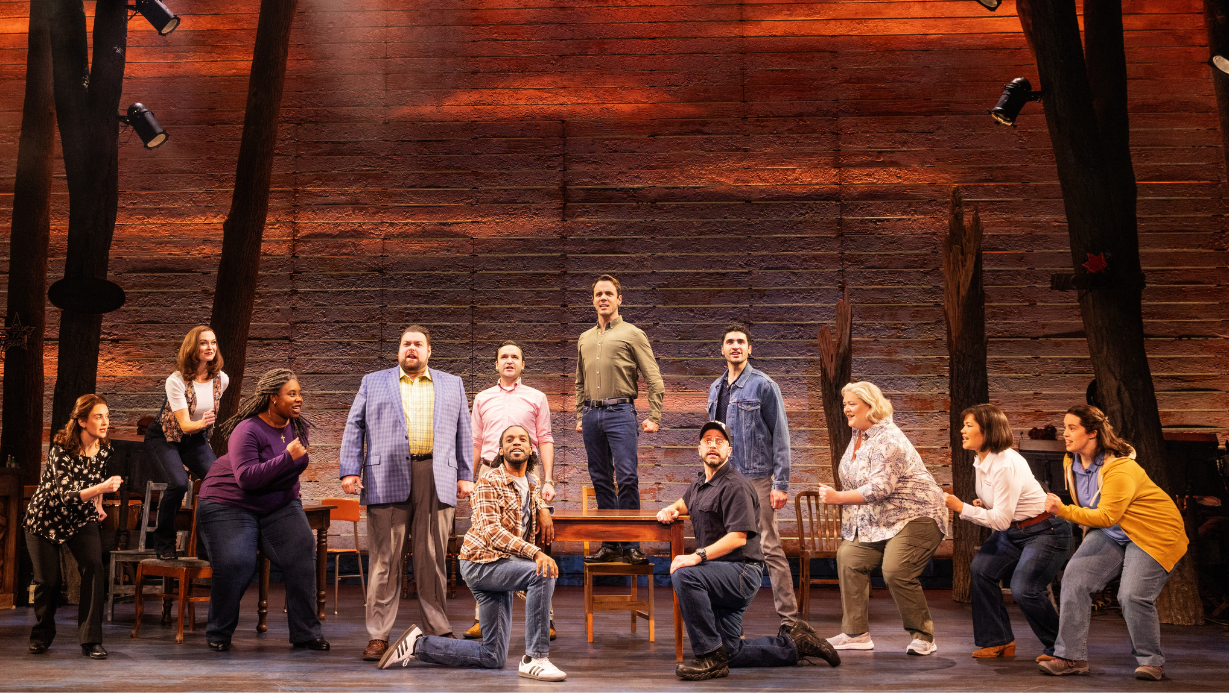
You know the story. Or you think you do. Most people hear "9/11 musical" and they immediately think of the high-energy, foot-stomping rhythms of the Broadway smash hit. It’s a masterpiece, sure. But there’s a massive difference between a Broadway actor mimicking a Newfinese accent and the raw, jagged reality of the actual humans who lived through the "plane people" crisis in Gander. That’s where the Come From Away documentary—officially titled You Are Here: A Come From Away Story—changes the entire perspective. It’s not just a "making of" featurette. Honestly, it’s a gut-punch of reality that makes the stage show feel like a sanitized postcard.
I’ve watched both. Many times. The musical gives you the emotional highs, but the documentary gives you the dirt, the exhaustion, and the weird, quiet moments that a stage can’t capture.
The Gander Reality vs. The Broadway Magic
Gander, Newfoundland, is a tiny place with a massive runway. On September 11, 2001, 38 planes were forced to land there when US airspace closed. Suddenly, a town of about 10,000 people had 7,000 scared, confused strangers dropped into their laps.
The Come From Away documentary does something the musical can’t: it shows you the faces. You see the real Captain Beverley Bass. You see the real Kevin Tuerff and the real Hannah O'Rourke. When you see the actual Hannah talking about waiting for news of her son, a firefighter in New York, the Broadway songs suddenly feel a lot heavier. It’s one thing to hear a professional singer belt out a power ballad. It’s another thing entirely to see a mother’s eyes go distant as she remembers the silence of a phone that wouldn't ring.
People forget how terrifying it was. The musical focuses on the "islanders" being nice. The documentary focuses on the islanders being human. They were exhausted. They were stripping the sheets off their own beds. They were cooking massive vats of stew in hockey rinks. The film, directed by Moze Mossanen, captures that frantic, adrenaline-fueled kindness that wasn't about being a "hero," but just about not knowing what else to do.
Why the "You Are Here" film hits differently
Most fans of the show don't realize that the Come From Away documentary actually won several Canadian Screen Awards. It wasn't some cheap promotional tie-in. It’s a legitimate piece of journalism. It weaves together the 2017 Broadway opening with the 10th-anniversary reunion in Gander back in 2011.
You see the "plane people" returning to this remote rock in the Atlantic. They aren't celebrities. They’re older now. They’re hugging the locals like they’re long-lost siblings. It’s weird. It’s beautiful. It’s also incredibly grounded.
There's a specific moment in the film involving the Mayor of Gander, Claude Elliott. In the musical, he’s a bit of a jovial archetype. In the documentary, you see the weight of the logistics he was dealing with. Imagine trying to find heart medication for a passenger from a country whose language you don't speak, while the world is literally falling apart on the news. The documentary digs into those logistics. It’s fascinating.
Beyond the Apple TV+ Pro-Shot
We have to talk about the confusion. If you search for the Come From Away documentary, you might stumble upon the 2021 filmed version of the stage play on Apple TV+. That’s a "pro-shot." It’s great. It’s the play. But it isn't the documentary.
The real documentary, You Are Here, is what you need if you want the truth.
- It features interviews with the real people.
- It uses actual archival footage from Gander in 2001.
- It explains the "Screech-in" ceremony without the choreographed dance numbers.
- It shows the local schools turned into massive dormitories.
Think about the sheer volume of toilet paper needed for 7,000 extra people. The musical doesn't talk about the plumbing. The documentary does.
The Nick and Diane Factor: Real Love in a Crisis
Everyone loves the story of Nick and Diane Marson. They met as strangers on a diverted flight and eventually got married. In the musical, their courtship is cute and fast-paced.
In the documentary, you see them. The real them. They are soft-spoken, a bit shy, and remarkably normal. Seeing them stand on the actual cliffs where they fell in love—without the spotlights and the pit orchestra—is arguably more romantic. It validates the "inspired by a true story" tag. Sometimes, Hollywood (or Broadway) exaggerates. Here, the documentary proves they didn't have to. The reality was already cinematic enough.
The dark side of the story
The Come From Away documentary doesn't shy away from the tension. There was fear. People didn't know if there were more terrorists on the planes sitting on the tarmac. There was a legitimate concern about who was being let into the community. While the overriding theme is one of radical hospitality, the film allows for the complexity of that moment in history. It wasn't all just singing and drinking Labatt Blue. It was a high-stakes security nightmare handled by people who usually spent their days worrying about moose on the highway.
How to actually watch the Come From Away Documentary
Finding it can be a bit of a hunt depending on your region. It’s often available on:
- HBO/Max: It had a significant run there.
- Crave: If you're in Canada, this is your best bet.
- Digital Rental: Amazon and Apple often have You Are Here for a few bucks.
Don't settle for just the musical. If you love the songs, you owe it to the real people of Gander to see their actual faces.
What we can learn from Gander today
Honestly, the world feels pretty divided. It's a cliché, but it's true. The Come From Away documentary acts as a bit of a reality check. It shows that when the systems of the world fail—when the planes stop flying and the towers fall—the only thing left is the person standing next to you.
The Gander residents didn't ask for political affiliations before they handed out blankets. They didn't check backgrounds before they invited people into their kitchens for tea.
The documentary highlights the "Gander 15," a group of flight diversions that ended up in a town that refused to let them be victims of circumstance. It’s a masterclass in community resilience.
Practical Steps for the True Fan
If you've already seen the show and you're planning to dive into the documentary, do these things first:
- Watch the documentary before re-watching the pro-shot. It adds a layer of "Easter egg" hunting because you'll recognize the real-life inspirations for specific lines of dialogue.
- Look up the Gander Heritage Memorial Park. The documentary mentions it, and seeing the photos of the actual piece of World Trade Center steel gifted to the town is moving.
- Research the "Pay It Forward" movement. Kevin Tuerff, one of the real passengers, started an initiative where he gives his employees the day off on September 11 and $100 to do something kind for a stranger. The documentary explores this legacy.
- Check out the book "The Day the World Came to Town" by Jim DeFede. If the documentary whets your appetite for the nitty-gritty details of the five days in Gander, this is the definitive text.
The Come From Away documentary isn't just a companion piece. It’s the foundation. It’s the proof that the kindness we see on stage wasn't a lyricist's dream, but a documented historical fact. Go find You Are Here. It’ll make "Me and the Sky" sound completely different the next time you hear it.
Actionable Insight: To get the full experience, host a "double feature" night. Watch the documentary You Are Here first to ground yourself in the historical facts and real human faces, then follow it with the Apple TV+ pro-shot of the musical. Seeing the real Beverley Bass describe her experience immediately before watching Jenn Colella perform "Me and the Sky" creates a powerful emotional resonance that watching the musical alone simply cannot replicate.



