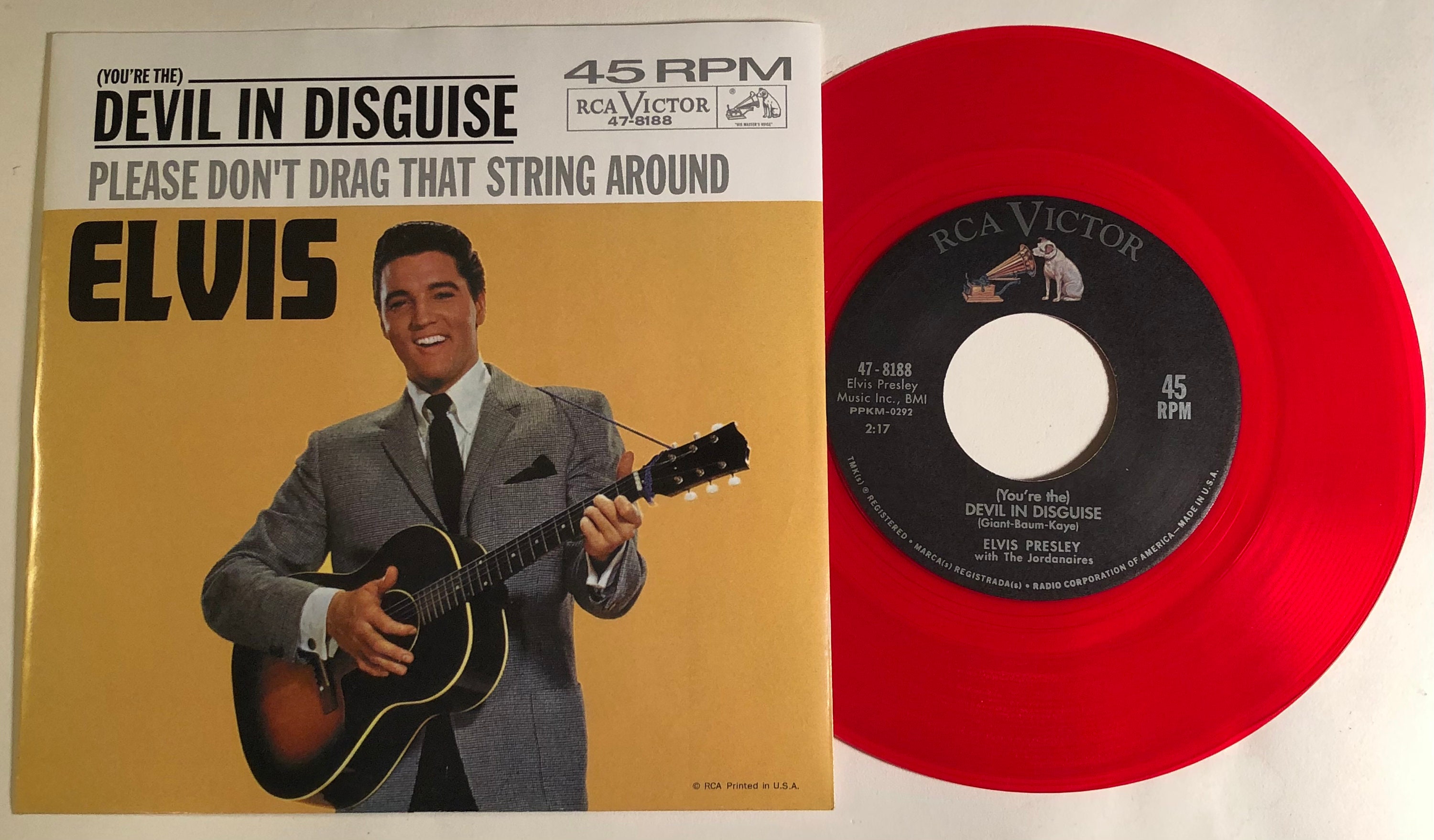
It starts with that deceptively sweet, shuffling beat. You know the one. Elvis Presley sounds almost angelic, crooning about an angel with a "smile like a cherub." Then, the snare kicks in, the tempo shifts, and the King’s voice drops into that growling, rhythmic accusation: (You're the) Devil in Disguise. It’s one of the most effective "gotcha" moments in pop history. Honestly, it’s kind of wild that a song recorded in a single night in Nashville became such a permanent fixture of global culture.
Elvis wasn't exactly in a "rock and roll" headspace in June 1963. He was deep into his movie era, churning out soundtracks that—let's be real—varied wildly in quality. But when he stepped into RCA Studio B, something clicked. He moved away from the fluff of It Happened at the World's Fair and gave us a track that perfectly captured the tension between appearance and reality. People still play this at weddings, which is hilarious if you actually listen to the lyrics.
The Nashville Sound and the June 1963 Sessions
Recording (You're the) Devil in Disguise wasn't some months-long experimental project. It was business. Elvis arrived at RCA's Studio B in Nashville on June 18, 1963. He was backed by the "A-Team," the legendary group of session musicians who defined the Nashville Sound. We’re talking about guys like guitarists Scotty Moore and Grady Martin, bassist Bob Moore, and the incredible D.J. Fontana on drums.
The Jordanaires provided those smooth, barbershop-adjacent harmonies that make the "angel" parts sound so innocent.
It took only a few takes to get it right. Elvis was a perfectionist regarding "feel" rather than technical precision. If the vibe was off, the song was dead. On Take 6, they found the magic. The contrast between the slow, melodic verses and the double-time bridge was a stroke of genius by songwriters Bill Giant, Bernie Baum, and Florence Kaye. It wasn't just a song; it was a performance of betrayal.
Why the Song Hit Different in 1963
By the early sixties, the music industry was changing. The raw, dangerous Elvis of 1956 had been somewhat tamed by the Army and Hollywood. Critics were starting to write him off as a ballad singer who’d lost his edge. (You're the) Devil in Disguise proved them wrong, but in a sophisticated way. It didn't rely on distorted guitars; it relied on Elvis’s ability to act through a microphone.
When the single dropped, it rocketed to number three on the Billboard Hot 100. Over in the UK, it was an absolute monster, holding the number-one spot for a month.
Interestingly, the song didn't make it onto a standard studio album right away. It was released as a standalone single with "Please Don't Drag That Messy String Around" on the B-side. Eventually, it found a home on the Elvis' Gold Records Volume 4 compilation. This era of Elvis is often overlooked by purists who only love the 1950s Sun Records stuff, but this track shows a vocalist at the absolute height of his powers. He knew exactly how to manipulate his tone to tell a story.
The Anatomy of a Hook
The song is built on a lie. That's the hook.
- The "Angel" Intro: The rhythm is light. Elvis uses his head voice. It’s pure 1950s doo-wop nostalgia.
- The "Devil" Transition: D.J. Fontana hits the snare like a physical punch. The bassline starts walking aggressively.
- The Reveal: Elvis moves to his chest voice, adding that famous sneer.
It’s a simple structure, but it’s incredibly difficult to execute without sounding cheesy. If a lesser singer tried this, it would feel like a novelty song. With Elvis, you actually believe he’s been burned by a femme fatale.
The Lyrics: More Than Just a Catchy Rhyme
Look at the words. "You cheated and you lied, and then you lied to me." It’s not poetic in a Bob Dylan sense, but it’s visceral. The "devil in disguise" metaphor is one of the oldest tropes in the book, yet it works because of the rhythmic delivery.
There’s a persistent rumor—mostly debunked but fun to talk about—that the song was a veiled commentary on the music industry or people in Elvis’s inner circle. While his "Memphis Mafia" was certainly a complex group of people, there's no real evidence the song was personal. Elvis was a song stylist. He took what Giant, Baum, and Kaye gave him and inhabited the character.
Cultural Impact and That Famous Lilo & Stitch Moment
You can’t talk about (You're the) Devil in Disguise today without mentioning a blue alien. In 2002, Disney’s Lilo & Stitch introduced a whole new generation to the King. The movie used several Elvis tracks, but "Devil in Disguise" was the standout. It played during a scene where Lilo tries to turn Stitch into a "model citizen."
It was a brilliant bit of needle-dropping. The song’s theme of something looking cute but being chaotic perfectly mirrored Stitch’s character. This led to a massive resurgence in Elvis’s streaming numbers. It’s one of those rare cases where a 40-year-old song became a "new" hit for kids who didn't even know who Elvis was.
Cover Versions and the Song's Versatility
Everyone has tried to cover this. Trisha Yearwood did a version. The Residents—the weird avant-garde collective—did a creepy, deconstructed version. It’s been tackled by punk bands, country stars, and lounge singers. Why? Because the skeleton of the song is indestructible. You can strip away the 1963 production and the core "slow-fast-slow" gimmick still works in almost any genre.
Technical Mastery in Studio B
If you’re a gearhead or a music production nerd, (You're the) Devil in Disguise is a masterclass in 1960s engineering. Bill Porter was the engineer at Studio B, and he was a wizard with microphone placement. He figured out how to record Elvis’s voice so it felt intimate but could still compete with a full band.
They didn't have 64 tracks and digital editing back then. If the drummer messed up, everyone started over. If Elvis went off-key, they took it from the top. The energy you hear on the record is the energy of a room full of people playing live. That’s why it feels so "human" compared to the quantized, pitch-corrected tracks we hear today. You can hear the slight imperfections, the breath, the physical movement in the room.
What Most People Get Wrong About 60s Elvis
There’s this narrative that Elvis was "lost" in the early 60s. People say he was just a puppet for Colonel Tom Parker, making bad movies and singing "Old MacDonald." While there’s some truth to the movie complaints, his studio output during this time—especially the Nashville sessions—was often stellar.
(You're the) Devil in Disguise is proof that even when the Hollywood machine was trying to flatten him, Elvis’s instinct for a hit was sharp. He wasn't just showing up for a paycheck; he was creating the template for the modern pop-rock "beat" song.
Actionable Insights for Music Lovers and Creators
If you’re a songwriter or just someone who loves dissecting pop culture, there are a few things to take away from the history of this track.
- The Power of Contrast: Don't be afraid of "The Switch." Moving from a slow, melodic section to a high-energy chorus is the oldest trick in the book because it releases dopamine.
- Trust the Pros: Elvis’s success in Nashville came from his chemistry with the A-Team. Finding people who understand your "vibe" is more important than finding the most technically skilled player.
- Simplicity Wins: The lyrics aren't complex. The metaphor is straightforward. But the delivery is everything.
To really appreciate the song, find a high-quality vinyl pressing or a lossless digital version. Listen to the way the bass interacts with the kick drum during the transition. It’s a perfect example of how a few musicians in a room can create something that lasts for sixty years without ever feeling dated.
If you want to dive deeper into this specific era, check out the The Nashville Marathon sessions. It gives a raw look at how Elvis worked in the studio during the mid-60s. You’ll hear the false starts, the jokes, and the moment where they finally nail the take. It’s a reminder that even the King had to work for it.
Exploring the Legend Further
- Listen to Take 6 of the song specifically (it’s on most "Essential" or "Legacy" editions). It's the one that became the master.
- Compare the original version to the 1968 Comeback Special performances. You can see how Elvis’s stage presence evolved to match the grit he was putting into his studio vocals.
- Look into the songwriting trio of Giant, Baum, and Kaye. They wrote dozens of songs for Elvis, and "Devil in Disguise" was arguably their crowning achievement.
The song remains a staple because it taps into a universal truth: sometimes, the people we think are "angels" are actually the ones causing all the trouble. Elvis just happened to say it with a better rhythm than anyone else.



