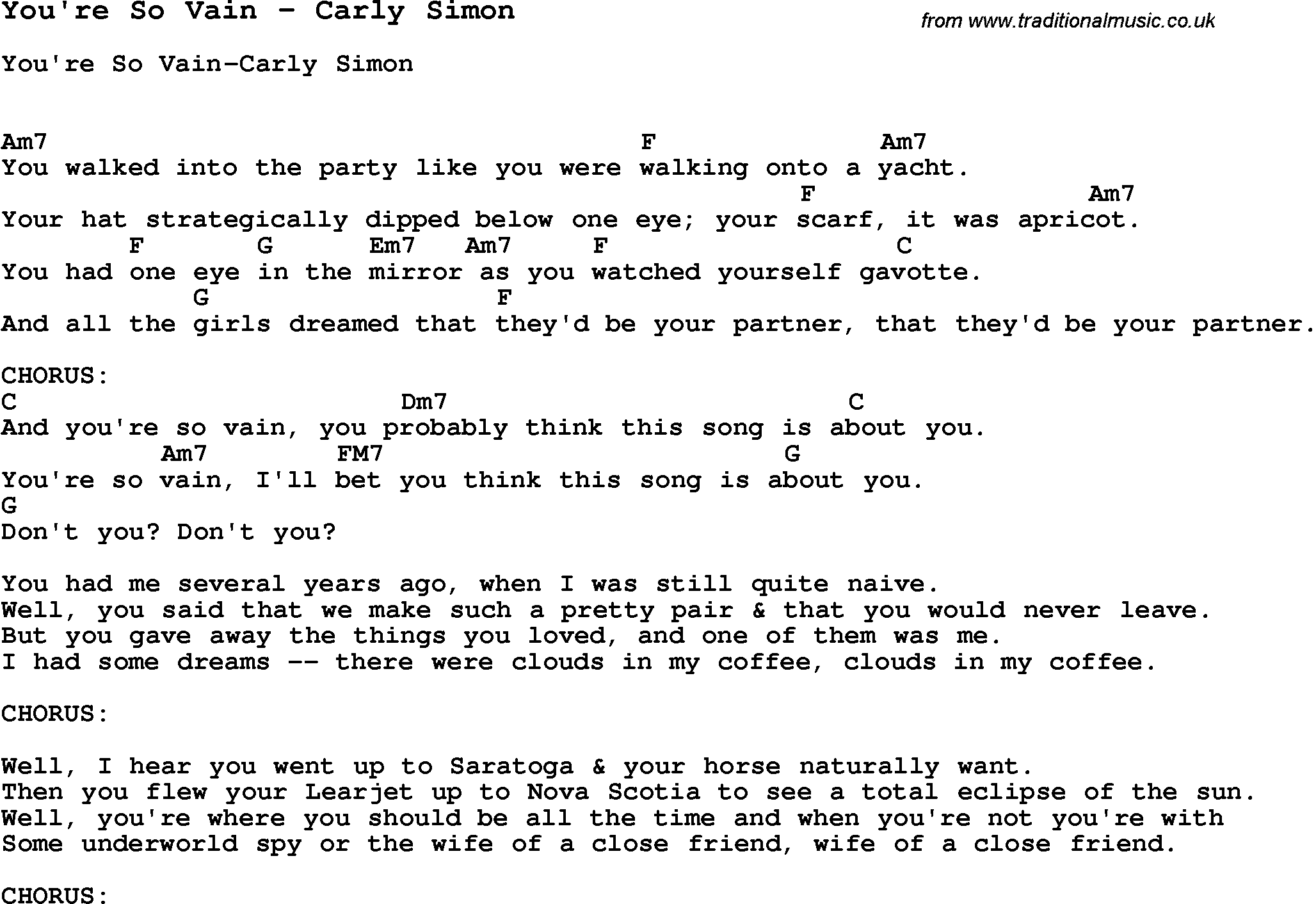
Carly Simon released a song in 1972 that effectively broke the celebrity gossip industry before the internet even existed. It’s been over fifty years. People are still obsessed. They want to know exactly who the words to You’re So Vain were written about, and honestly, the mystery is probably more famous than the melody itself at this point.
It’s a masterclass in songwriting. Simon managed to create a track that is simultaneously a biting takedown of a specific person and a universal anthem for anyone who has ever been exhausted by an egomaniac. If you’ve ever sat in a coffee shop or a bar and heard those opening bass notes, you know the feeling. You start wondering. Is it Warren Beatty? Mick Jagger? Maybe David Geffen?
The song isn't just a hit; it's a puzzle. Simon has spent decades dropping crumbs, selling secrets at auctions, and whispering names into the ears of the highest bidders for charity. It’s brilliant marketing, sure, but it’s also a testament to how deeply a good lyric can embed itself in the cultural psyche.
The Lyrics that Launched a Thousand Theories
When we look at the words to You’re So Vain, the imagery is incredibly specific. You probably remember the line about the apricot scarf. Or the private jet. These aren't just random rhymes thrown together to fit a beat. They describe a very particular lifestyle—the high-flying, international jet-set world of the early 1970s.
"You walked into the party like you were walking onto a yacht."
That’s a killer opening line. It immediately establishes the subject's arrogance. Simon isn't just saying the guy is handsome; she’s saying he treats the entire world as his stage. He’s performing. He’s not even looking at her; he’s watching himself in the "gavotte." For those who aren't history buffs, a gavotte is a formal French folk dance. By using that word, Simon suggests a level of performative, old-world vanity that feels both sophisticated and utterly ridiculous.
The genius of the song lies in the central irony: "You're so vain, you probably think this song is about you."
Think about that for a second. If the subject hears the song and thinks it’s about him, he’s proving her point. If he ignores it, he’s safe. But how can you ignore a song that describes your scarf and your horse winning at Saratoga? You can't. It’s a psychological trap set to music.
The Warren Beatty Factor (and the Others)
For years, the loudest whispers pointed at Warren Beatty. It makes sense. Beatty was the quintessential Hollywood playboy of the era. He was gorgeous, he was everywhere, and he certainly had the ego to match the lyrics.
In 2015, Simon finally gave up some ground. During an interview with People magazine while promoting her memoir, Boys in the Trees, she confirmed that the second verse—the one about Saratoga and the "naive" girl—is definitely about Warren Beatty.
"I have confirmed that the second verse is Warren," she told the magazine. But she didn't stop there. She followed up by saying that while Warren thinks the whole song is about him, it actually isn't. There are at least two other men involved in the composite sketch that makes up the track.
So, who are the others?
- Mick Jagger: He actually sang backup vocals on the track! You can hear his distinctive voice if you listen closely to the chorus. Some think it’s a meta-joke—having the subject of the song sing on the song. Simon has generally denied it’s about him, though they certainly had a "moment" back then.
- James Taylor: They were married, so he’s always a suspect, but Simon has explicitly said it’s not about "Sweet Baby James."
- Kris Kristofferson: Another name that pops up in 70s lore, but there’s less evidence here than with the others.
- David Geffen: This was a popular theory for a long time, especially because of the line about "the wife of a close friend." At the time, Geffen was the head of Elektra Records (Simon's label), and some thought she was resentful of the attention he was giving to label-mate Joni Mitchell. Simon eventually debunked this, noting she didn't even know Geffen in the way the song implies.
The Secret in the Recording
If you listen to the 2009 re-recorded version of the song on her album Never Been Gone, there’s a moment where Simon whispers a name. If you play it back, or if you were lucky enough to hear the "hush" version, many fans swear they hear her whisper "David."
This reignited the David Geffen theories, but Simon later clarified that she was whispering "David" in reference to a different David entirely, or perhaps just playing with the audience. She’s a bit of a trickster. She knows that once she gives the full answer, the magic dies.
There was also a famous charity auction in 2003. Dick Ebersol, the former president of NBC Sports, won a bid to have Simon tell him the secret. He paid $50,000 for the privilege. The condition? He couldn't tell anyone. He did, however, get permission to reveal one clue: the name contains the letter "E."
That didn't help much. Warren, Mick, James, Geffen... they all have an "E."
Why the Song Still Works in 2026
We live in the era of the "Main Character." Social media has turned everyone into a version of the man in the apricot scarf. We take selfies in mirrors, we "walk into the party" (or the Zoom call) looking for our own reflection, and we are constantly narrating our lives for an invisible audience.
The words to You’re So Vain feel more relevant now than they did in 1972 because vanity has been democratized. We all probably think the song is about us.
Musically, the track is also just solid. The bass line, played by Klaus Voormann, is iconic. The production by Richard Perry is lush but has enough grit to keep it from feeling like a standard pop ballad. It’s got a bit of a rock edge, a bit of folk, and a lot of attitude. It doesn’t feel dated because the emotion—indignation mixed with a lingering fascination—is timeless.
Deconstructing the "Clouds in My Coffee"
"I had some dreams, they were clouds in my coffee."
This is one of the most debated lines in music history. What does it even mean? Simon has explained that it came from a flight she took where the clouds outside the window were reflecting in her coffee cup. It’s a beautiful, melancholy image of something fleeting and intangible. Your dreams are just reflections; they aren't the coffee itself, and they aren't the clouds. They’re just a trick of the light.
It captures the disillusionment of the song. The narrator isn't just mad; she's disappointed. She had dreams that this person was something more than a mirror, but he wasn't. He was just a reflection of his own ego.
The Mystery as Art
Carly Simon did something that very few artists manage to do: she created a permanent conversation. Usually, when a "diss track" comes out, the target is revealed within a week. We knew who Alanis Morissette was singing about (mostly). We know who Taylor Swift’s songs are about because the fans do the detective work in hours.
But Simon has held the line for over half a century. By revealing only one "verse-worth" of the secret, she kept the song alive. It’s not just music; it’s a piece of performance art that continues as long as she lives.
What You Can Learn from the Lyrics
If you’re a songwriter or a writer of any kind, there’s a huge lesson here. Specificity is your friend. If she had just said "You’re a mean guy who travels a lot," the song would be forgotten. Instead, she gave us:
- A Saratoga horse race.
- A private jet to Nova Scotia.
- A total eclipse of the sun.
- An apricot scarf.
These details make the song feel "real." Even if we don't know the man, we know the man. We’ve seen him. We’ve probably dated him or worked for him.
Actionable Takeaways for the Curious
If you want to dive deeper into the lore of this track, don't just look at lyrics websites. Look at the history of the era.
- Listen to the backup vocals: Put on a high-quality pair of headphones and listen to the final choruses. You can clearly hear Mick Jagger’s "street-urchin" drawl behind Simon’s smooth delivery. It’s one of the best uncredited cameos in rock history.
- Read "Boys in the Trees": Carly Simon’s memoir is actually a very well-written book. It covers her childhood, her struggle with a stammer, and her relationships with the men of the era. It provides the "vibe" that led to the song.
- Watch the Saratoga footage: If you can find clips of the Saratoga races from the early 70s, you’ll see the exact world she was describing. It was the playground of the rich and restless.
- Analyze the "E" Clue: If you’re a crossword lover, try to cross-reference all the men Simon knew in 1971-1972 who have the letter "E" in their name and were known for being particularly self-absorbed. (Spoiler: It’s almost all of them).
The words to You’re So Vain remain a perfect snapshot of a moment in time when celebrities were becoming the new royalty, and someone had the nerve to tell them they were being ridiculous. Whether the full list of names is ever revealed doesn't really matter. The song has already told us everything we need to know about the nature of ego.
Next time you're at a party and someone walks in like they're walking onto a yacht, you know exactly what to hum. Just don't be surprised if they think you're singing about them. That's the whole point.