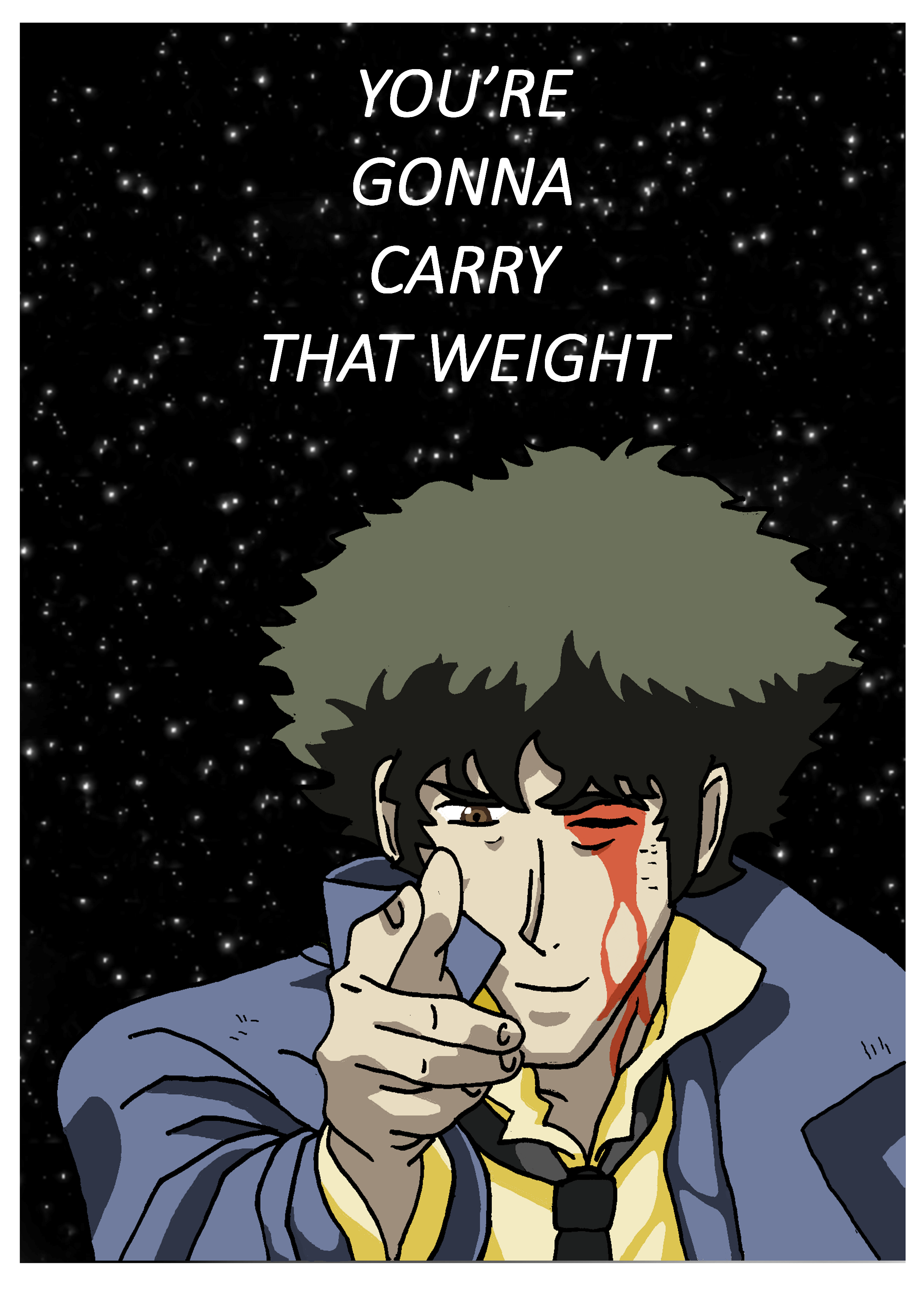
Twenty-six episodes of jazz, space combat, and bell peppers and beef with no beef. Then, four words on a black screen. You're going to carry that weight. If you watched Cowboy Bebop back in the late nineties on Adult Swim or discovered it through a Netflix binge recently, those words probably stuck in your gut like a lead weight.
It’s not just a cool quote. It’s a thesis statement.
Shinichirō Watanabe didn’t just make a show about bounty hunters; he made a show about the impossibility of outrunning your own ghost. When Spike Spiegel walks down those stairs at the Syndicate headquarters and mimics a gunshot with his fingers, he isn't just finishing a fight. He’s accepting the bill for a life he tried to leave behind. We’re still talking about it decades later because most shows give you closure, but Cowboy Bebop gives you a burden.
The Beatles, The Blues, and The Meaning of the Burden
Let’s get the obvious trivia out of the way first. The phrase "You're going to carry that weight" is a direct lift from The Beatles. It’s the title of the penultimate track on Abbey Road. Paul McCartney wrote it during the messy, slow-motion car crash that was the breakup of the world’s biggest band. It was about the pressure of maintaining their legacy while everything crumbled.
In the context of the Bebop crew—Spike, Jet, Faye, Ed, and even Ein—the meaning shifts. It becomes about the emotional luggage we refuse to check at the gate.
Spike Spiegel spent the entire series claiming he was "living in a dream he couldn't wake up from." He had one eye on the present and one eye on the past. That’s a literal detail, by the way; his right eye is artificial. He’s a man perpetually looking backward at a life with Julia and the Red Dragon Syndicate. When he finally confronts Vicious, he isn't "winning." He’s just finally acknowledging that the weight of his past is too heavy to carry any further.
Honestly, the show is kinda cruel about it. It spends twenty-four episodes building a makeshift family on a fishing boat turned spaceship, only to remind you that a shared present isn't enough to erase a fractured past. You can’t just "move on" when your soul is still anchored to a specific moment in time.
Why the Ending of Cowboy Bebop Isn't Actually Sad
A lot of people call the ending a tragedy. I don't buy that.
Tragedy is when something is avoidable. Spike’s end felt inevitable from the very first frame of the pilot. The "weight" mentioned in the closing card is the realization that our actions have permanent consequences. You don't get to kill people, lead a criminal empire, and then just go live on a farm with a girl and some roses. Life doesn't work that way. The universe—or at least Watanabe’s version of it—demands a balance.
Jet Black carries the weight of his lost arm and his lost career as a "tongue" (police officer). Faye Valentine carries the weight of a debt she didn't ask for and a past she literally cannot remember until it's too late to reclaim it.
The Faye Valentine Factor
Faye’s journey is arguably the most heartbreaking. She spends the series being a cynic because if you don't care about anyone, they can't leave you. But by the time she fires her gun into the ceiling, begging Spike not to go, she’s realized that she does have a home. The Bebop is it. But Spike’s weight is too heavy; he pulls the whole structure down with him.
It’s a masterclass in tone. The music—Yoko Kanno’s "Blue"—doesn't sound like a funeral dirge. It sounds like an ascension. Spike is finally, for the first time in years, light. He’s handed the weight off to us, the viewers.
The Aesthetic of Melancholy
We have to talk about the visuals because the phrase "you're going to carry that weight" wouldn't mean anything if the show looked like a generic Saturday morning cartoon. The art direction in Cowboy Bebop is heavily influenced by French New Wave cinema and noir. There are long stretches of silence. Shadows are deep and unforgiving.
When Spike confronts Vicious in The Real Folk Blues (Part 2), the choreography is frantic but the emotional beats are slow. It’s "Space Jazz." Jazz is built on improvisation and the space between notes. The "weight" is that space. It’s the silence after the music stops.
Some fans argue about whether Spike survived. To them, I say: You’re missing the point. Whether his heart is beating at the end of that episode is irrelevant. The story of Spike Spiegel, the man who ran away from death, is over. If he lived, the weight would be even heavier. By ending it there, the show ensures the legend remains intact.
How This Influenced Modern Storytelling
Before Bebop, western audiences were used to anime being either ultra-violent (like Akira or Fist of the North Star) or kid-friendly. Bebop introduced the concept of "cool" that was deeply tied to sadness. It’s a vibe we see now in shows like The Mandalorian or movies like John Wick. The protagonist who is tired. The hero who would rather be napping but is haunted by a debt.
It’s also why the live-action Netflix adaptation struggled. It tried to explain too much. It tried to lighten the load. But the soul of the original is the heaviness. You can't have Cowboy Bebop without the lingering sense of regret that permeates every frame.
Real World Actionable Takeaways from Spike’s Journey
It feels weird to pull "life lessons" from a show about space bounty hunters, but if you're actually going to carry that weight, you might as well learn how to do it properly.
First off, acknowledge the "eye" you have on the past. We all have things we’re looking back at—a failed business, a lost relationship, a version of ourselves we liked better. The lesson of Spike Spiegel isn't that you should go die in a blaze of glory; it’s that living in a dream state is a slow suicide.
Stop pretending your past doesn't exist. The Bebop crew tried to do that, and it resulted in a fragmented, lonely existence. Jet tried to bury his cop days, but they kept finding him. Faye tried to ignore her debt, but it defined her every move.
Instead of running:
- Identify your "Vicious." What is the one thing from your past that keeps drawing you back into a fight you can’t win? Face it, resolve it, or accept that it’s part of your story.
- Audit your "Ship." Who are the people you’ve surrounded yourself with while you’re "drifting"? Are you actually building a life with them, or are you just killing time until your past catches up?
- Accept the Weight. This is the big one. Understand that some things don't get fixed. Some mistakes stay made. Maturity is the ability to carry that knowledge without letting it paralyze you.
The phrase "You're going to carry that weight" is a promise. It’s the universe telling you that you are the sum of everything you’ve done. It’s not a threat. It’s just the truth. Spike Spiegel found peace when he stopped trying to drop the weight and just decided to walk with it one last time.
See you, Space Cowboy.
To truly understand the depth of this narrative, watch the "Ballad of Fallen Angels" (Episode 5) and "The Real Folk Blues" (Episodes 25-26) back-to-back. Notice how the visual motifs of feathers, church bells, and falling are mirrored. It reveals that the ending wasn't a surprise—it was a symphony being composed from the very beginning.



