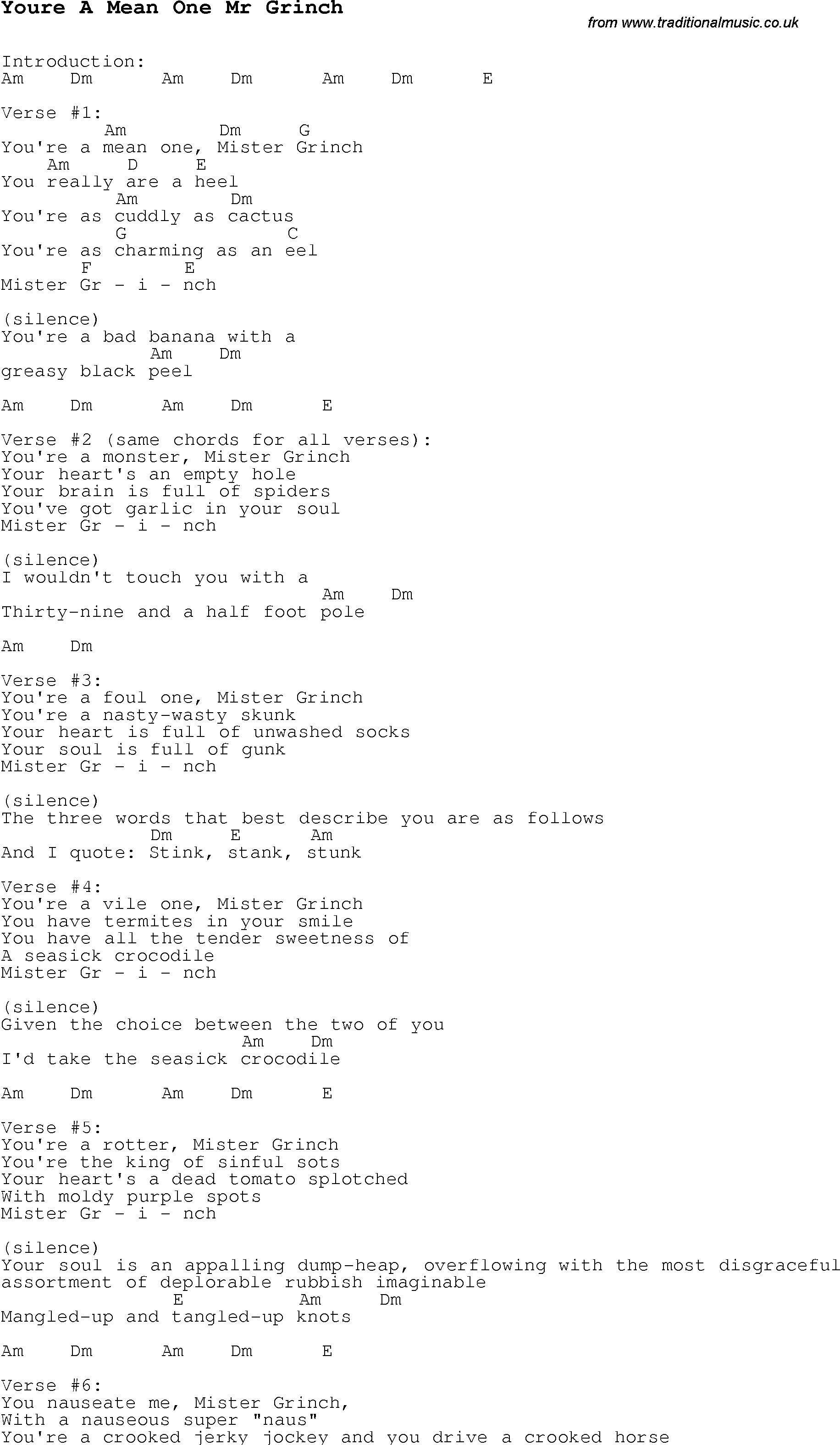
It is the sonic equivalent of a slow-motion car crash involving a garbage truck. Every December, like clockwork, that deep, rumbly bass-baritone voice kicks in and we all start nodding along to a song that is, basically, a three-minute long roast session. If you look at the You're a Mean One Mr Grinch lyrics, you aren't just looking at holiday fluff. You’re looking at a piece of literary assassination penned by Dr. Seuss himself. It’s mean. It’s visceral. It’s weirdly obsessed with hygiene and zoology.
Most people think they know the song. They hum along to the "seasick crocodile" bit and call it a day. But if you actually sit down and read the words, the level of hatred being directed at this green guy is honestly staggering. It’s impressive.
The Mystery of the Voice: No, It Wasn't Boris Karloff
Let’s clear up the biggest lie in Christmas history right now. Most people bet their life savings that Boris Karloff, the legendary Frankenstein actor who narrated the 1966 TV special, sang the song. He didn't.
Karloff had a great voice, but he couldn't hit those basement-level notes. The actual man behind the microphone was Thurl Ravenscroft. You might not know the name, but you know the voice—he was Tony the Tiger. "They're Gr-r-reat!" That was him.
Because Ravenscroft wasn't credited in the closing titles of the special, everyone just assumed it was Karloff. Dr. Seuss felt so bad about the mix-up that he actually wrote a letter to every major columnist in the country to set the record straight. Ravenscroft’s voice is what gives those lyrics their weight. Without that specific vibrating, gravelly texture, lines about "garlic in your soul" just wouldn't land with the same thud.
Breaking Down the Most Savage Lines
The lyrics operate on a level of "disgust imagery" that you just don't see in modern songwriting. Theodor Geisel (Dr. Seuss) was a master of the English language, and he used every tool in the shed to make the Grinch sound like the most repulsive creature on the planet.
Take the line about the "seasick crocodile." Think about that. A crocodile is already a predator. A seasick one is unpredictable, messy, and miserable. It’s a double-layered insult. Then you’ve got the "three-decker sauerkraut and toadstool sandwich with arsenic sauce." That isn't just a gross meal; it's a death sentence.
He calls him a "bad banana with a greasy black peel." We’ve all seen that banana at the bottom of the fruit bowl. It’s slimy. It’s fermented. It’s a specific kind of organic decay that makes your skin crawl. Seuss knew that calling someone "evil" is boring. Calling them "greasy" is personal.
The Anatomy of the Insult
Seuss focuses on three specific areas to tear the Grinch down:
- Physical Rot: Termites in the teeth, garlic in the soul, greasy peels.
- Moral Bankruptcy: A heart full of unwashed socks, a soul full of gunk.
- Social Isolation: The idea that a 39-and-a-half-foot pole isn't long enough to touch him.
That specific distance—39-and-a-half feet—is such a classic Seuss detail. Why not forty? Because 39-and-a-half feels measured. It feels like someone actually calculated the exact distance required to avoid catching "Grinchiness."
The Lyrics as a Structural Weirdo
Musically, the song is a freak of nature. Albert Hague composed the music, and he didn't follow the standard "verse-chorus-verse" pop structure of the 1960s. Instead, it’s a series of escalating jabs.
Each verse starts with the titular line—You're a mean one, Mr. Grinch—and then spends the next several lines justifying that statement with increasingly bizarre metaphors. The rhyme schemes are jagged. "Stink, stank, stunk" shouldn't work as a lyrical climax, yet it’s the most memorable part of the entire track. It's monosyllabic perfection.
Honestly, the word "stunk" is the heavy hitter there. It’s a finality. It’s the period at the end of a very smelly sentence.
Why We Love Being Mean to the Grinch
There is a psychological reason why these lyrics have survived since 1966 while other Christmas songs die out. Most holiday music is about joy, family, and snow. It’s sugary. The Grinch lyrics are the salt.
We live in a world where we have to be polite. We have to smile at the office party. The You're a Mean One Mr Grinch lyrics give us permission to revel in total, unadulterated negativity for three minutes. It’s cathartic. There’s something deeply satisfying about hearing someone described as a "foul one" whose heart is an "empty hole."
It’s also one of the few holiday songs that doesn't feel dated. While other 60s tracks use slang or references that feel dusty, Seuss’s invented vocabulary—words like "heart-zerts" or the conceptual "soul-gunk"—feels timeless because it never existed in the real world to begin with.
The Cover Versions: Who Did It Best?
Because the song is such a staple, everyone from Tyler, The Creator to Jim Carrey has taken a crack at it.
- Jim Carrey (2000): Carrey’s version is chaotic. It fits the high-energy, fever-dream vibe of the Ron Howard movie. He talks through half of it, leaning into the comedy rather than the vocal gravitas.
- Tyler, The Creator (2018): This was a polarizing one. He stripped back the big band sound and replaced it with a heavy, minimalist beat. It’s darker. It feels more like a modern rap diss track, which, if you think about it, is exactly what the song has always been.
- Arie and CeeLo Green: They tried to make it soulful. It’s technically good, but it lacks that "monster under the bed" quality that Thurl Ravenscroft brought to the table.
The reality is that nobody beats the original. Ravenscroft had a specific resonance in his chest cavity that sounds like a pipe organ in a haunted house. You can’t manufacture that with auto-tune.
Misheard Lyrics and Common Mistakes
Despite being ubiquitous, people mess up the words all the time.
A common one is the "three-decker sauerkraut" line. People often forget the "arsenic sauce" part, which is arguably the most important bit because it moves the song from "gross" to "dangerous."
Another is the "termites in your smile" line. People often substitute "teeth" for "smile." While "teeth" makes more sense biologically, "smile" is way more sinister. It implies that the very expression of his happiness is infested with parasites. That’s dark, even for a kids' special.
The Cultural Legacy of a "Stink, Stank, Stunk"
This song changed how we view villains in children's media. Before the Grinch, villains usually got a scary theme song, but they didn't get a "roast track." This song isn't sung by the Grinch; it’s sung about him by an omniscient narrator who clearly despises him.
It set the stage for Disney’s "villain songs" decades later. Without the Grinch, do we get "Poor Unfortunate Souls" or "Be Prepared"? Probably not. The idea that you can have a catchy, fun song about how much of a "heel" someone is started right here in Whoville.
How to Use These Lyrics Today
If you’re looking to analyze the lyrics for a school project or just want to win a trivia night, focus on the "three S's": Simile, Satire, and Seuss. 1. Look for the Similes: "You're as cuddly as a cactus." It’s the perfect comparison of soft vs. painful. 2. Check the Metaphors: "Your heart is a dead tomato splotched with moldy purple spots." That is descriptive writing at its peak. 3. The Vocabulary: Notice how many words aren't "real" but make total sense in context.
The song is a masterclass in creative writing. It teaches us that you don't need a wide vocabulary of curse words to absolutely destroy someone's reputation. You just need to compare them to a "nauseous super-naus."
Getting the Most Out of Your Grinch Experience
To truly appreciate the You're a Mean One Mr Grinch lyrics, you have to listen to the mono mix of the original 1966 soundtrack. Modern stereo remasters often thin out the bass to make it "cleaner," but you want that mud. You want to feel the vibration of those low notes in your teeth.
If you're planning a holiday playlist, don't bury this between "Silent Night" and "Away in a Manger." It’ll kill the mood. Put it next to something with some teeth—maybe some Nightmare Before Christmas tracks or some upbeat jazz.
Actionable Steps for Grinch Fans
- Watch the 1966 original: Pay attention to how the animation syncs with the lyrics. When the lyrics mention the "three-decker sandwich," look at the visual—it’s a perfect 1:1 match that heightens the comedy.
- Compare the versions: Play the Thurl Ravenscroft original side-by-side with Tyler, The Creator’s version. It’s a fascinating look at how "menace" has changed in music over 50 years.
- Read the book: Interestingly, these lyrics are not in the original 1957 book. They were written specifically for the TV special. Reading the book versus watching the special shows you how much "edge" the song added to the Grinch’s character.
- Host a Roast: Next time you're with friends, try to write a "Grinch-style" verse about a common annoyance (like traffic or slow internet). It’s a great exercise in using descriptive imagery over simple complaints.
The song remains a masterpiece because it refuses to be nice. In a sea of holiday sentimentality, the Grinch stands alone with his garlic soul and his termites, and honestly, we wouldn't have it any other way.



