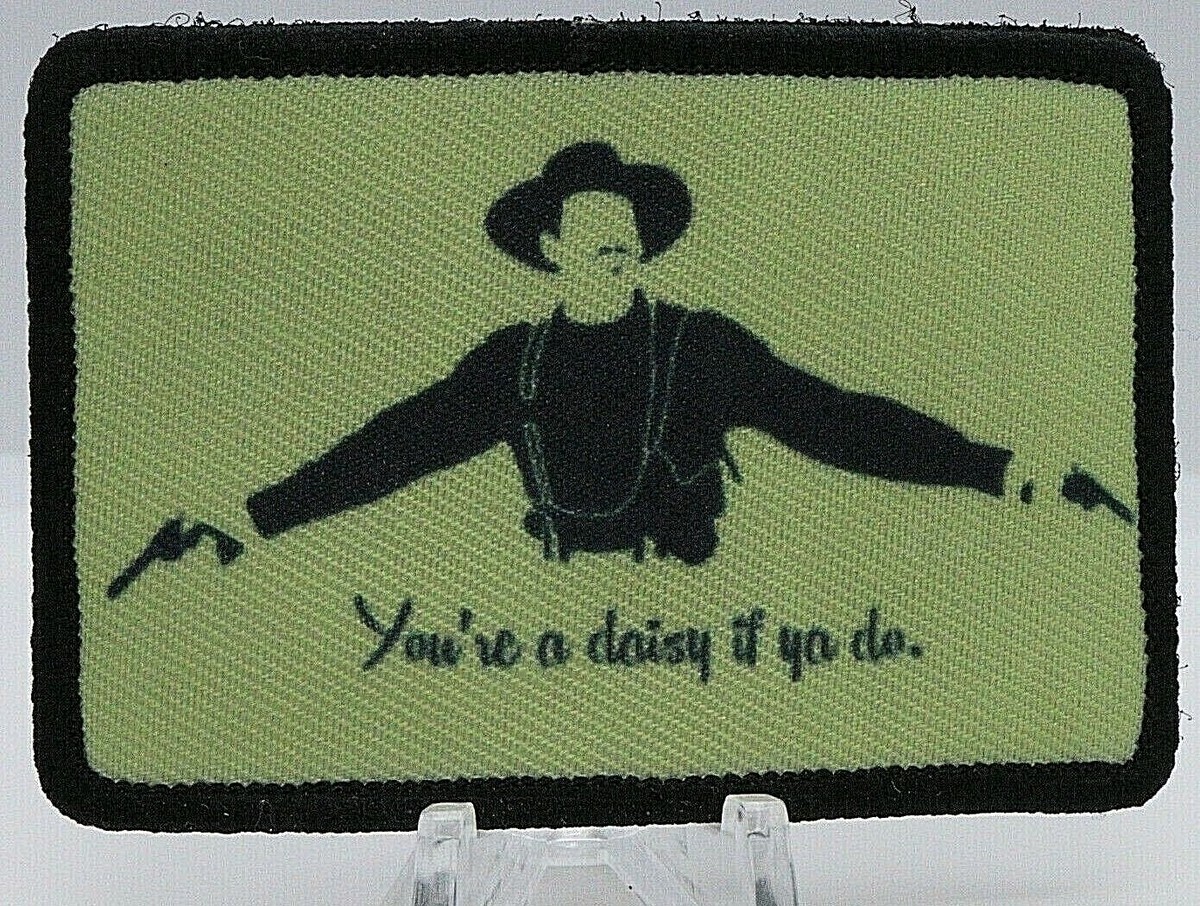
Val Kilmer didn't just play Doc Holliday; he basically lived him for a few months in 1993. Most people who’ve watched the Western classic Tombstone can quote at least five lines from memory. But there’s one specific phrase that keeps popping up on t-shirts, tattoos, and internet memes decades later. You're a daisy if you do. It’s weird, right? It sounds almost delicate, maybe even a little flowery, especially coming from a man who spent his final years coughing up blood and staring down the barrels of Colt Peacemakers.
Honestly, the phrase is a linguistic riddle. If you ask a random person on the street what it means, they might guess it’s about being pushed up like a flower in a graveyard. They aren't entirely wrong, but they’re missing the Victorian "swagger" that made the real John Henry Holliday such a terrifying figure in the Old West.
The Actual History Behind the Line
Movies usually make stuff up. That’s just Hollywood. But the crazy thing about "you're a daisy if you do" is that it actually happened. Sort of. We have to look at the O.K. Corral gunfight on October 26, 1881. It wasn't some long, drawn-out tactical battle like you see on screen. It was thirty seconds of chaos, smoke, and lead in a narrow lot.
According to several historical accounts and trial testimonies—specifically those recorded by the Nugget and the Epitaph newspapers at the time—the exchange happened during the heat of the fight. Frank McLaury, one of the Cowboys, reportedly told Holliday, "I've got you now!" or something to that effect. Doc, cool as a cucumber despite being shot at, supposedly replied with some variation of the "daisy" line.
Why "daisy"? In the slang of the 1880s, a "daisy" was something or someone considered "the best" or "top-notch." Think of it like saying "you're a peach" or "that's a dandy." By telling McLaury he’d be a daisy if he actually managed to kill him, Holliday was essentially mocking his opponent’s skill. He was saying, “If you actually pull this off, you’re better than I thought.” It was the ultimate 19th-century trash talk.
Val Kilmer’s Performance and the "Daisy" Resurgence
Kilmer’s delivery is what turned a historical footnote into a cultural icon. He plays Holliday with this sweating, vibrating intensity. He’s dying of tuberculosis—consumption, they called it then—and he knows it. That gives him a weird kind of superpower: he isn't afraid of death because he’s already invited it to dinner.
When he says, "You're a daisy if you do," he does it with a smirk that says he’s bored by the prospect of dying. Kevin Jarre, the original screenwriter for Tombstone, was obsessed with historical accuracy in the dialogue. He dug deep into the research to find these period-specific idioms. While the movie takes massive liberties with the timeline and the "Ringo vs. Doc" rivalry (which was mostly exaggerated for drama), the linguistic flavor is surprisingly authentic to the era.
The Contrast of the "Huckleberry" Line
You can't talk about the daisy line without mentioning "I'm your huckleberry." People constantly confuse the two. While "daisy" is a challenge to an opponent, "huckleberry" was a way of saying, "I'm the man for the job."
Imagine the scene at the O.K. Corral. It’s cold. There’s snow on the ground. Everyone is wearing long coats to hide their pistols. The tension is thick enough to choke on. In that environment, using flowery language isn't a sign of weakness; it’s a sign of absolute, terrifying confidence. It’s what we call "Earpian" stoicism, though Doc was a gambler and a dentist, not a lawman by trade.
What Most People Get Wrong About the Meaning
There is a persistent myth that "you're a daisy" refers to being dead and buried—"pushing up daisies." While that phrase existed, it wasn't the primary intent in this context.
If Holliday meant "you'll be dead," the sentence structure doesn't quite work. "You're a daisy if you do" implies the person doing the action (shooting him) earns the title of "daisy." It’s a compliment wrapped in a death threat. It’s sardonic. Doc was a classically educated man from Georgia. He spoke Latin. He played piano. His insults were always going to be more sophisticated than the "Draw!" or "Get out of town" tropes we see in cheaper Westerns.
Why the Old West Lexicon Still Matters
Language tells us about the values of a time. The late 1800s were a mix of brutal violence and extreme Victorian politeness. People were "sirring" and "maming" each other right before they stepped out into the street to settle a debt with a shotgun.
The phrase you're a daisy if you do survives because it captures that specific duality. It feels elegant but carries a heavy weight. We live in a world of "bet" and "no cap," but there’s something about the rhythmic, almost poetic nature of Doc’s taunt that feels more permanent. It’s about the "cool factor."
The Real Doc Holliday vs. The Legend
The real John Henry Holliday was a complicated guy. He wasn't just a drunk with a gun. He was a man whose life was derailed by a terminal illness, forcing him to move West for the dry air. He was a dentist who found that gambling paid better and didn't require as much standing up.
When he stood in that lot in Tombstone, he was carrying a short-barreled Metroplitan Arms Co. shotgun under his coat. He wasn't looking for a fair fight. He was looking to end it. That’s the nuance the "daisy" line provides—it’s the mask of a gentleman over the heart of a killer.
The Legacy in Modern Media
Since Tombstone, we’ve seen a shift in how Westerns are written. Deadwood took the profanity to an extreme, but it kept that same rhythmic, "Shakespeare in the mud" quality. Justified did the same thing with Raylan Givens.
They all owe a debt to the "daisy" line. It proved that audiences actually enjoy complex, weird, and period-accurate dialogue more than the generic "tough guy" talk. We want characters who sound like they belong to a different world.
Actionable Insights for Fans and Writers
If you’re looking to dive deeper into the world of Doc Holliday or just want to use the phrase correctly in your own life, keep these things in mind.
- Context is King: Use the phrase when someone thinks they’ve got the upper hand on you, but you know something they don't. It’s a challenge, not a greeting.
- Read the Original Transcripts: If you’re a history buff, look up the "Inquest into the O.K. Corral Shootout." It’s fascinating to see how the witnesses’ stories diverged and where the "daisy" line actually fits into the legal record.
- Watch the 1994 Wyatt Earp: For a totally different take, watch Dennis Quaid play Doc Holliday in the film released just a year after Tombstone. He’s much more skeletal and arguably more "historically accurate," but he lacks Kilmer’s "daisy" charm. It’s a great study in how two actors can interpret the same man.
- Visit Tombstone: It’s a bit of a tourist trap now, but standing in the actual space where these guys stood gives you a sense of just how close they were. They weren't across the street; they were practically breathing on each other.
The phrase isn't just a movie quote. It’s a piece of linguistic DNA from a time when the West was being "tamed" by people who were just as wild as the land itself. Doc Holliday died in a bed in Glenwood Springs, Colorado, not in a gunfight. His last words were reportedly "This is funny," as he looked at his bare feet—he’d always assumed he’d die with his boots on. He was a daisy until the very end.
To really grasp the weight of these words, one must look at the psychological state of a man who has nothing left to lose. Holliday was a living ghost. When you are already dead in your own mind, the threats of others become a joke. That is the essence of being a daisy. It is the peak of performance under pressure, a flash of wit in the face of the void. Don't just quote it because it sounds cool; quote it because it represents the ultimate refusal to be intimidated by the inevitable.
Go back and watch that scene again. Notice the way the light hits Kilmer’s eyes. He isn't just saying a line; he’s daring the world to try and stop him. That’s the energy we’re all chasing when we repeat those five simple words. It’s not just about a flower. It’s about being the best, even when the worst is happening.
Next time you find yourself in a high-stakes situation, remember Doc. Keep your composure, keep your wit, and if someone thinks they've finally cornered you, just smile and let them know exactly what they’ll be if they actually manage to pull the trigger. It’s a power move that has lasted over a hundred years for a reason.
Study the primary sources, like the diaries of Mary Wyatt or the various biographies by authors like Gary L. Roberts, who is widely considered the leading authority on Holliday. You'll find a man much more interesting than any 120-minute film could ever fully capture. The "daisy" was just one petal of a very complex and thorny life.
The most important thing to take away is that history is often stranger—and more poetic—than the fiction it inspires. Doc Holliday proved that you can be a deadly gunslinger and a witty conversationalist at the same time. He didn't just survive the O.K. Corral; he defined it with a single, biting remark that refused to let the moment be forgotten. That is the true power of a well-placed phrase. It turns a brief moment of violence into an enduring legend.



