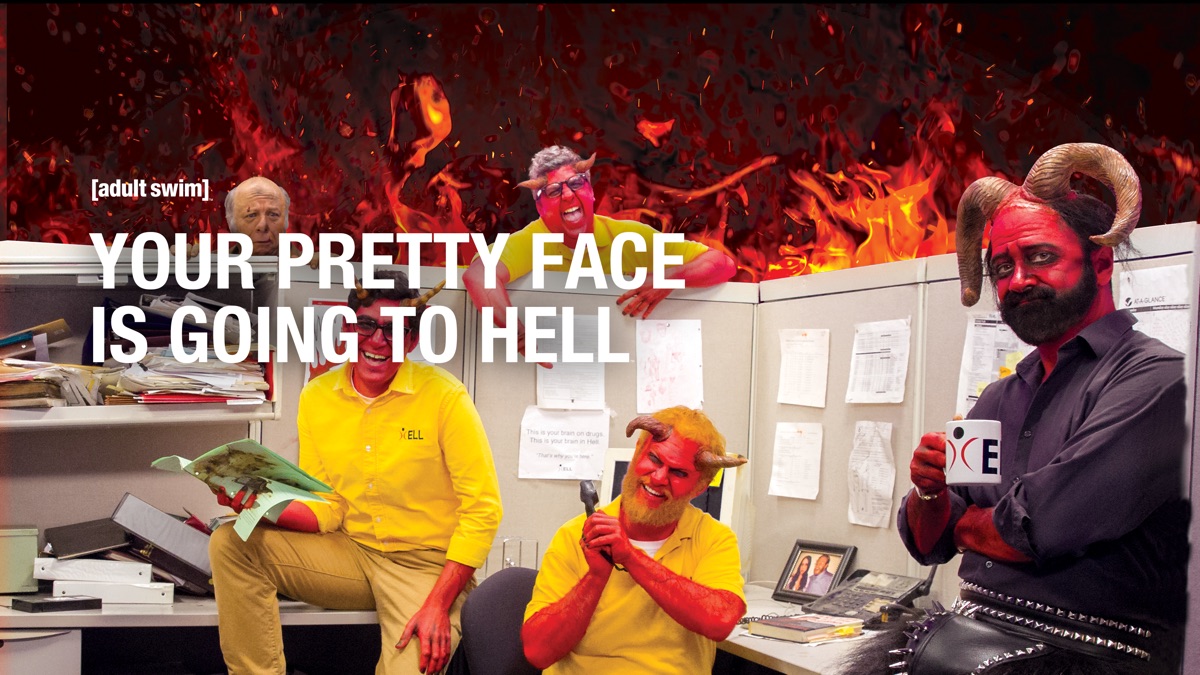
Hell is a cubicle. Specifically, it’s a cubicle where you’re trying to hit your soul-collection quota while wearing itchy red prosthetic makeup and a cheap tie. If you missed the chaos during its original run, Your Pretty Face Is Going to Hell is basically what happens when you take the soul-crushing bureaucracy of The Office and relocate it to a literal pit of eternal fire.
It’s weird. It’s messy. It’s surprisingly smart.
Most people remember the show for the gore or the absurd sight of Henry Zebrowski—long before his Last Podcast on the Left fame reached its current peak—running around in red face paint as Gary, the bumbling demon. But the show, created by Casper Kelly and Dave Willis, actually tapped into something much deeper about how much we all hate our middle managers. It ran for four seasons on Adult Swim, plus some digital shorts, and honestly, it’s one of the few live-action comedies from that era that actually holds up under a modern lens.
What Most People Get Wrong About Your Pretty Face Is Going to Hell
People think it’s just a "stoner show." They see the bright colors, the practical effects, and the Adult Swim logo and assume it’s just random nonsense designed for 2:00 AM viewing. That’s a mistake. The writing is incredibly tight. Gary isn't just a loser; he’s an optimist in a system designed to crush optimism. He’s the guy at your office who thinks a "Best Employee" certificate actually means something.
The dynamic between Gary and Claude (played by Matt Servitto) is the engine of the series. Claude is the weary, cynical veteran. He’s seen every torture technique, every soul-capture gimmick, and he just wants to get through his shift without Gary blowing something up. It’s a classic workplace comedy trope—the wide-eyed rookie and the jaded mentor—but it’s elevated by the fact that their "KPIs" involve torturing people for eternity.
The Practical Effects Are a Lost Art
You don’t see shows like this anymore. Everything is CGI now. It’s cheap. It’s sterile. Your Pretty Face Is Going to Hell went the opposite direction. The makeup process for Zebrowski and Servitto was notoriously brutal. We’re talking hours in the chair every single morning just to get those prosthetic ears and the skin tone right.
There’s a tactile quality to the show. When a demon’s head explodes or someone gets flayed, it looks like physical stuff because it is physical stuff. It’s puppetry, corn syrup, and latex. This gives the show a cult-horror vibe that CGI just can’t replicate. It feels like a Troma movie with a slightly better budget and way better jokes.
The Corporate Satire Nobody Talks About
If you’ve ever sat through a "synergy" meeting or had a boss explain why "we’re a family here" while cutting your benefits, this show will trigger your fight-or-flight response. Satan, played with a hilarious, frat-boy energy by Matt Yates, is the ultimate CEO. He’s fickle. He’s obsessed with branding. He doesn't actually know how the work gets done, but he’s happy to scream at you if the numbers are down.
The show treats the afterlife not as a grand theological battlefield, but as a mid-tier logistics firm. There are memos. There are HR disputes. There are tech support issues with the torture equipment.
- Gary tries to use social media to "disrupt" the soul-collecting industry.
- Claude deals with the burnout of being a mid-level manager in a literal abyss.
- The interns are, predictably, treated worse than the people being tortured.
This groundedness makes the supernatural elements funnier. It’s not scary that you’re in Hell; it’s scary that Hell has a dress code and a mandatory "lunch and learn" session about efficient pitchfork usage.
Why the Show Ended (And Why It’s Still Relevant)
Adult Swim has a habit of moving on from live-action shows once they get too expensive or the creators want to try something else. After Season 4, the show transitioned into a series of digital shorts and eventually a finale of sorts. It didn’t get a massive, multi-season send-off like The Venture Bros., but it didn't really need one. The episodic nature meant you could jump in anywhere.
The show remains relevant because the "gig economy" and corporate culture have only become more hellish since it premiered. In 2013, the idea of a demon needing to "hustle" to stay relevant felt like a joke. In 2026, it feels like a documentary. Gary’s desperation to be "somebody" in a world that views him as a disposable unit is the universal modern experience.
The Last Podcast Connection
It’s impossible to talk about the show now without mentioning Henry Zebrowski’s massive success in the podcasting world. For many fans of Last Podcast on the Left, Your Pretty Face Is Going to Hell is the "origin story." You can see the seeds of his manic, high-energy comedic persona in Gary. His ability to commit 100% to a ridiculous bit—like trying to convince a "cool" teenager to sell their soul for a skateboard—is what makes the show work. Without that total commitment, the red paint would just look silly. With it, it’s iconic.
Watching It Now: A Guide for the Uninitiated
If you’re going to dive back in, don’t expect a linear narrative. This is a show meant to be consumed in chaotic bursts. The episodes are short—usually around 11 minutes. It’s the perfect length for a comedy that relies on high-concept visual gags and rapid-fire dialogue.
- Start with Season 2. The first season is great, but the show really finds its rhythm in the second year. The chemistry between the leads is solidified, and the writers stop explaining the rules of Hell and just start breaking them.
- Look for the guest stars. You’ll see familiar faces from the alt-comedy scene popping up as tortured souls or rival demons. It’s a "who’s who" of people who would go on to do big things in the late 2010s.
- Pay attention to the background. The production design is littered with jokes. The signs on the walls, the posters in the breakroom, the specific "tools" used in the background of shots—it’s all there for the eagle-eyed viewer.
The Legacy of Gary and Claude
Ultimately, Your Pretty Face Is Going to Hell is a reminder that you can make something high-concept on a budget if you have a clear vision and a cast willing to suffer for their art. It’s a cult classic for a reason. It didn't try to appeal to everyone. It didn't try to be "prestige TV." It just wanted to be the funniest, grossest thing on television at midnight on a Tuesday.
It succeeded.
The show taught us that even if you're literally in the pit of despair, you're still going to have to deal with a printer that won't work and a boss who can't remember your name. That's the real horror.
Next Steps for Fans: If you've finished the series, check out the Your Pretty Face Is Going to Hell digital shorts on the Adult Swim website or YouTube. They capture the same energy in even smaller, more concentrated doses. After that, look into Casper Kelly’s other work, specifically the viral short Too Many Cooks, to see more of the surrealist DNA that made the show possible. If you want more of Henry Zebrowski’s specific brand of chaos, Last Podcast on the Left is the obvious next stop, specifically the "Side Stories" episodes where his improvisational skills are on full display.



