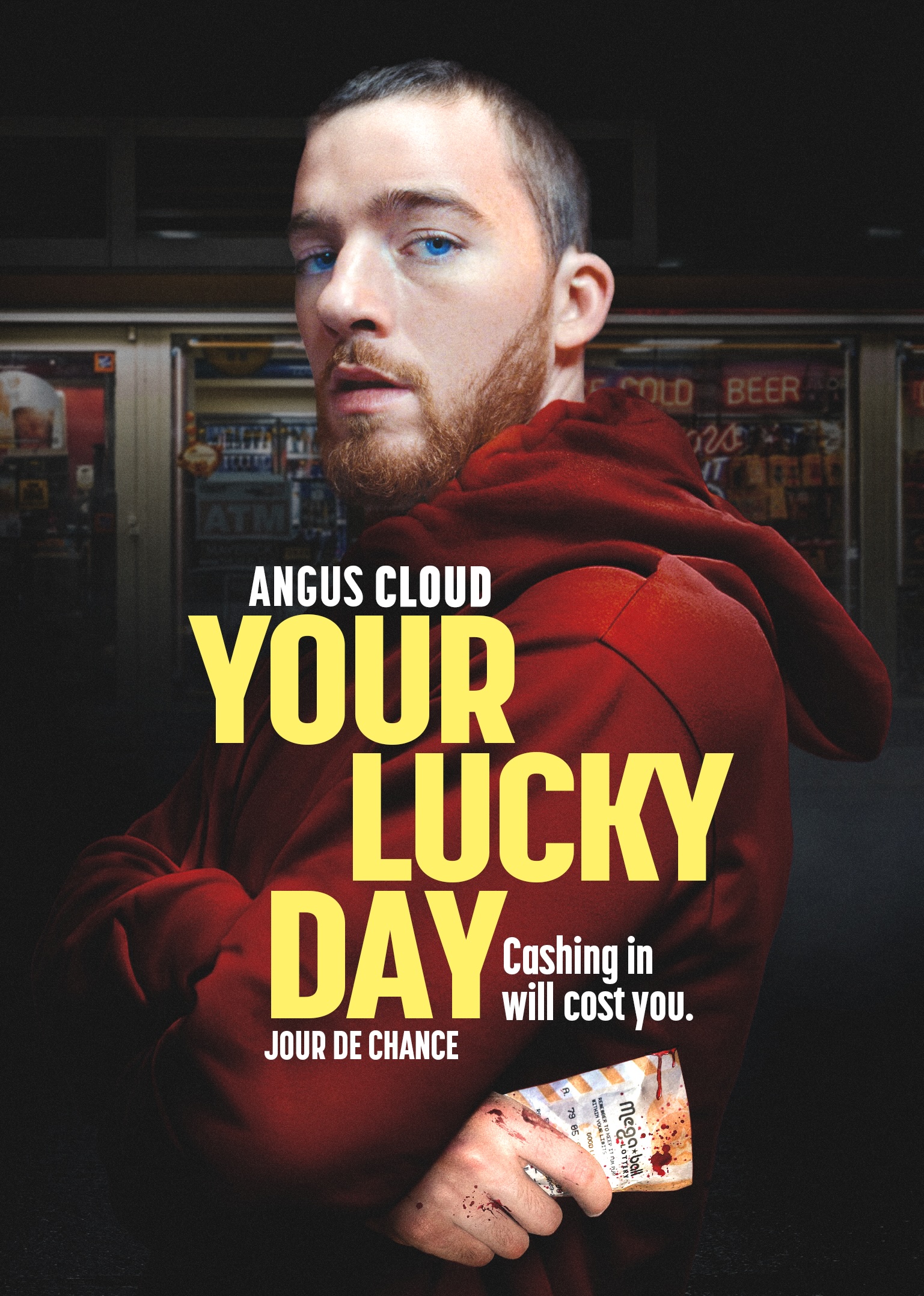
It starts with a lottery ticket. Not just any ticket, but a $156 million winning slip of paper clutched in the hand of a wealthy, entitled man in a convenience store. Then the power goes out. In that sweaty, claustrophobic darkness, a desperate man named Sterling makes a choice that changes everything. If you haven't seen Your Lucky Day, you're missing out on one of the most razor-sharp critiques of the American Dream ever put to film. It’s a movie that feels like a punch to the gut.
Honestly, it’s refreshing. Most modern thrillers feel like they were written by a committee or an algorithm designed to play it safe. This one? It’s lean. Mean. It doesn’t care if you like the characters. It just wants you to watch them bleed for a piece of the pie.
The Tragedy of Angus Cloud
It is impossible to talk about Your Lucky Day without mentioning Angus Cloud. This was one of his final performances before his tragic passing in 2023. Most of us knew him as Fezco in Euphoria, that soft-spoken drug dealer with a heart of gold. Here, he plays Sterling, a small-time crook who is essentially the catalyst for a bloodbath. Cloud brings that same weary, soulful energy to the role. You can see the desperation in his eyes—it's not just about the money; it's about the crushing weight of a system that never gave him a chance.
Watching him on screen now feels bittersweet. He had this incredible ability to ground even the most heightened situations in a sense of reality. When he holds up that store, he isn’t a "movie villain." He’s a guy who has reached his breaking point. Dan Brown, the director, actually based this feature on his own 2010 short film of the same name. It took over a decade to bring the full vision to life, and Cloud’s performance is the anchor that keeps the whole thing from drifting into pure exploitation.
A Pressure Cooker of Social Class
The setup is basic. One store. A handful of witnesses. A dead body. And a ticket worth a fortune. But the movie isn’t just about the heist; it’s about how quickly "good people" abandon their morals when there is enough zeros on a check. It’s a microcosmic look at class warfare. You have the wealthy victim, the struggling perpetrator, the immigrant store owner, and the cops who aren't exactly heroes.
Things get messy fast.
The film tackles the "Model Minority" myth through the character of Amir, the shopkeeper played by Mousa Hussein Kraish. He’s caught between his desire to do the right thing and the terrifying reality of what that $156 million could do for his family. Then there's Ana, a pregnant woman played by Jessica Garza, who becomes the moral compass—or perhaps the ultimate survivor. The pacing is relentless. It’s only about 90 minutes long, which is a miracle in an era where every blockbuster thinks it needs to be a three-hour epic. It gets in, does the damage, and leaves.
Why Your Lucky Day Hits Different in 2026
We live in a world where the wealth gap isn't just a talking point; it's a chasm. Your Lucky Day taps into that collective frustration. It asks a very uncomfortable question: What would you actually do? Most of us like to think we’d be the hero. We’d call the police. We’d help the victim. But when you’re staring at a ticket that represents generational wealth—the kind of money that deletes every problem you’ve ever had—your brain starts doing some pretty wild mental gymnastics to justify some very bad things.
The cinematography by Alex Wendler deserves a shout-out. The store feels like a cage. The neon lights flicker, casting long, sickly shadows. It’s ugly in a way that feels intentional and beautiful. It reminds me a bit of Uncut Gems, though it’s less about the kinetic energy of a gambling addict and more about the slow-burn dread of a hostage situation gone wrong.
The "Lottery Curse" Reality
The movie leans into the idea of the "lottery curse." Statistically, lottery winners are more likely to declare bankruptcy within three to five years than the average American. They face lawsuits, estrangement from family, and even violence. Your Lucky Day just speeds up that timeline. It turns the "lucky day" into a literal death sentence for several characters.
The dialogue is snappy but feels authentic to the street. It’s not "Hollywood" talk. People stutter. They talk over each other. They make stupid decisions because they are terrified. That realism makes the violence much harder to watch. It’s not stylized; it’s clumsy and brutal.
Breaking Down the Ending (Without Spoiling Everything)
Without giving away the final frame, the ending of Your Lucky Day is polarizing. Some people find it cynical. Others think it’s the only way a story like this could end. It forces the audience to reconcile with the fact that in a capitalist society, "winning" usually means someone else had to lose. It doesn’t provide a neat bow. It leaves you feeling a little dirty, which is exactly what a good noir thriller should do.
It’s a stark contrast to the way movies like The Pursuit of Happyness or other "pull yourself up by your bootstraps" stories work. This film says the bootstraps are broken, and the only way up is to step on someone else’s head. It’s bleak. It’s honest.
How to Get the Most Out of Your Lucky Day
If you’re planning to watch it, or if you’ve already seen it and are trying to process what happened, here is the best way to approach it.
- Watch the original short film first. You can find Dan Brown’s 2010 short online. It’s fascinating to see how the core concept evolved from a 10-minute burst of violence into a nuanced social commentary.
- Pay attention to the background noise. The sound design in the store is incredible. The hum of the refrigerators, the distant sirens—it all adds to the claustrophobia.
- Look at the casting. Beyond Angus Cloud, the supporting cast is phenomenal. Elliot Knight and Jessica Garza bring a lot of weight to roles that could have easily been one-dimensional tropes.
- Ignore the "B-Movie" label. Yes, it has a modest budget. Yes, it’s a genre flick. But the themes it explores are as heavy as any Oscar-bait drama released this year.
This isn't a movie you put on while you're folding laundry. You need to sit with it. You need to feel the tension. It’s a reminder that Angus Cloud was a massive talent taken way too soon, and it’s a testament to the power of independent filmmaking.
Essential Next Steps for Fans
If you're looking for what to do after the credits roll, don't just jump into the next Netflix recommendation.
- Compare it to 'Shallow Grave'. If you liked the "friends turning on each other for money" vibe, Danny Boyle’s directorial debut is the gold standard. It makes for a perfect double feature.
- Research the "Lottery Lawyer" phenomenon. There are actually lawyers who specialize specifically in protecting winners from the types of people depicted in this movie. It’s a bizarre, real-world industry born out of the chaos of sudden wealth.
- Check out Dan Brown's other work. Not the Da Vinci Code guy—the director. He has a very specific eye for tension and spatial awareness within a single location.
Your Lucky Day is a gritty, unsparing look at what happens when the American Dream turns into a nightmare. It’s one of the most underrated films of the last few years, and it deserves a spot on your watchlist if you want a thriller that actually has something to say.
To fully appreciate the film’s impact, watch it a second time specifically focusing on the character of Amir. His transition from a passive bystander to an active participant in the chaos is one of the most subtle and chilling arcs in the movie. It reflects the reality of how systemic pressure can bend even the strongest moral compass until it snaps.