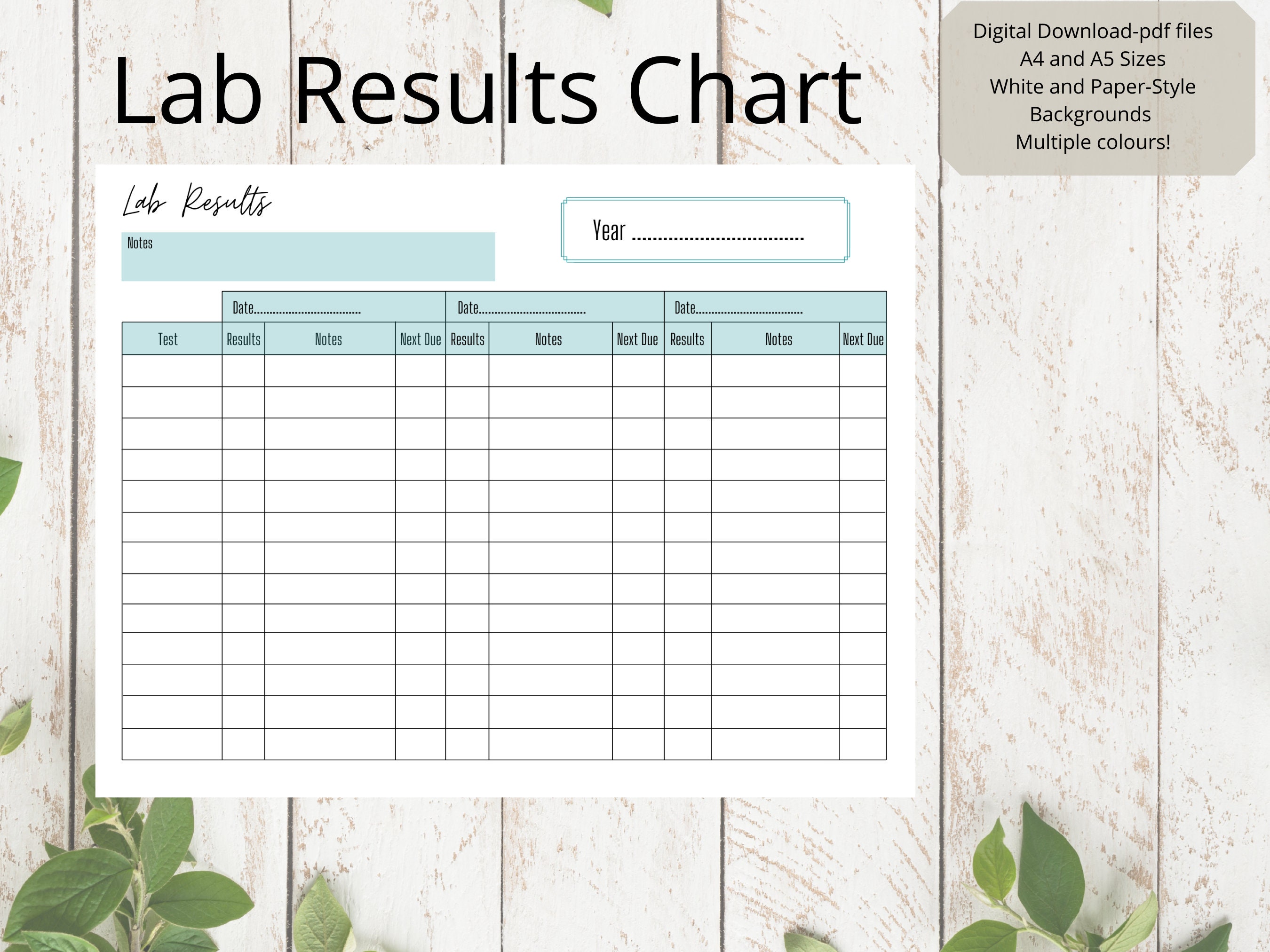
You're sitting at your kitchen table, staring at a PDF from the patient portal. It’s a mess of acronyms like MCV, GFR, and TSH. Suddenly, you see it. A bolded number. A little red arrow pointing up. Your heart sinks. You’re already Googling "high creatinine" and "kidney failure" before you’ve even finished your coffee. We've all been there. It’s scary.
But here’s the thing about a lab test results chart: it isn't a grade on an exam. It’s a snapshot. A single moment in time.
Most people treat their lab report like a binary "pass/fail" system, but medicine is way more "gray area" than that. Doctors don't just look at the number; they look at the trend. They look at you. If you ran a marathon yesterday and your muscle enzymes are high today, that’s actually normal for you. If you were dehydrated when the needle hit your vein, your electrolyte balance will look wonky. Context is everything. Honestly, a "normal" range is just a statistical average of a specific population, usually healthy adults, which might not even represent your specific body or lifestyle.
Reading Your Lab Test Results Chart Without Panicking
When you open that digital file, you’ll usually see four columns. There’s the name of the test, your result, the units (like mg/dL), and the "reference range." That reference range is the most misunderstood part of the whole document. It’s basically the "safe zone" determined by the lab that processed your blood or urine.
Labs like Quest Diagnostics or LabCorp actually have slightly different reference ranges. Why? Because they use different equipment. They use different chemical reagents. So, a 10.2 on a calcium test might be "high" at one clinic but "normal" at the hospital across town. It’s frustrating. It feels inconsistent. But it's just the reality of how medical technology works.
The Mystery of the Reference Range
How do they even decide what’s normal? They take a huge group of people—usually about 120 or more—who are considered "healthy" and measure their levels. Then they apply a bell curve. They cut off the top 2.5% and the bottom 2.5%. This means that, by definition, 5% of perfectly healthy people will always fall outside the reference range on a lab test results chart. If you run a panel of 20 different tests, there is a statistically high chance that at least one of them will come back flagged as "abnormal" just because of how the math works.
It doesn’t mean you’re dying. It might just mean you’re in that 5%.
Common Acronyms You’ll See
- CBC (Complete Blood Count): This is the big one. It looks at your red cells, white cells, and platelets. If your white blood cell (WBC) count is high, you might be fighting a cold. Or you might just be stressed. Or you might have taken a certain medication.
- CMP (Comprehensive Metabolic Panel): This checks your liver, kidneys, and blood sugar.
- Lipid Panel: This is the cholesterol talk. LDL is the "bad" one, HDL is the "good" one. But even here, the ratio matters more than the individual numbers sometimes.
Why Your Results Might Be "Off" (And It's Not Your Fault)
I talked to a nurse practitioner once who told me she had a patient come in terrified because their potassium was through the roof. Turns out, the technician who drew the blood left the tourniquet on too long. That’s called "hemolysis." The blood cells basically pop, releasing potassium into the sample. The patient was fine; the sample was just "garbage."
Things that mess with your lab test results chart:
- That "fasting" rule? If you snuck a piece of toast, your glucose and triglycerides are going to be wild.
- Biotin supplements. These are huge right now for hair and nails, but they are notorious for interfering with thyroid (TSH) tests. They can make it look like you have Grave’s disease when you’re totally healthy.
- Intense exercise. A heavy lifting session can spike your AST and ALT (liver enzymes) because your muscles are repairing themselves.
- Time of day. Cortisol is high in the morning and low at night. If you get it drawn at 3 PM, the "normal" range is different than at 8 AM.
Understanding the "Critical" Flag
Sometimes, you’ll see a result marked as "Critical" or "Panic Value." This is different from just being a little bit outside the range. A critical value means the lab is legally or professionally obligated to call your doctor immediately. We’re talking about blood sugar so low you might faint, or potassium so high it could affect your heart rhythm. If you are looking at your results at home and haven't heard from your doctor yet, and it’s been more than a few hours, it’s usually not a "critical" situation. Doctors prioritize the scary stuff first.
The Liver and Kidney Conundrum
People get really tripped up by the GFR (Glomerular Filtration Rate) on their lab test results chart. This is a calculated number that estimates how well your kidneys are filtering. Here’s a weird fact: the formula often includes age and sometimes race. If you’re very muscular, your GFR might look lower than it actually is because you have more creatinine (a muscle waste product) in your blood. Doctors call this "over-diagnosis" in athletes.
Similarly, with liver enzymes like ALT and AST, a slight elevation is often just "fatty liver" from a poor diet or a few too many drinks over the weekend. It's a "yellow light," not a "red light." It’s your body saying, "Hey, maybe eat a salad and skip the IPA for a bit."
Specific Examples of Misleading Results
Let’s look at Vitamin D. In the Pacific Northwest or Northern Europe, almost everyone is "low" in the winter. If your lab test results chart says you’re at 28 ng/mL and the range starts at 30, is that a crisis? Probably not. It’s a supplement conversation.
Or take TSH (Thyroid Stimulating Hormone). The "normal" range is widely debated. Some endocrinologists think the upper limit should be 2.5, while most labs set it at 4.0 or 4.5. You could feel like absolute garbage with a "normal" 3.8, or feel like a superhero with an "abnormal" 4.2. This is why you have to treat the patient, not the paper.
Actionable Steps for Your Next Appointment
Don't just walk into your doctor's office and say, "Is everything okay?" They'll say "Yes" and move on to the next patient. You have to be your own advocate.
- Ask for the "Trend": Ask your doctor to show you these results compared to three years ago. Is your cholesterol climbing, or has it always been a little high? A stable "abnormal" is often safer than a "normal" that is rapidly changing.
- Mention Your Supplements: Bring a list of everything you take. Ashwagandha, Biotin, even protein powder. These things matter.
- Confirm Fasting: If you weren't told to fast but you didn't eat anyway, tell them. If you ate a burger two hours before, definitely tell them.
- The "Why" Question: If a number is high, ask, "What else besides [Scary Disease] could cause this?" It forces the doctor to think through the variables.
When to Actually Worry
You should pay attention when multiple results point to the same problem. If your glucose is high and your A1c is high and you’re thirsty all the time, that’s a pattern. That’s a diagnosis. A single high calcium score is a fluke. A high calcium score combined with high parathyroid hormone and a bone density scan showing loss? That’s a medical issue.
Medicine is like a puzzle. Your lab test results chart is just three or four pieces. You can't see the whole picture of the Eiffel Tower if you only have the pieces of the sky.
Insights for the Future of Testing
We are moving toward "personalized" reference ranges. Eventually, your "normal" will be based on your own DNA and your own history, not a bell curve of 120 strangers. Until then, take a breath. Look at the numbers. But remember that you are a human being, not a spreadsheet.
The best way to handle a confusing report is to write down your top three concerns and send them through the portal or bring them to the follow-up. Most doctors appreciate a patient who is engaged but calm. If you see a bolded number, don't assume the worst. Assume there's a story behind that number that hasn't been told yet.
If you’re looking at your results right now and something seems confusing, call the office. A five-minute chat with a nurse can save you three nights of insomnia. They see thousands of these charts. They know the difference between a "glitch in the system" and a reason to change your lifestyle. Trust the expertise, but keep your curiosity. Your health is a long game, not a single blood draw.
- Check for Hemolysis: Ask if the sample was "clear" or "hemolyzed" if results seem strangely high.
- Track over time: Use an app or a simple folder to keep your own history of these charts.
- Be honest about lifestyle: Tell the doctor about that bender in Vegas or the 5k you ran the morning of the test.
- Request a re-test: If a result is wildly out of character for you, ask to do it again in two weeks. Often, it clears right up.
/i.s3.glbimg.com/v1/AUTH_08fbf48bc0524877943fe86e43087e7a/internal_photos/bs/2025/H/e/ewwgKCQCSopdUJUwy6DA/imagem-2025-04-27-114802986.png)


