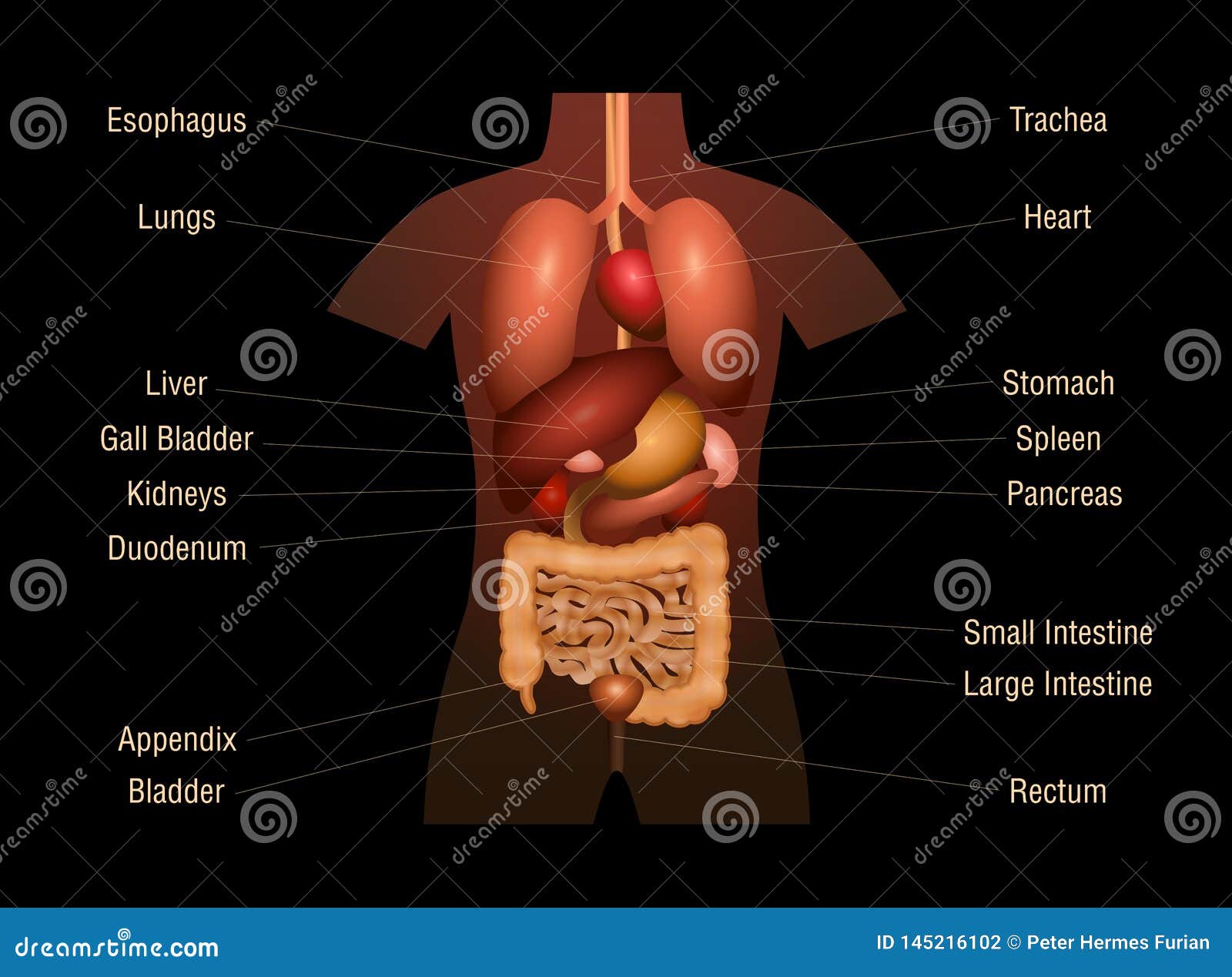
You probably think you know where your stomach is. Most people point to their belly button when they feel a cramp, but honestly, your stomach is tucked much higher up, mostly behind your lower left ribs. It’s funny how we live in these bodies for decades without actually having a clear map of the organs in our heads. We’re basically walking mysteries to ourselves.
Understanding where things sit isn't just for surgeons or med students pulling all-nighters. It matters when you’re trying to describe a weird pain to a doctor or wondering why a "kidney punch" hurts where it does (hint: they’re much higher and further back than you’d guess). The human torso is packed tighter than a suitcase on a budget flight. There isn't a millimeter of wasted space in there.
The Crowded Chest and the Upper Management
Right at the top, protected by the cage of your ribs, you’ve got the heavy hitters. The heart isn't on the far left; it’s more central, just tilted. It sits in a space called the mediastinum. Surrounding it are the lungs, but they aren't symmetrical. The right lung is shorter because the liver—a massive, three-pound chemical plant—is pushing up from underneath it. Meanwhile, the left lung is narrower because it has to make room for the heart’s "cardiac notch."
It’s a game of Tetris.
If you look at a map of the organs, you’ll see the diaphragm acting like a floor for the chest and a ceiling for the abdomen. It’s a thin, dome-shaped muscle. When it spasms, you get hiccups. Simple as that. But below that "floor" is where the geography gets really messy and interesting.
The Upper Abdomen: The Heavy Lifters
Just under your ribs on the right side is the liver. It's huge. Seriously, it's the largest solid organ in your body. It does everything from cleaning your blood to making bile. Tucked right underneath it is the gallbladder, a tiny pouch that stores that bile. People often don't realize that when they have gallbladder issues, the pain can actually radiate up to their right shoulder blade. The body’s wiring is weird like that.
On the flip side, the left side houses the spleen. It’s about the size of a fist and acts as a massive blood filter. Most of us forget it exists until it gets enlarged from something like mononucleosis. Then there’s the pancreas, which is tucked horizontally behind the stomach. It’s a "retroperitoneal" organ, meaning it’s way back there, almost touching your spine. This is why pancreatic issues often feel like deep, boring back pain rather than a stomach ache.
The Great Coiling: Navigation of the Gut
The middle of your map of the organs is dominated by the intestines. If you unspooled them, you’d have about 20 feet of tubing. The small intestine—consisting of the duodenum, jejunum, and ileum—is where the real work of digestion happens. It’s all coiled up in the center of your belly.
Surrounding that coil like a picture frame is the large intestine (the colon). It starts at the bottom right—where the famous, and somewhat useless, appendix hangs out—goes up the right side (ascending colon), across the middle (transverse colon), and down the left (descending colon) before turning into the S-shaped sigmoid colon and out the exit.
- The Ascending Colon climbs up toward the liver.
- The Transverse Colon drapes across the top of your "gut" area.
- The Descending Colon heads down toward the hip.
- The Sigmoid Colon is the final curve.
When people say they have "lower abdominal pain," it’s a total toss-up. Is it a cramp in the descending colon? Is it an ovarian cyst? Is it a bladder infection? The density of organs in the lower pelvis makes DIY diagnosis almost impossible.
The Hidden Back-Office: Kidneys and Adrenals
If you’re looking at a map of the organs from the front, you might miss the kidneys entirely. They’re "retroperitoneal," just like the pancreas. They sit against the back muscles, roughly at the level where your lowest ribs end. They aren't down by your belt line. If you put your hands on your hips with your thumbs pointing toward your spine, your thumbs are roughly over your kidneys.
On top of each kidney sits an adrenal gland. These tiny hats are responsible for your "fight or flight" response. They pump out adrenaline and cortisol. Even though they’re small, they’re some of the most powerful real estate in your entire body.
Why Anatomical Variations Matter
Here is the thing: nobody is a textbook. While a standard map of the organs shows you the "average" layout, humans are wildly different inside. There’s a condition called Situs Inversus where all your major organs are mirrored—your heart is on the right, your liver is on the left. It’s rare, affecting about 1 in 10,000 people, but it happens.
Even without a rare condition, your organs move. When you breathe, your liver moves up and down. When you eat a huge Thanksgiving dinner, your stomach expands and pushes your other organs aside. During pregnancy, the uterus expands so much it literally shoves the intestines up into the ribcage and squashes the bladder. It’s a miracle anything functions at all under that kind of pressure.
Misconceptions That Mess People Up
We tend to think of our insides as static blocks, like a 3D puzzle. They’re more like a bag of wet sponges.
One big mistake is the location of the heart. Most people think it’s under the left breast. If you’re doing CPR, though, you push on the center of the chest, on the sternum. That’s because the bulk of the heart is right there in the middle.
Another one? The "kidney area." People often point to their lower back (the lumbar region) when they think their kidneys hurt. Usually, that’s just muscle strain. Real kidney pain is often felt higher up, or even in the "flank"—the side of the body between the ribs and the hip.
Putting This Knowledge to Use
Knowing the map of the organs isn't just a party trick. It changes how you advocate for your health. If you feel a sharp pain in your lower right quadrant, you now know that’s the "McBurney's Point" area, home to the appendix. If you have a dull ache under your right ribs after a fatty meal, you can ask your doctor about your gallbladder specifically.
Don't rely on a quick Google search to diagnose yourself, though. Use this map as a communication tool.
Actionable Steps for Your Next Checkup:
- Be Specific with Geography: Instead of saying "my stomach hurts," point exactly to where it is. Use "under the ribs," "near the hip bone," or "deep in the back."
- Note the Radiation: Does the pain stay in one spot on the map, or does it move? Gallbladder pain often moves to the back; heart pain can move to the jaw or arm.
- Check the "Back Side" of the Map: Remember that your kidneys and pancreas are closer to your back than your front. If your "back pain" feels different than a muscle pull, mention it.
- Understand the Pressure: If you feel bloated, realize it's often the transverse colon (the top part of the "frame") being distended, which can even put pressure on your diaphragm and make it feel hard to take a deep breath.
The more you understand the actual layout of your "inner city," the less scary it feels when something goes a bit haywire. You’re not just a vague collection of parts; you’re a highly organized, tightly packed masterpiece of biological engineering.
/i.s3.glbimg.com/v1/AUTH_08fbf48bc0524877943fe86e43087e7a/internal_photos/bs/2025/H/e/ewwgKCQCSopdUJUwy6DA/imagem-2025-04-27-114802986.png)


