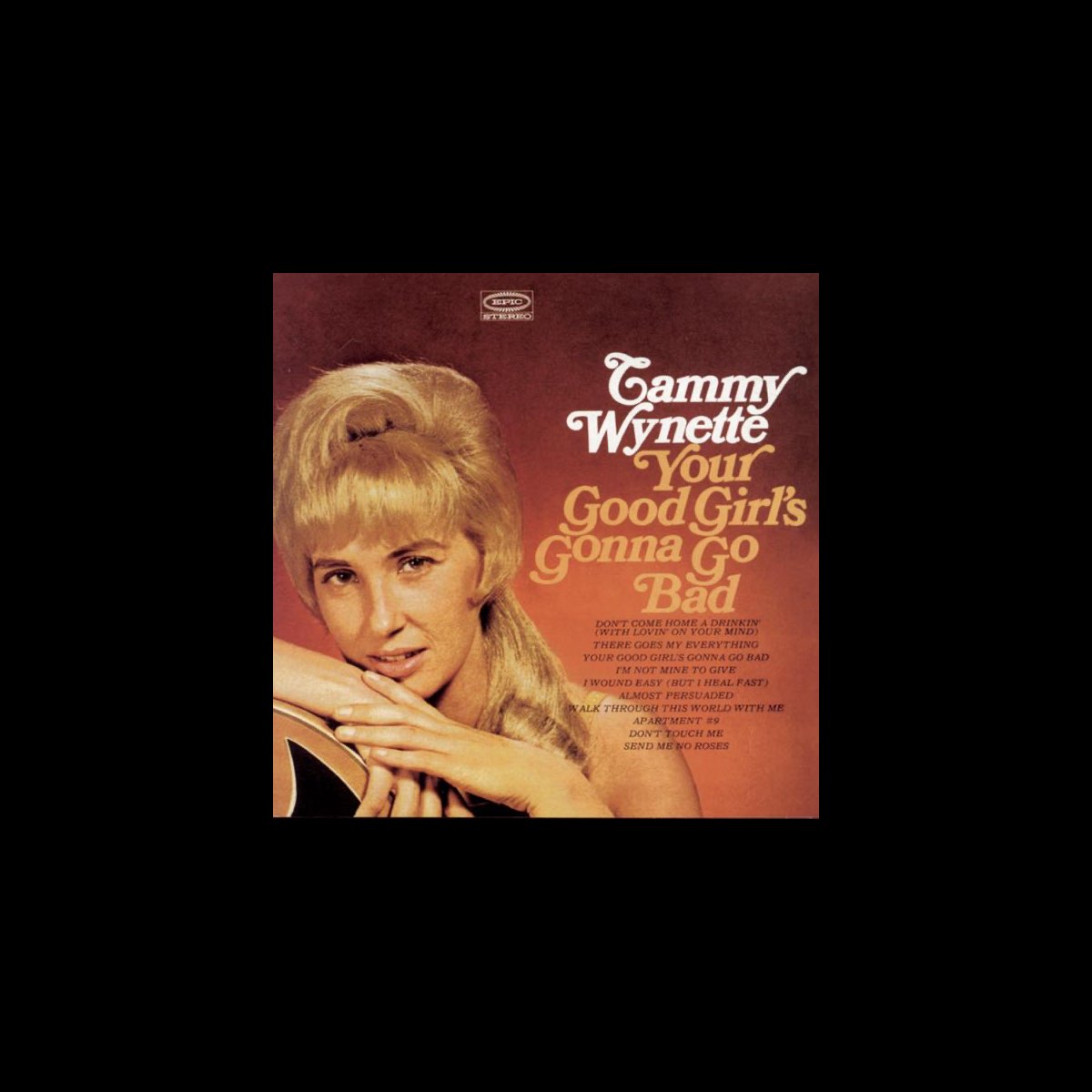
Nashville in 1967 was a specific kind of pressure cooker. You had the "Nashville Sound" smoothing out the edges of country music with strings and background singers, while the actual lives of the people singing the songs remained messy, dusty, and complicated. Enter Tammy Wynette. Before she was the "First Lady of Country Music," she was a hairdresser from Mississippi named Virginia Wynette Pugh who had just moved to Tennessee with three kids and a dream that felt more like a desperate necessity. When she released Your Good Girl's Gonna Go Bad, it wasn't just another song on the radio. It was a warning shot.
It’s easy to look back and see the bouffant hair and the sequins and think it’s all just kitsch. It isn't.
That song changed the trajectory of how women were allowed to "be" in country music. Honestly, the lyrics are kinda scandalous for the time. You’ve got a woman telling her partner that if he’s going to spend his nights in bars and chasing "painted ladies," she’s done sitting at home waiting. She’s going to join him. She’s going to trade her virtue for a night on the town. It’s a song about the breaking point of domestic patience.
The Story Behind Your Good Girl's Gonna Go Bad
Billy Sherrill produced it. If you know anything about country music history, Sherrill is the guy who basically invented the "Countrypolitan" sound. He heard something in Tammy's voice—a tear, a catch, a literal sob—that sounded like real life. They recorded the track in early 1967.
At the time, the charts were dominated by men singing about cheating and women singing about... well, mostly being cheated on. Tammy flipped the script. She wasn't just the victim here. She was a participant. The song peaked at number three on the Billboard Country Singles chart, which was a massive deal for a newcomer. People weren't used to that level of grit coming from someone who looked so polished.
Why the 1960s Weren't Ready (But Bought it Anyway)
Sociologically, 1967 was the "Summer of Love" in San Francisco, but in Nashville, the traditional family unit was still the gold standard. Your Good Girl's Gonna Go Bad poked a hole in that. It suggested that goodness was a choice, and that choice had an expiration date if it wasn't reciprocated.
You have to remember that Tammy herself was living a life that didn't fit the "good girl" mold of the era. She had already been married and divorced. She was a single mom. She was working 10-hour days at a beauty shop before heading to the studios. When she sang about the frustration of a woman pushed to the edge, she wasn't acting. She was venting.
The songwriting credits go to Billy Sherrill and Glenn Sutton. They were a powerhouse duo, but they needed Tammy to make the words believable. Anyone else singing those lyrics might have sounded like they were playing dress-up. Tammy sounded like she was looking for her car keys and her darkest lipstick.
The Sound of Rebellion
Musically, the track is a masterclass in mid-60s production. You have the steel guitar—that classic, crying sound—but it’s paired with a driving rhythm that feels modern for 1967. It doesn’t plod. It moves.
- The opening line: "I've never seen the inside of a barroom..."
- The transition: "But if you wanna drink, well I'll buy the first round."
- The defiance: "I'll be as wild as any gal in town."
It’s a transformation. In under three minutes, the "good girl" disappears. Most people focus on "Stand By Your Man" when they talk about Tammy Wynette, but that song is actually the outlier. If you listen to her early catalog, especially Your Good Girl's Gonna Go Bad, she’s much more of a firebrand than she gets credit for. She’s telling the man that his behavior has consequences. If he wants a "bad" girl, he’s about to get one—and he might not like the result.
Why We Still Care Decades Later
Kinda makes you wonder why it still resonates, right?
Because the "good girl" trope hasn't actually gone anywhere. We just call it different things now. In the 60s, it was about barrooms and "painted ladies." Today, it’s about the mental load, the "tradwife" aesthetics vs. reality, and the constant pressure on women to be perfect anchors for imperfect men.
When modern artists like Miranda Lambert or Maren Morris sing about burning things down or heading to the bar to forget a guy, they are standing on the foundation Tammy built. Your Good Girl's Gonna Go Bad was the blueprint for the "outlaw" woman in country music long before the 1970s Outlaw movement ever got a name.
Cultural Impact and Misconceptions
One of the biggest misconceptions is that Tammy Wynette was "anti-feminist" because of her later hits. People love to point at her and say she was submissive. That’s a total surface-level take.
If you actually look at her life and her debut hit, she was a woman who took control of her career and her image in a way that was incredibly rare. She wasn't asking for permission to go bad. She was stating it as a fact. The song isn't a plea; it’s a notification.
Real experts in the genre, like historian Bill C. Malone, have noted that Tammy brought a "proletarian" feel to country music. She spoke for the waitresses, the hairdressers, and the stay-at-home moms who were tired of being ignored. She gave them a voice that wasn't just "whining"—it was powerful.
Breaking Down the Lyrics
Let’s look at the second verse. She mentions that she’s going to "see how it feels to step on the wild side." This isn't just about drinking. It's about identity.
In 1967, "going bad" meant losing your reputation. In a small town, that was everything. By singing this, Tammy was signaling to her audience that some things—self-respect, parity in a relationship, being seen—were more important than a "good" reputation.
The song is also incredibly catchy. That’s the "Sherrill Touch." He knew how to wrap a radical message in a melody that you couldn't help but hum. It’s a Trojan horse. You think you’re listening to a standard country shuffle, but you’re actually listening to a manifesto of domestic rebellion.
Comparing Tammy to Her Peers
To understand how big Your Good Girl's Gonna Go Bad was, you have to look at what else was out there.
Loretta Lynn was singing "Don't Come Home A-Drinkin' (With Lovin' on Your Mind)" around the same time. Loretta was feisty and blunt. Dolly Parton was just starting to break out with "Dumb Blonde." Tammy’s lane was different. She wasn't as overtly "tough" as Loretta, and she wasn't as bubbly as early Dolly. She was the "Tragic Heroine."
Her voice had this built-in heartbreak. Even when she was singing about going out and getting wild, she sounded like she was doing it because she had no other choice. That vulnerability made the rebellion more relatable. It wasn't just "I'm going to be bad because it's fun." It was "I'm going to be bad because you've left me no room to be good."
Practical Takeaways from the Legacy of the Song
If you’re a fan of music history or just someone who likes a good comeback story, there’s a lot to learn here.
- Authenticity over perfection. Tammy didn’t have the "perfect" voice, but she had the most honest one.
- Timing is everything. She hit the market right as women were starting to question their traditional roles in the American household.
- The power of a "pivot." She took the trope of the "suffering wife" and added a layer of agency that hadn't been there before.
What Happened After the Song Hit?
The success of Your Good Girl's Gonna Go Bad led to a string of hits that would define the era. It gave her the leverage to eventually record "Stand By Your Man," "D-I-V-O-R-C-E," and "Apartment No. 9."
It also established Epic Records as a powerhouse in the Nashville scene. Before Tammy, Epic wasn't really a player in country music. She put them on the map.
Critics sometimes dismiss this era as "over-produced," but if you strip away the strings, the core of the song is pure honky-tonk. It’s a bridge between the old world of Kitty Wells and the new world of Shania Twain. You can’t get to the 90s "girl power" country without passing through Tammy’s 1967 rebellion.
Actionable Steps for Music History Buffs
If you want to really understand the impact of this song, don't just listen to the digital remaster on Spotify. Do a little digging.
- Listen to the full 1967 album. The album (also titled Your Good Girl's Gonna Go Bad) features some incredible covers and deep cuts that show her range.
- Watch the live performances. Search for her early TV appearances from '67 and '68. Look at her eyes when she sings. She’s not just performing; she’s telling a story.
- Compare the "Sherrill Sound" to contemporary producers. Listen to how he uses the "tear" in her voice compared to how other producers treated female vocalists in the mid-60s.
Tammy Wynette’s legacy is often reduced to a caricature of the "long-suffering woman." But if you go back to the beginning, to the song that started it all, you see a much more complex figure. You see a woman who was willing to burn it all down if it meant she finally got a seat at the table—or a stool at the bar.
Your Good Girl's Gonna Go Bad remains a high-water mark for country music because it’s true. It acknowledges that "goodness" isn't a static state; it's a bargain. And when the bargain is broken, all bets are off.
Next time you hear that steel guitar intro, remember that you’re listening to a revolution in a mini-skirt. It changed Nashville, it changed country radio, and it gave millions of women a way to say "enough."
To appreciate the full scope of Tammy's influence, track the evolution of the "rebel woman" archetype from this song through the 1970s outlaw era. You’ll find that the line between Tammy Wynette and Waylon Jennings is a lot thinner than most people realize. Examine the production notes of Billy Sherrill to see how he specifically highlighted vocal imperfections to create emotional resonance, a technique that remains a staple in modern recording sessions across all genres. For a deeper dive, read Tammy Wynette: Tragic Country Queen by Jimmy McDonough to understand the bleak reality that fueled her most defiant tracks.



