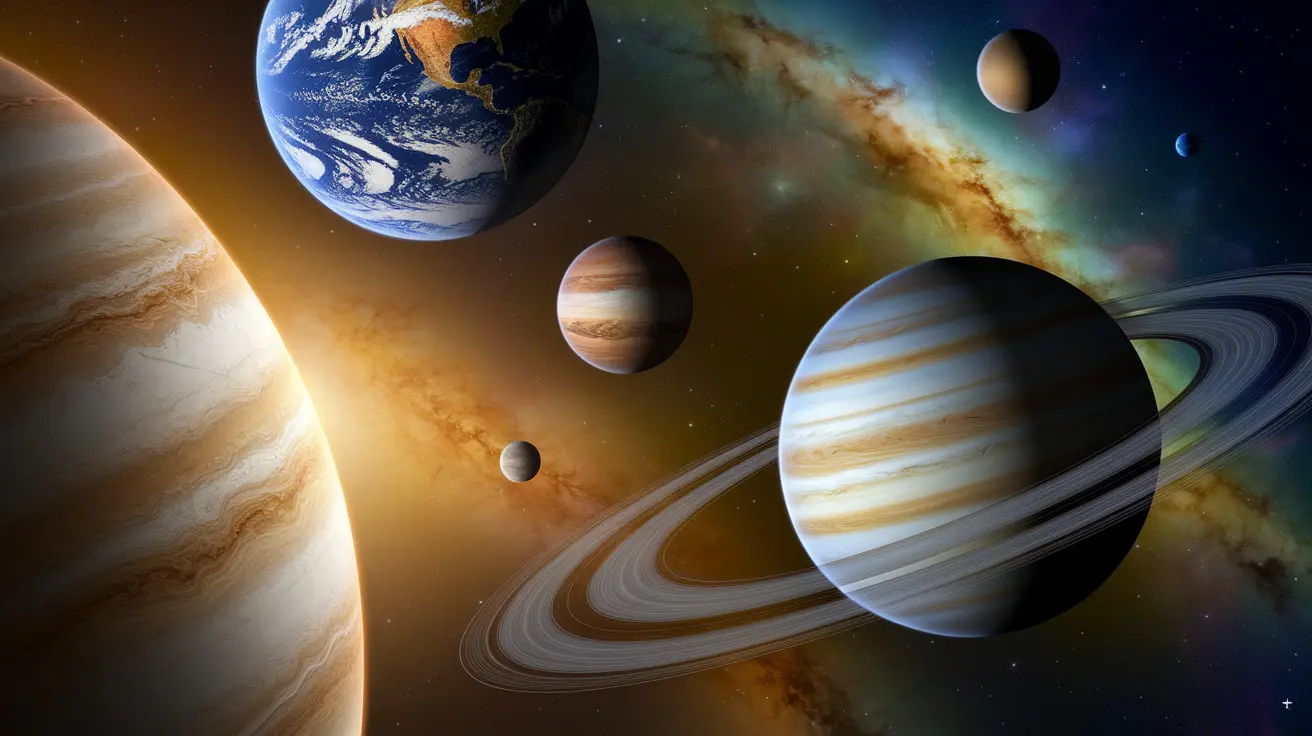
Ever feel like the years are just flying by too fast? Well, if you moved to Mercury, you’d be blowing out birthday candles every 88 days. That’s a lot of cake. Honestly, the way we think about time is incredibly Earth-centric, which makes sense because we live here, but the universe doesn't really care about our 365-day calendar. When we talk about age on different planets, we're basically talking about how fast a giant ball of rock or gas can sprint around a star. It’s simple physics, but the results are wild.
Time is relative. Not just in the "Einstein-trippy" way, but in a very literal, mechanical sense. On Earth, a year is just the time it takes us to complete one lap around the Sun. If you’re on a track that’s smaller, you finish the lap faster. If you’re on a track that’s miles wide, it takes forever.
The Mercury Sprint and Why You’d Be a Centenarian
Mercury is the solar system’s speedster. Because it’s so close to the Sun—about 36 million miles away on average—gravity pulls on it with a massive amount of "get moving" energy. It zips through space at about 30 miles per second.
If you are 30 years old on Earth, you are roughly 124 years old on Mercury. You’ve seen over a hundred "years" pass. But here’s the kicker: a day on Mercury is weirdly long. It rotates so slowly that a single day (from sunrise to sunrise) actually takes 176 Earth days. You could literally have a birthday every few hours if you measured by the sun's position. It’s a mess. Scientists at NASA’s Jet Propulsion Laboratory often have to clarify these distinctions because "day" and "year" get tangled up when you leave our atmosphere.
Venus: Where a Day Outlasts a Year
Venus is the true rebel of the solar system. Most planets spin in the same direction, but Venus spins backward. It’s also incredibly slow. It takes Venus about 243 Earth days to rotate once on its axis.
How long does it take to go around the Sun? About 225 Earth days.
Think about that. On Venus, your day is actually longer than your year. If you tried to calculate your age on different planets and landed on Venus, you’d find that you technically haven't even finished a single day by the time your first anniversary rolls around. It’s the ultimate "Monday that never ends." Because of the thick carbon dioxide atmosphere, you wouldn't even see the Sun anyway. It’d just be a perpetual, crushing gloom of 900-degree heat.
The Red Planet Mid-Life Crisis
Mars is the one most people care about because, frankly, it’s the only other place we might actually set foot on anytime soon. A Martian year is 687 Earth days.
If you’re 40 on Earth, you’re only about 21 on Mars. You’re barely legal to buy a drink in the States. This shift in perspective is something mission planners at SpaceX and NASA have to take into serious account. They don't just use Earth time; they use "Sols." A Sol is a Martian day, which is about 39 minutes longer than an Earth day.
- A 10-year-old Earthling is only 5.3 in Martian years.
- Someone "retiring" at 65 would be a spritely 34 on the Red Planet.
- Your heart beats the same number of times, but the calendar looks way different.
The gravity on Mars is also about 38% of Earth's. While your chronological age changes based on the orbit, your biological age—the wear and tear on your bones and muscles—would change because of the environment. You’d feel lighter, but your bones might age faster due to density loss. It’s a trade-off.
The Gas Giants: Where You’re Basically a Newborn
Once you cross the asteroid belt, the numbers get staggering. Jupiter is massive, but it’s far out. It takes almost 12 Earth years to make one trip around the Sun.
If you’ve lived through 36 Earth years, you are a toddler on Jupiter. You’re 3. That’s it.
But while the years are long, the days are lightning-fast. Jupiter rotates in about 10 hours. It’s a giant, spinning ball of hydrogen and helium that refuses to slow down. If you lived there (ignoring the fact that there’s no solid ground and the pressure would turn you into a pancake), you’d experience thousands of sunrises in a single Jupiter year.
Saturn’s Long Haul
Saturn takes about 29.5 Earth years to orbit the Sun.
Most people hitting their "Saturn Return" in astrology are actually just completing their first literal Saturnian year. If you’re 30 right now, Happy 1st Birthday! You’ve finally made it around once. The rings are beautiful, but the wait for a birthday party is brutal.
The Loneliness of Uranus and Neptune
Then we get to the ice giants. This is where the concept of age on different planets starts to feel a bit depressing.
Uranus takes 84 Earth years to orbit the Sun. For many humans, a lifetime is just one single orbit. You’re born in the "spring" and you die before the next spring starts. Neptune is even more extreme. It takes 165 Earth years to go around once. Since its discovery in 1846 by Urbain Le Verrier and Johann Galle, Neptune has only completed about one and a bit laps around the Sun.
If you were born on Neptune, you wouldn't live to see your first birthday. Not even close. You’d be a fraction of a year old your entire life.
Why Does This Matter? (Beyond Cool Trivia)
You might think this is just fun math for nerds, but it has real implications for space travel and our understanding of biology. Humans have a circadian rhythm—an internal clock—tuned to a 24-hour cycle. When astronauts on the ISS (International Space Station) see 16 sunrises a day, it messes with them.
We also have to talk about Time Dilation. According to Einstein's Theory of General Relativity, time actually moves differently depending on gravity and speed.
$$t' = \frac{t}{\sqrt{1 - \frac{v^2}{c^2}}}$$
While the "orbital age" is about the calendar, "velocity age" is about the actual passage of time. If you spent a year orbiting a black hole, you might return to Earth to find your children are older than you. We aren't there yet, but it’s the next level of the "how old am I" question.
How to Calculate Your Own Planetary Age
If you want to do the math yourself without a specialized calculator, you just need the orbital period of the planet.
Basically, take your age in Earth days (years times 365.25) and divide it by the planet's orbital period in Earth days.
- Find your age in days: $30 \times 365.25 = 10,957.5$
- Divide by Mars' year: $10,957.5 / 687 = 15.9$
- You're 15 on Mars.
It’s a fun perspective shift. It reminds us that "a year" isn't some fundamental constant of the universe. It's just a local measurement based on our specific neighborhood in the Milky Way.
Actionable Next Steps
If you're fascinated by how time and space interact, don't just stop at the math. Here’s how to actually use this info:
- Check your real-time age: Use a tool like the Exploratorium's "Your Age on Other Worlds" calculator to get the exact decimals. It's oddly satisfying to see you're 0.18 years old on Neptune.
- Observe the "Age" in the Sky: Download a stargazing app like Stellarium. When you see Jupiter in the sky, remember that it hasn't moved very far in its "year" since the last time you saw it, even if you've lived through a dozen Earth seasons.
- Read up on Chronobiology: Look into how NASA manages "Mars time" for rover drivers. It’s a fascinating look at how the human brain tries to adapt to a 24.6-hour day.
- Plan a "Planetary Birthday": If you have a kid (or you're just a fun adult), celebrate your Mercury birthday. It’s a great excuse for cake every three months.