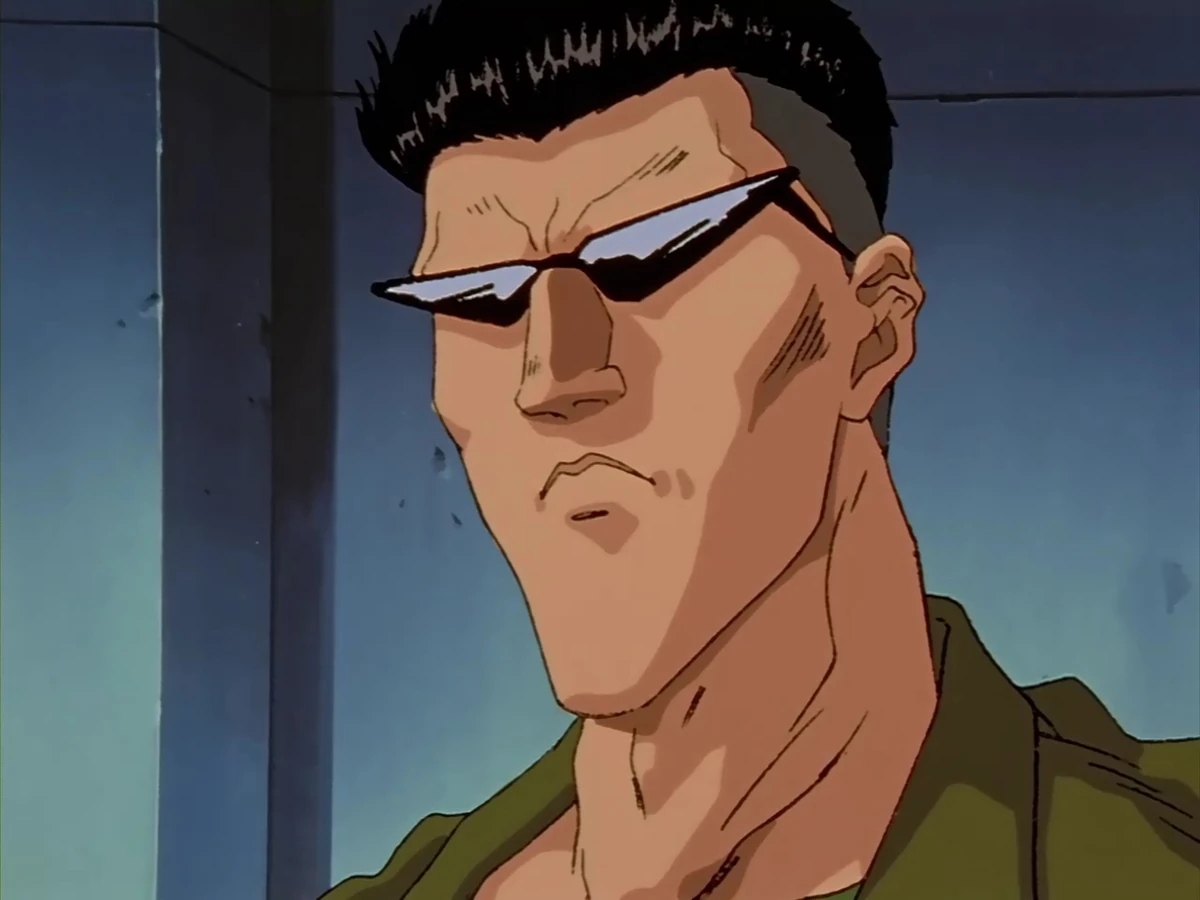
He’s just standing there. Most villains in the early 90s were screaming about world domination or cackling from a throne made of skulls, but not the Younger Toguro. He’s just standing in a ring, wearing tinted sunglasses that hide eyes we aren't even sure are still human, and he’s asking a teenage boy to hit him harder. It’s terrifying. Honestly, if you grew up watching the Dark Tournament saga of Yu Yu Hakusho, Toguro wasn't just a boss fight; he was a literal force of nature that redefined what a "bad guy" could be in shonen anime.
You’ve probably seen the memes about his muscle percentages. 100%. 120%. It sounds goofy on paper. But in the context of Yoshihiro Togashi’s writing, those numbers weren't just power levels. They were a countdown to the total erasure of a soul. Toguro represents a very specific kind of existential dread: the man who got exactly what he wanted and realized too late that it cost him everything worth having.
The Human Cost of 100 Percent Power
We have to talk about the backstory because that's where the tragedy hides. Before he was a demon with shoulders wider than a doorway, Toguro was a martial arts master. He was a man. He had a school, students he cared about, and a complicated, deep relationship with the psychic Genkai. Then Kairen showed up.
Kairen didn't just beat Toguro; he slaughtered Toguro’s students and forced him to watch. It broke something inside him. While most heroes in Yu Yu Hakusho find strength in their bonds, Toguro decided that bonds were a weakness. He decided that being human was the problem. To ensure he’d never be that helpless again, he won the Dark Tournament fifty years prior to the main series and asked for the ultimate prize: to be turned into an immortal demon.
He traded his aging process for a permanent state of peak physical violence.
It’s a grim mirror to Yusuke Urameshi. Yusuke is a punk who learns to care about people through fighting. Toguro is a man who cared about people and chose to stop so he could keep fighting. When you see them square off, you aren't just watching a spirit gun versus a fist; you're watching two different philosophies on what it means to be alive. Toguro is basically what happens when you let trauma win and then dress it up in a trench coat.
Why the Dark Tournament Works Because of Him
The Dark Tournament is widely considered the gold standard for anime tournament arcs. Why? Because Toguro is a looming shadow over every single episode. Even when Yusuke is fighting Dr. Ichigaki’s team or Jin the Wind Master, you know Toguro is watching from the VIP section. He doesn't have to say a word. The atmosphere changes the second he enters a room.
Think about the moment he "kills" Genkai. It’s one of the most brutal scenes in the series because there is no grand monologue. It’s personal. It’s a man putting down the only person who truly knew him because she reminded him of the humanity he threw away. He’s trying to provoke Yusuke into becoming a monster just like him. He wants to be proven wrong, but he's too far gone to admit it.
His power isn't flashy. He doesn't throw energy beams or cast spells. He just hits things. Hard. He flicked a thumb and sent a shockwave that decimated a stadium. He carried a massive fighting ring on his back like it was a backpack. This physical simplicity makes him feel more "real" than a villain like Sensui or Yomi. You can understand a fist. You can feel the weight of it.
The Myth of the Heartless Monster
People often get Toguro wrong. They think he’s just a meathead. In reality, Toguro is the most disciplined character in the show. He has a code. It’s a warped, terrifying code, but it’s there. He hates people who cheat. He hates people who are weak and don't try to be better.
Look at his relationship with his elder brother. Elder Toguro is a literal parasite—slimy, dishonest, and cruel for the sake of being cruel. Younger Toguro eventually kicks his own brother into the horizon because he finds him disgusting. Even though they are both demons, Younger Toguro still holds onto a sense of martial honor. He wants a fair fight. He wants to lose to someone who is "pure."
The Sunglasses Stay On
There’s a reason he never takes those glasses off until the very end. They are a barrier. Toguro spends the entire series performing a role. He’s playing the part of the ultimate obstacle so that Yusuke has something to crash against and grow.
When he finally hits 100% of his power, his body deforms. He stops looking like a bodybuilder and starts looking like a nightmare. His neck muscles expand, his skin turns grey and leathery, and his face contorts. It’s a physical manifestation of his self-loathing. He has turned himself into a literal monster to hide the fact that he’s still grieving for the students he lost decades ago.
The Ending Most People Miss
The real gut-punch isn't the fight itself. It’s what happens in the Spirit World after Toguro dies. He’s offered a lighter sentence because of his past service, but he refuses. He chooses Limbo—the harshest punishment possible. Ten thousand years of torture, repeated ten thousand times, followed by total oblivion.
Why? Because he doesn't think he deserves forgiveness.
Even after death, Toguro is the ultimate stoic. He meets Genkai on the bridge to the afterlife, takes off his glasses for the first and last time, and tells her to take care of Yusuke. It’s the only moment of genuine tenderness we get from him, and it’s devastating. He’s going to hell by choice because he can’t live with the man he became.
Most villains want to live forever or rule the world. Toguro just wanted to be punished for not being strong enough when it mattered.
How to Revisit Toguro Today
If you’re looking to dive back into this character, there are a few ways to do it that go beyond just rewatching the anime. The nuance is everywhere.
- Watch the Sub vs. Dub: Justin Cook’s performance in the Funimation dub is iconic, but the original Japanese performance by Akira Negishi offers a slightly more somber, weary tone that highlights Toguro's exhaustion.
- The Live Action Comparison: The Netflix live-action adaptation takes some liberties with Toguro’s introduction. It’s interesting to see how they handle his physical presence, though many fans feel nothing can quite capture the scale of his 120% form from the manga.
- Analyze the Manga Art: Yoshihiro Togashi’s linework in the Dark Tournament arc is incredibly detailed. The way he draws Toguro’s muscles bursting through his skin is meant to look painful, not cool. It’s body horror disguised as a power-up.
Toguro remains the peak of the series for many because he wasn't just a hurdle. He was a mirror. He showed us what happens when you value strength above everything else. He won every fight he ever had, except for the one against his own guilt.
To really understand the impact of the Younger Toguro, you have to look at the characters who came after him. He paved the way for the "tragic powerhouse" trope, but few have managed to balance the sheer physical intimidation with that level of soul-crushing regret. He didn't want to destroy the world; he just wanted someone to be strong enough to stop him from destroying himself.
Next time you’re watching that final showdown, don't just look at the Spirit Gun. Look at Toguro’s face when he finally falls. He isn't angry. He’s relieved.
Actionable Insights for Fans:
- Compare Toguro's philosophy to the Chapter Black arc's Shinobu Sensui to see how Togashi evolved his "villain with a point" writing style.
- Research the real-world bodybuilding influences Togashi used for Toguro's designs; the exaggerations are rooted in 80s and 90s fitness culture.
- Check out the Yu Yu Hakusho manga volumes 6 through 13 for the most dense character development regarding Toguro's past that the anime occasionally trims for pacing.



