The rain in Sheffield doesn’t just fall. It bleeds into the pavement, turning the grey stone into a dark, reflective mirror that bounces the neon beer signs back at the sky. It was a Friday night, the kind where the air smells of wet wool, cheap lager, and the sharp, metallic tang of the nearby tram tracks. Inside the bar, the bass was a low, rhythmic thumping that you felt in your teeth more than you heard in your ears. Outside, a young woman stood just beneath the awning, pulling her jacket tightly around her shoulders to keep out the damp chill.
She was waiting for a taxi. She was checking her phone. She was laughing at a text.
Then the glass shattered.
We tend to view tragedy through the lens of a movie camera. We expect a crescendo. We expect the lighting to change, the ambient noise to drop away, or a sudden, instinctual warning to flash through the victim's mind. But real violence is remarkably quiet until the exact second it isn't. It doesn't announce itself. It simply disrupts a perfectly ordinary moment and tears a hole through it.
The bullet didn’t belong to her. It was never meant for her. It was born from a grievance she knew nothing about, fired by a hand she had never seen, aimed at a target she didn’t know existed. Yet, when the smoke cleared from the street corner, she was the one on the ground.
The Geography of Chance
Every city has its invisible borders. We walk them every day without realizing it. You cross a street, pass a specific storefront, or linger for three minutes too long outside a particular venue, and the risk profile of your life shifts by a fraction of a percent. Most of the time, that mathematics works in our favor. We get home safe. We complain about the wait for the Uber. We complain about the drizzle.
But sometimes, the gears of the city grind together in a way that catches the entirely innocent.
Consider the physics of a crowded nightlife district. You have hundreds of moving parts—people spilling out of clubs, doormen managing queues, cars idling at the curb, and tension simmering just beneath the surface of the weekend euphoria. When a dispute flares up between factions, it creates a sudden, violent vortex.
South Yorkshire Police later confirmed what everyone at the scene already whispered in the dark: she was a bystander. Entirely blameless. A passerby caught in the crossfire of someone else's malice.
To look at the sterile police reports is to miss the entire weight of the event. The official statements use words like incident, discharge of a firearm, and peripheral casualty. These words are designed to cool the blood. They are clinical. They turn a nightmare into a file folder. They isolate the event as an anomaly, a statistical blip in the quarterly crime data.
The reality on the tarmac is entirely different. It is a scream that cuts through the music. It is the sudden, frantic stampede of heels on wet concrete as people realize that the sharp pop-pop-pop wasn't fireworks. It is the terrifying realization that the safety we assume we carry with us like a shield is actually as thin as a cobweb.
The Myth of the Right Place
We comfort ourselves with a lie. We tell ourselves that if we play by the rules, we are insulated from the dark underbelly of the world. We stay away from the dim alleys. We don't engage with the aggressive strangers. We go to respectable establishments, buy our drinks, keep our heads down, and expect the social contract to protect us.
This is the illusion of control.
When an innocent bystander is shot outside a neighborhood venue, that illusion evaporates. It sends a tremor through the community because it breaks the unwritten agreement of city life. The terror doesn't come from the fact that a crime occurred; crime happens every day in every major city across the globe. The terror comes from the total randomness of the strike.
It makes every person who has ever waited for a friend on a street corner look at the shadows differently.
If it could happen to her, standing exactly where she was supposed to be, doing exactly what she was supposed to be doing, then the boundary between the safe world and the violent world isn't a wall at all. It is a line drawn in the dust.
The ripple effect of a single stray round extends far beyond the immediate victim. It alters the psychology of an entire neighborhood. The regulars at the bar start drinking at home. The staff look toward the door with a slight tightness in their chests every time it swings open. The parents of young adults living in the city spend their Friday nights staring at their phones, waiting for the "I'm home" text that they used to take for granted.
The Machinery of Justice and the Silence After
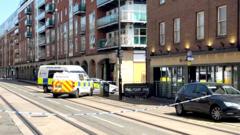
In the days that follow, the blue and yellow police tape becomes a temporary monument to chaos. Detectives scour the gutters for brass casings. They knock on doors, review CCTV footage, and ask the public for dashcam clips. They look for the silver car that sped away, or the figure in the dark hood who vanished down a side street.
But the machinery of an investigation moves at a different pace than the human heart.
While the forensic teams measure angles of deflection and analyze ballistic paths, a family sits in a sterile hospital waiting room, listening to the hum of fluorescent lights. The city moves on outside. The trams keep rattling down the rails. The bars open their doors again the next evening, because commerce cannot afford to mourn for long.
The public quickly demands answers, demanding to know how a gun ended up on a British high street where such things are supposed to be rare. We want a narrative that makes sense. We want to hear that the shooter was a monster, that the target was a villain, and that by locking them both away, the world will become predictable again.
The truth is usually much more pathetic.
Most street violence isn't organized, calculated, or grand. It is petty. It is an escalated argument over a look, a word, or a minor debt, amplified by a weapon that gives cowards the power of gods. The tragedy of the bystander is that their life is altered forever by a situation so small it wouldn't even make the local news if the trigger hadn't been pulled.
The Scars We Don't See
We often measure the gravity of these events by the medical updates. We look for words like stable, critical, or recovering. If the victim survives, the collective sigh of relief is audible. We check the box, assume the story has a happy ending, and turn the page.
That is our second mistake.
A bullet leaves two holes: one where it enters the body, and a much larger one where it exits the victim's sense of safety. The physical wound might heal. The bone mends, the tissue scars over, and the physical therapy sessions eventually come to an end. But the psychological architecture of the person is permanently rewritten.
Imagine walking through the world knowing that a random alignment of stars can bring a piece of lead through your flesh on a Friday night. Every loud noise becomes a threat. Every crowded room feels like a trap. The open sky, once a symbol of freedom, feels like an exposed ceiling where you are entirely unprotected.
The woman outside the Sheffield bar didn't choose to participate in the drama of that evening. She was an author of her own life, writing a completely different story—one about a night out, a conversation, a weekend plans. The shooter forced their way into her book and ripped out the pages, replacing them with a narrative of blood, sirens, and rehabilitation.
The rain eventually washes the street clean. The blood is scrubbed from the pavement. The blue tape is cut down and thrown into a municipal bin. By Monday morning, commuters walk over the exact spot where a life changed forever, entirely unaware of the invisible history beneath their boots.
We are all just a few seconds away from the wrong side of a line. We cross it not through our own choices, but through the careless momentum of a world that doesn't look where it's shooting. The next time you stand under the neon light of a city bar, watching the droplets fall through the glow, you realize the truest, most terrifying fact of all: the only thing separating you from the news report is a few inches of air and a stranger's erratic aim.