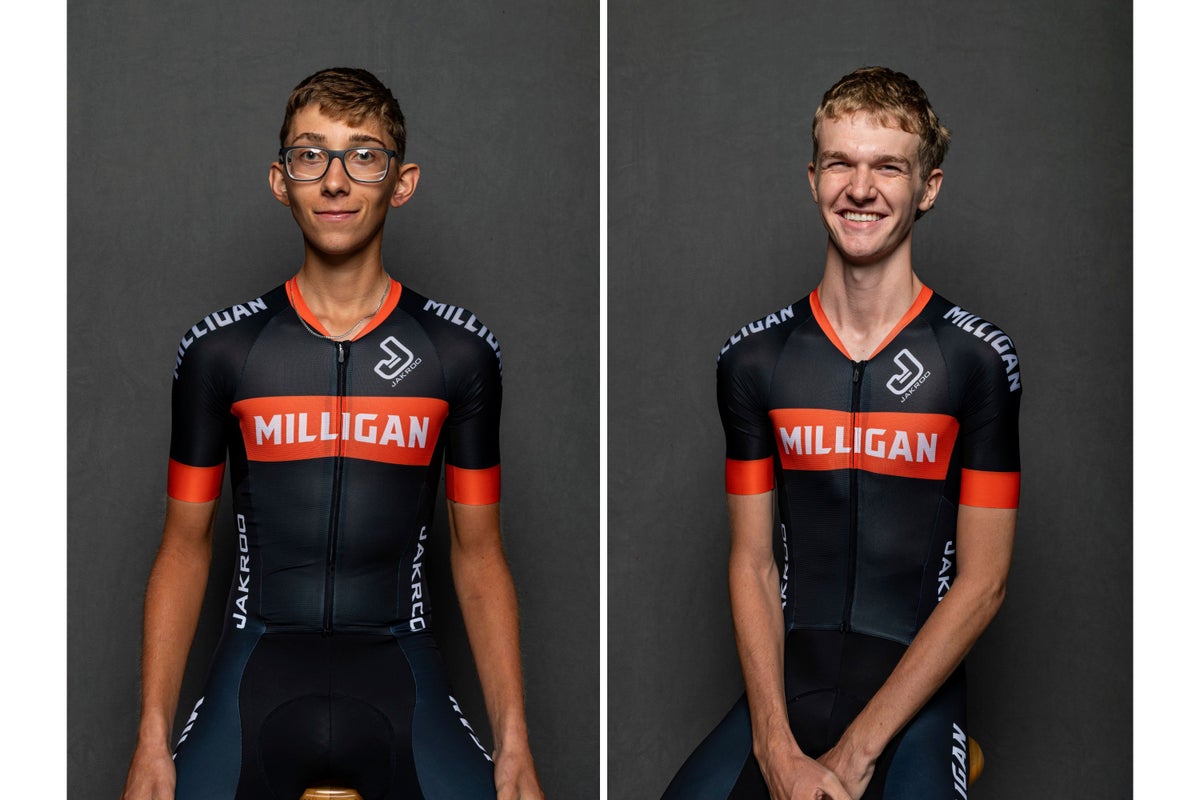
Morning on a rural mountain highway does not announce itself with sirens. It arrives in fragments of gold filtering through the mist of the Appalachian foothills, catching the dew on a carbon-fiber frame, warming the shoulders of athletes who woke before the world. Eleven young men and women from Milligan University clipped into their pedals. They were not casual weekend riders. They were elite competitors, precision-tuned machines of muscle and discipline, moving together in the synchronized rhythm of a paceline along U.S. Highway 19E in Carter County, Tennessee.
They were doing everything right. They were visible. They were predictable.
Then came the sound that split the valley.
Consider what happens next: metal yields to bone, momentum becomes a weapon, and an ordinary Wednesday morning fractures into an eternity of loss. Two of those students, Haylan Engdahl and Brayden Rogers, would never unclip. Seven others would find themselves scattered across hospital corridors, airlifted by helicopter to trauma centers while emergency lights painted the asphalt in alternating flashes of red and blue.
Every cyclist knows the feeling. It is a quiet, persistent hum at the back of the mind—the shadow of a passing grille, the sudden rush of displaced air that threatens to pull you under, the terrifying proximity of a multi-ton vehicle driven by someone who views the road not as a shared space, but as an exclusive concession for steel.
We treat these tragedies as isolated anomalies. We call them accidents. But behind the statistics lies a deeper, more uncomfortable cultural failure.
To understand the vulnerability of a cyclist on an American highway, imagine standing on a narrow strip of pavement with nothing between your skin and the earth except a centimeter of expanded polystyrene foam and a jersey. There are no airbags. There are no crumple zones. There is only balance, focus, and the fragile social contract that says the person behind the steering wheel recognizes your right to exist.
When that contract shatters, the consequences are absolute.
Authorities would later arrest a 69-year-old driver from North Carolina, slapping him with charges of reckless vehicular homicide and aggravated assault. Legal terms. Cold terminology. They do not capture the weight of a classroom suddenly missing two desks. They do not measure the silence in a dorm room where text messages go unanswered. Haylan Engdahl from Illinois and Brayden Rogers from Alabama had traveled across state lines to pursue an education and a passion, trusting that the winding mountain roads of East Tennessee would hold space for their youth.
Instead, those roads became a crime scene.
The horror of U.S. Highway 19E is not an outlier. Across the nation, tension between drivers and those who travel on two wheels has curdled into something corrosive. Social media feeds hum with casual hostility, algorithmic outrage that dehumanizes people in spandex, framing them as obstacles to be bypassed rather than sons, daughters, teammates, and friends. When a culture permits drivers to view cyclists as an irritation, asphalt becomes a battleground.
We look away because the reality is too frightening to inhabit. We prefer to think that elite athletes, seasoned and hyper-aware, must have missed something. Yet District Attorney Steven Finney made it clear: this was an elite team. They knew the rules of the road better than almost anyone. Their tragedy wasn't born of carelessness. It was born of a system that treats human lives on bicycles as acceptable collateral damage in the rush to get somewhere five seconds faster.
The trauma medical director at Johnson City Medical Center received the broken bodies of a collegiate team. Four critical. Two stable. Entire families summoned to emergency waiting rooms to hear news that no parent should ever absorb. And for what? A hurried transit. A momentary distraction. A flash of impatience on a double yellow line.
The mist has long since burned off the asphalt in Hampton, Tennessee. The wreckage has been cleared, the skid marks measured, the initial court dates set. But the white line on the shoulder remains, a narrow boundary separating life from oblivion, waiting for the next morning sun to rise over riders who ask for nothing more than the space to pass through this world safely.