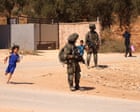
For five agonizing nights, families in the West Bank village of Qusra found themselves completely cut off from the outside world. Settlers had erected tents right at the perimeter of local homes, barricading doors and severing basic lifelines like electricity and running water. Inside one of those besieged houses sat Qusai Abu Rida and his teenage son, forced to resort to drinking well water while dozens of hostile outsiders camped just feet away. Thousands of miles away in Ohio, his brother watched the whole terrifying ordeal unfold via security camera feeds, desperately making phone calls to find a way to help.
This isn't an isolated scuffle. It represents a brutal, systematic escalation of West Bank displacement that is actively redrawing the maps of occupied territories and pushing traditional diplomatic relationships to a breaking point.
Inside the Qusra Siege and the Reality on the Ground
When you look closely at what happened in Qusra, the mechanics of forced displacement become glaringly obvious. The siege began on a Sunday when settlers blocked access points to homes on the edge of the town. They didn't just stop people from leaving; they actively shut down access for emergency services, preventing an ambulance from reaching a sick toddler trapped inside the zone.
Rights organizations like B'Tselem have documented a staggering trajectory over recent years. Dozens of Palestinian communities, comprising thousands of residents, have been entirely erased or emptied due to this relentless pressure.
The cycle usually follows a predictable, grim pattern:
- Radical settlers establish illegal outposts or makeshift tent encampments near Palestinian residential areas.
- Essential utilities like water and electricity lines are intentionally cut or sabotaged.
- Daily harassment, rock-throwing, and physical intimidation make normal life impossible.
- When residents attempt to stand their ground, military forces often step in not to protect the civilians, but to enforce movement restrictions or evacuations under the guise of security operations.
In Qusra, Maj Gen Avi Bluth, the top Israeli military commander in the West Bank, eventually visited the area and promised intervention. Yet, the immediate result of the military operation wasn't just clearing the hostile elements; troops forced multiple Palestinian families out of their homes entirely, moving them into cramped shared quarters while claiming the structures were needed for military zones. Returning homeowners later found properties vandalized, with personal items destroyed.
Why Washington and International Allies Are Speaking Out
The sheer scale of violence this year has triggered an extraordinary shift in international rhetoric. United Nations human rights offices have warned that the territory is at a catastrophic breaking point, noting that 2026 is on track to record the highest volume of settler attacks in over two decades.
Even more striking is the reaction from Washington. US Ambassador Mike Huckabee publicly labeled the actions of the settlers involved in the Qusra siege as "terrorists" and "disgusting", deploying vocabulary typically reserved for militant threats. While critics argue that rhetorical condemnations do little to stop the machinery of settlement expansion backed by far-right figures in Prime Minister Benjamin Netanyahu's government, the blunt language signals mounting anxiety among Israel's closest allies.
Former Israeli Prime Minister Ehud Olmert didn't mince words either, publicly characterizing these coordinated events as a meticulous attempt at ethnic cleansing that leaves him deeply ashamed. When domestic leaders and international diplomats use terms like ethnic cleansing and terrorism to describe state-supported displacement, it's clear the crisis has moved far beyond local policing issues.
The Broader Political Strategy Behind the Surge
You have to understand the political calculus driving this surge to see why it won't stop on its own. Israel's current governing coalition leans heavily on religious and ultranationalist factions that view the entire West Bank through a biblical lens, entirely rejecting the viability of a future Palestinian state.
Cabinet ministers openly celebrate the reconstruction of dismantled settlements, signaling to radical factions that aggressive ground actions will face minimal political friction. With domestic elections approaching, political survival for hardline officials often relies on appeasing constituents who want total territorial dominance.
The human cost gets lost in the geopolitical chess match. Families like the Ridis are left wondering if their family homes—purchased, built, and lived in for generations—will simply be stolen piece by piece while the world watches through security cameras.
If you want to track where this heads next, watch the legal challenges brought by human rights attorneys and monitor whether international sanctions against violent West Bank actors are strictly enforced or quietly rolled back. The situation on the ground remains volatile, and the pressure on civilian populations isn't easing up.