Two inches.
In carpentry, two inches is the difference between a load-bearing beam resting squarely on its sill plate and a roof sagging slowly into the living room during the first heavy snow of winter. In politics, when two men stand at the apex of American power during a shooting war in the Middle East, that tiny margin of space between them has a specific name.
They call it daylight.
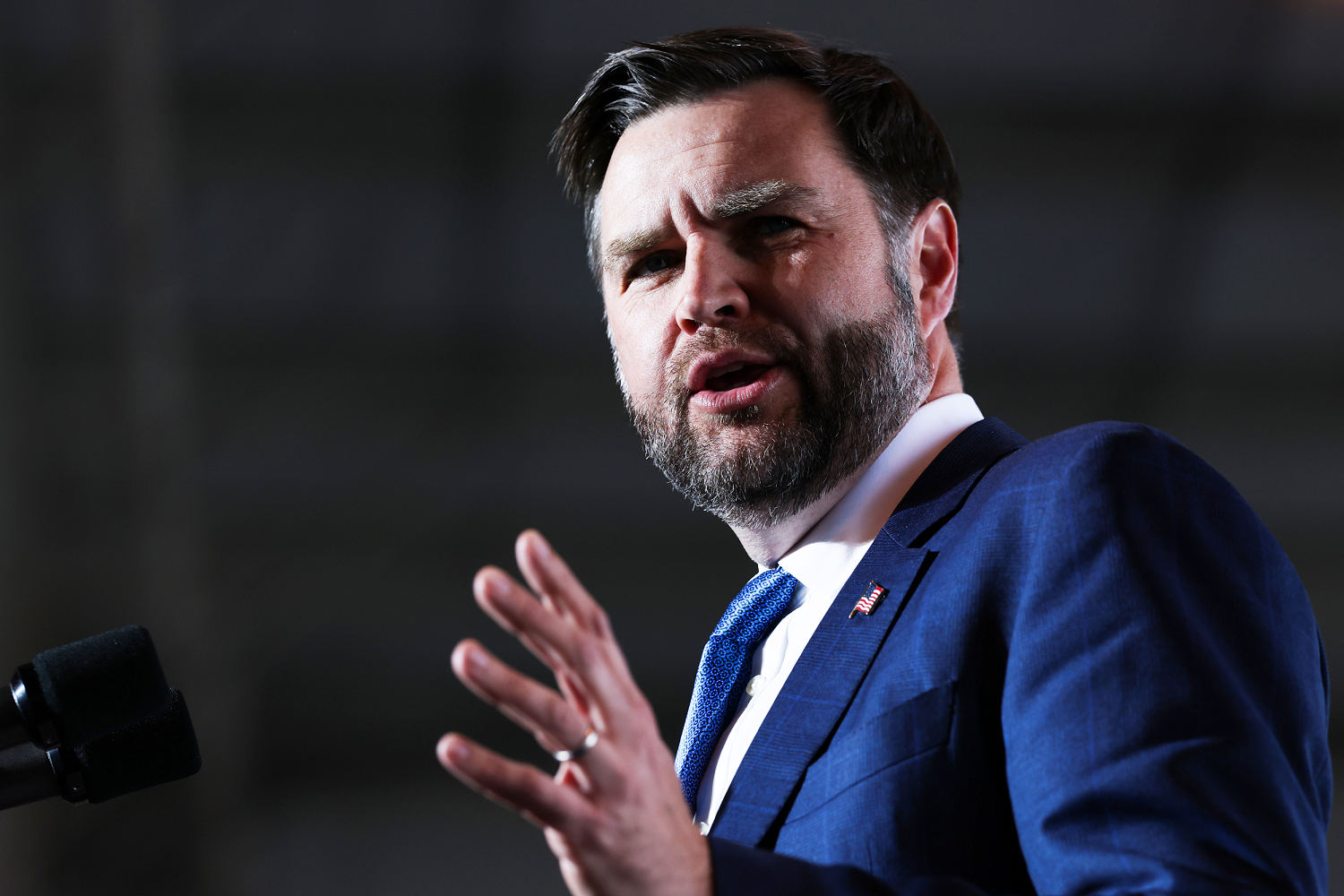
When Vice President JD Vance stepped up to a microphone recently and declared there is "no daylight" between himself and President Donald Trump regarding the war with Iran, the cable news chyrons barely blinked. Political reporters jotted down the quote, filed it under routine administration messaging, and moved on to the next briefing. It sounded like standard boilerplate—the kind of loyal echo every vice president since John Adams has been paid to produce when the cameras roll.
Look closer, though. Feel the air pressure in the room when a phrase like that drops into the middle of an active military conflict.
"No daylight" is not just a talking point about staff alignment or messaging discipline. It is a statement about who gets to pull the emergency brake when a geopolitical crisis accelerates toward a cliff. For millions of Americans watching fuel prices tick upward at the corner pump, or checking their phones late at night for unit deployment updates from bases in North Carolina and Texas, the absence of daylight between the Oval Office and the Vice President's residence changes the geometry of the entire war.
The Architecture of a Unified Front
To understand why those two words matter so much right now, step away from Washington for a moment and picture a kitchen table in Toledo, Ohio, or outside Fort Bragg.
Let us invent a character to make the math real—a hypothetical composite, though anyone who has spent time in a military town knows dozens of families just like hers. Call her Elena. Her husband is an aviation mechanic deployed on a carrier strike group operating near the Strait of Hormuz. Elena does not read foreign policy white papers from think tanks on Massachusetts Avenue. She watches the evening news with the volume turned low while her seven-year-old does math worksheets at the counter.
When Elena hears the Vice President say there is no daylight between him and the President on the war in Iran, she hears two completely different things at once.
First, she hears certainty. In wartime, chaos is the enemy of morale. If the Commander-in-Chief and his second-in-command are publicly bickering over targeting lists, rules of engagement, or diplomatic off-ramps, adversaries in Tehran smell hesitation. They stall. They escalate. They test the seams of American resolve. A locked-arms posture signals to Iran's leadership that waiting out the current news cycle or hoping for an internal palace coup in Washington will buy them nothing.
Second, however, Elena hears something colder. She hears that the room where decisions get made has no dissenting voice at the top table.
Historically, the vice presidency has often functioned as a pressure valve inside the West Wing. During the Cuban Missile Crisis in October 1962, Lyndon Johnson sat in the Executive Committee meetings, occasionally muttering doubts and testing the assumptions of the Pentagon brass while John F. Kennedy weighed blockade versus airstrikes. Four decades later, during the run-up to the Iraq War, Dick Cheney was the engine of escalation, creating a dynamic where Colin Powell became the lone skeptic across the river at the State Department. Even in 2011, Joe Biden famously advised Barack Obama against the Abbottabad raid to kill Osama bin Laden, playing the deliberate skeptic so the President had to stress-test every single variable before giving the green light.
Think of the executive branch like an aircraft cockpit. The pilot flies the plane; the co-pilot cross-checks the instruments, calls out wind shear, and challenges a bad approach before the wheels touch down. When the co-pilot announces over the intercom that there is zero daylight between his readings and the captain's, passengers either feel deeply reassured—or they wonder who is watching the altimeter.
Why Vance's Alignment Carries an Unusual Charge
JD Vance is not a traditional political understudy. Long before he took the oath of office, he built his entire political identity on skepticism toward Middle Eastern entanglements.
Anyone who followed his 2022 Senate campaign in Ohio, or read his essays and speeches throughout 2023 and 2024, remembers the core thesis. Vance argued relentlessly that a generation of American blood and treasure had been squandered in the sands of Iraq and Afghanistan by a bipartisan foreign policy establishment addicted to regime change and endless policing. He spoke as a Marine veteran who had served in Iraq—someone who knew firsthand what dust in the teeth and burned-out Humvees on the side of the highway actually look like, far removed from the climate-controlled conference rooms of the Pentagon.
That lived history is precisely why his recent remarks land with such heavy torque.
When a lifelong hawk beats the drums for military action against Tehran, nobody raises an eyebrow; it is simply a tiger showing its stripes. When a self-described realist—a man whose brand was forged in opposition to foreign intervention—stands shoulder-to-shoulder with the President and declares complete unity on a war with Iran, the political terrain shifts beneath everyone's feet.
Critics on both ends of the spectrum immediately seized on the contradiction. Anti-war voices on the populist right felt a sudden chill, wondering if the restraint wing of the administration had quietly folded its tent. Meanwhile, traditional defense hawks watched with cautious satisfaction, convinced that the realities of sitting inside the Situation Room—looking at raw intelligence intercepts, satellite imagery of fortified underground centrifuges, and real-time reports of proxy strikes on American sailors—had forced a rapid education.
Both interpretations miss the deeper human truth of what happens inside that basement room beneath the West Wing.
Intelligence briefings have a way of stripping away ideological bumper stickers. When you are a senator, a crisis in the Persian Gulf is an abstract debate about deterrence theory and budget appropriations. When you are the Vice President, the briefing book placed on your desk at six in the morning contains the names, ages, and hometowns of twenty-two-year-old service members standing watch on destroyers within range of ballistic missiles. Abstraction dies the second you sign off on the rules of engagement.
The Ghost of 1979 and the Strait of Hormuz
To grasp the invisible stakes behind the Trump-Vance alignment, you have to look at a map of the Persian Gulf and trace a narrow curved strip of water barely twenty-one miles wide at its tightest pinch point.
The Strait of Hormuz is the jugular vein of the global economy. Roughly a fifth of the world's petroleum passes through those waters every single day. Tankers the length of three football fields glide through shipping lanes narrower than a suburban highway corridor, flanked on the north by the rugged, radar-studded coastline of Iran.
The feud between Washington and Tehran did not start last Tuesday, nor did it begin with this administration. It stretches back nearly half a century to November 1979, when Iranian students scaled the walls of the U.S. Embassy in Tehran and held fifty-two Americans hostage for 444 days. Since that winter, every single American president—from Jimmy Carter and Ronald Reagan through George W. Bush, Barack Obama, and Joe Biden—has spent sleepless nights staring at that same twenty-one-mile stretch of saltwater.
For decades, the conflict remained mostly in the shadows: tanker wars in the 1980s, covert cyberattacks like Stuxnet that spun Iranian centrifuges to pieces, proxy battles fought through Hezbollah in Lebanon, the Houthis in Yemen, and militias in Iraq and Syria. Both sides played a deadly game of calibrated escalation—pushing right up to the red line without stepping fully across it.
War breaks out when the calibration fails.
Once kinetic strikes begin—when air defenses light up the night sky over Isfahan or Natanz, and retaliatory salvos streak toward regional bases—the old rules of shadow boxing evaporate. The question stops being how do we deter Iran? and becomes how does this end without setting the entire region on fire?
And that brings us straight back to the phrase "no daylight."
The Temptation of the Echo Chamber
I remember covering local emergency management drills years ago, sitting in the back of a municipal command center during a simulated chemical spill. The director had a strict rule: before any evacuation order went out, one senior deputy was assigned the mandatory role of tearing the plan apart. Even if the deputy agreed with the director ninety-nine percent of the time, he had to spend ten minutes arguing why the wind shift might push the plume toward the elementary school instead of the river.
Why? Because under extreme stress, human beings crave consensus. When stakes are terrifyingly high, disagreement feels like disloyalty, and doubt feels like weakness.
In Washington, that psychological gravity is ten times stronger.
When Vance says there is no daylight between him and Trump, he is projecting ironclad loyalty—a quality Donald Trump values above almost every other political virtue. Trump has never tolerated aides or deputies who leak doubts to the press or hedge their bets in television interviews. For Vance, whose political future depends entirely on maintaining the trust of the President and the movement he built, public alignment is survival.
Yet there is a profound difference between public unity and private groupthink.
A healthy administration can—and must—maintain absolute discipline in front of the cameras while fiercely debating options behind closed mahogany doors. If "no daylight" means Vance and Trump present a seamless front to Tehran, Beijing, and Moscow so that no adversary can drive a wedge between them, that is textbook statecraft. Nobody wants a repeat of past administrations where the Pentagon and the State Department leaked rival war plans to the Sunday newspapers while troops were in harm's way.
If, however, "no daylight" means that the questions Vance used to ask on the campaign trail—What is the exit strategy? How do we prevent mission creep? What happens on day ninety after the initial targets are destroyed?—are no longer being asked inside the room, then the danger multiplies exponentially.
History is merciless to leaders who confuse unanimity with wisdom.
In 1965, Lyndon Johnson surrounded himself with brilliant, credentialed men—Robert McNamara, Dean Rusk, McGeorge Bundy—who locked arms around the escalation in Vietnam. George Ball, the Under Secretary of State, wrote memo after memo warning that America was wading into a quagmire it could not win, yet his voice was politely filed away so the appearance of unified resolve could be preserved. Decades later, looking back at the wreckage, the architects of that consensus admitted they had mistaken their own certainty for foresight.
What the Rest of Us Are Actually Asking
Strip away the cable news panels and the partisan scorekeeping, and the confusion most Americans feel right now is completely justified. It is scary to watch another Middle Eastern war unfold when the memory of twenty-year occupations is still fresh enough to ache.
People are not stupid. They can hold two competing thoughts in their heads at the exact same time: they do not want a nuclear-armed Iranian regime threatening global stability, and they do not want their sons, daughters, brothers, or neighbors fighting another open-ended war on the other side of the planet.
When voters hear that Trump and Vance are completely aligned on the war in Iran, their instinct is to ask practical, grounded questions that rarely get answered in thirty-second soundbites:
- Does alignment mean escalation, or does it mean a strictly limited campaign? Both Trump and Vance have repeatedly argued that American military force, when used at all, should be overwhelming, brief, and targeted—not an exercise in nation-building. If their shared doctrine holds, the goal is degrading specific capabilities and forcing a diplomatic settlement from a position of strength, rather than putting boots on the ground in Tehran.
- How does this hit home economically? Every flare-up in the Persian Gulf sends tremors through crude oil futures. Even though the United States produces far more domestic energy than it did during the oil shocks of the 1970s, oil is priced on a global market. A prolonged disruption in the Strait of Hormuz translates within weeks into higher diesel costs for freight trucks, higher grocery bills in suburban supermarkets, and tighter budgets for working families who have zero margin for error.
- Who holds the constitutional reins? Under the War Powers Resolution of 1973, a president must notify Congress within forty-eight hours of committing armed forces to military action and cannot keep them there for more than sixty days without congressional authorization. A unified White House makes it far harder for lawmakers on Capitol Hill—especially members of the President's own party—to push back or demand formal war authorization votes.
Consider what happens next when a political coalition built on "America First" restraint has to metabolize an active foreign war.
For years, the populist movement rallied behind the promise that Washington would finally stop prioritizing distant borders over domestic factories, crumbling bridges, and struggling towns. Now, the two men leading that movement are asking their supporters to trust that this conflict is different—that it is decisive, necessary, and tightly bounded. That trust is a finite currency. Every week the conflict drags on without a clear, verifiable conclusion, the strain on that coalition grows heavier.
The Silence Between the Words
Late at night, long after the press corps has packed up its tripods on the North Lawn and the evening broadcasts have faded to reruns, the White House becomes an eerily quiet building.
Walk down the West Wing colonnade after midnight and you can hear the hum of the ventilation system and the soft click of a Secret Service agent's shoes on the marble floor outside the Oval Office. It is in those quiet hours—away from the podiums, the cameras, and the carefully calibrated phrases—that the true weight of executive power settles onto human shoulders.
When JD Vance says there is no daylight between himself and Donald Trump on the war in Iran, he is drawing a line in the sand for the world to see. He is telling Tehran that America will not fracture from within. He is telling allies in the region that Washington's commitment will not waver at the first sign of diplomatic turbulence. And he is telling the American public that the two men at the helm are steering by the exact same compass.
Yet in carpentry, just as in statecraft, a seasoned builder knows a quiet secret about tight joints. Wood swells in the summer humidity and shrinks in the winter freeze. If you butt two massive beams together without leaving even a hairline gap for expansion, the pressure doesn't disappear—it builds silently inside the grain until something splits.