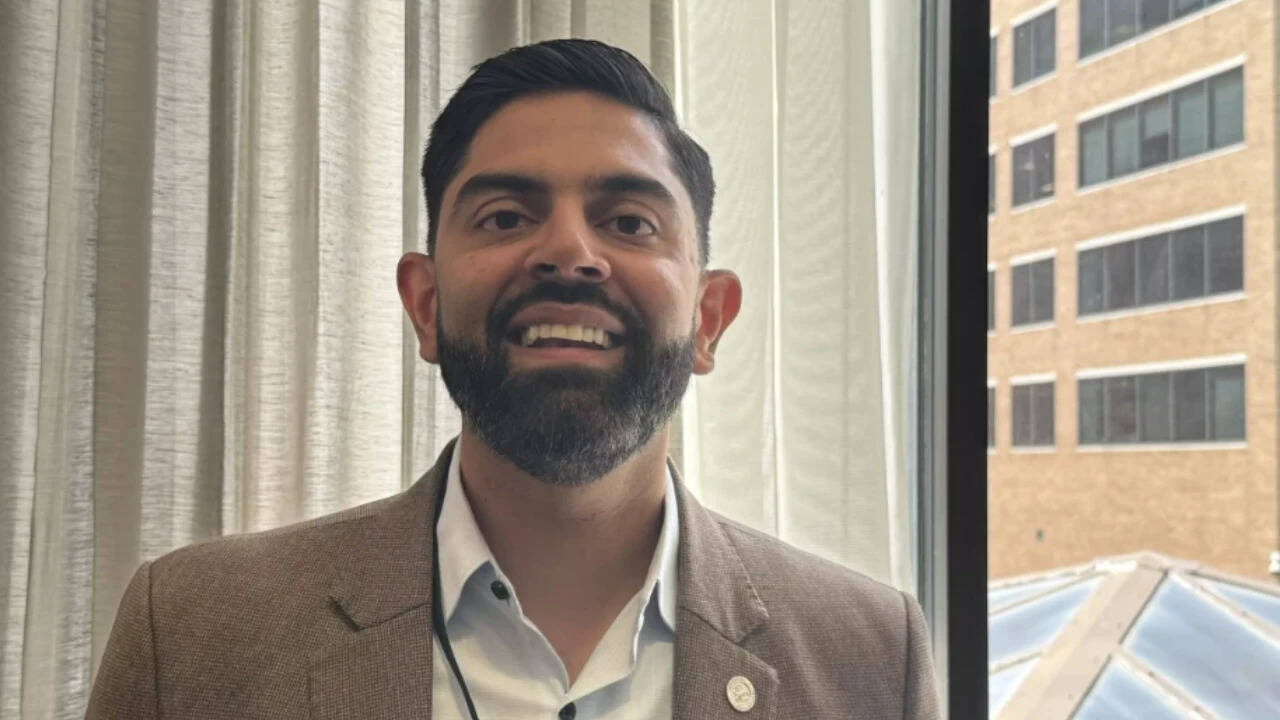
The wood of a gavel does not care who holds it. Oak is oak. Brass is brass. Yet when a hand closes around that handle on the floor of the Michigan House of Representatives, the room shifts, the air thickens, and a century of unspoken assumptions suddenly has to reckon with a new reality.
History, in state capitols, usually arrives wearing a sensible suit and carrying a thick binder of procedural rules. It rarely announces itself with fireworks. Instead, it sounds like a clerk reading a roll call, the dry rustle of paper, and the quiet click of a microphone turning on. When Ranjeev Puri stepped forward in Lansing to claim the title of Michigan House Speaker, becoming the first Indian-American to hold the gavel in the state’s history, the headlines immediately reached for the obvious superlatives. First. Historic. Milestone.
Those words are accurate, of course, like calling the Mackinac Bridge a large piece of steel. They tell you what the thing is without telling you what it holds up, or how hard the wind blows across the water when nobody is looking.
To understand what actually happened in that chamber, you have to step away from the podium and walk out into the humid suburban sprawl of Canton Township, down the aisles of Indian grocery stores in Farmington Hills, and into the quiet living rooms of families who spent decades learning how to lower their voices so they wouldn't draw the wrong kind of attention. You have to look at the invisible math of political power—and what happens when someone who grew up on the margins of that equation suddenly becomes the person writing the formula.
The Arithmetic of Belonging
For years, if you grew up South Asian in the Midwest, politics was something that happened to you, not something you directed. You were a demographic slice on a campaign manager’s spreadsheet, a reliable source of fundraising checks, or a polite face standing three rows behind the candidate during a Diwali photo op.
Consider a hypothetical scene that has played out in a thousand variations across Wayne and Oakland counties over the last thirty years. Picture a kitchen table in the late 1990s. A father, an engineer who arrived in Detroit with two suitcases and a degree that American firms initially eyed with suspicion, is helping his son with math homework while the evening news murmurs in the background. On the television, politicians in Lansing argue over auto insurance rates, school funding, and road repairs. The father watches quietly, understanding every policy nuance, yet feeling an invisible glass wall separating his family from the people making those decisions. To him, safety meant stability. You kept your head down, you excelled in medicine or engineering or business, and you left the messy, combative theater of American governance to people whose names didn't require phonetic spelling guides.
That instinct wasn't cowardice; it was survival arithmetic. When you are building a foothold in a new country, you do not gamble your family's security on the volatile whims of an electorate.
Ranjeev Puri’s trajectory breaks that old calculus wide open, not because he rejected the world his parents built, but because he carried its exact mechanics into a place that wasn't designed for him. Born in Wisconsin to Indian immigrants, educated in business, and seasoned in the pragmatic grind of corporate strategy and community organizing before winning his seat representing Canton, Puri did not arrive in Lansing as a symbolic ornament. He arrived as a tactician.
And in Michigan politics, tactics are everything.
Why the Speaker’s Chair Is Different
Most people outside of state government misunderstand what a Speaker of the House actually does. They imagine a ceremonial moderator—someone who bangs a wooden hammer, calls for order when tempers flare, and occasionally gives a speech for the local news cameras.
That is a comforting fiction. The reality is far sharper.
Think of the Michigan House of Representatives not as a debating society, but as a massive, pressurized water system serving ten million residents. Every bill—whether it funds a rural hospital in the Upper Peninsula, regulates PFAS chemicals in municipal water, or rewrites tax credits for electric vehicle battery plants—is water trying to move through the pipes. The Speaker of the House holds the main valve. Nothing flows without their consent. Nothing reaches the floor for a vote unless they decide it survives committee. They control committee assignments, determine which bills live or die in quiet drawers, manage caucus discipline when margins are razor-thin, and negotiate directly with the Governor and the Senate Majority Leader behind closed doors where the real compromises are hammered out.
Power. Pure, procedural, unglamorous power.
In a state like Michigan, where partisan majorities have swung wildly and single-vote margins can turn a routine Tuesday session into a hostage negotiation, the Speaker’s chair is arguably the second most consequential seat in state government. When Ranjeev Puri ascended to that role, he wasn't just breaking a demographic barrier; he was taking control of the legislative engine in one of the most fiercely contested political battlegrounds in America.
I remember watching a local precinct meeting in suburban Detroit nearly fifteen years ago, back when the idea of an Indian-American leading a legislative chamber in the Rust Belt felt like pure fantasy. A handful of young South Asian volunteers were trying to pitch a local party chair on translating voter guides into Hindi, Punjabi, and Gujarati. The chair—a well-meaning veteran of union politics who had worked the same turf since the Carter administration—looked at them with genuine confusion. "Do those folks even vote in primaries?" he asked, not out of malice, but out of total blind-spot ignorance. He simply couldn't picture them as a constituency worth courting, let alone leading.
That blind spot didn't vanish overnight. It eroded slowly, election by election, as South Asian communities in Michigan grew into one of the fastest-expanding demographic groups in the state. Between 2010 and 2020, the Asian American population in Michigan surged by over thirty-five percent, clustering heavily in the exact suburban corridors—Canton, Troy, Novi, Ann Arbor—that decide statewide elections.
Numbers alone, however, do not translate into authority. Plenty of growing communities remain politically fractured or perpetually sidelined. To convert demographic presence into institutional leadership requires someone who understands both worlds fluently—someone who can walk into a union hall in Downriver, a gurdwara in Canton, and a boardroom in downtown Detroit without changing their core cadence.
The Quiet Mechanics of the Climb
Puri’s rise inside the Michigan House Democratic caucus followed a pattern that political insiders recognize immediately, even if voters rarely see it up close. Before becoming Speaker, he served as Majority Whip—a title that sounds like something out of a nineteenth-century boarding school, though its real function is closer to an air traffic controller during a thunderstorm.
As Whip, your job is to count noses and read souls. You have to know which member is nervous about a tough vote because their district leans conservative, which member is holding out for road funding in their township, and who is bluffing when they threaten to tank a bill. You spend hours listening to complaints, absorbing anxiety, and finding the narrow path where fifty-six distinct egos can somehow agree on a single piece of legislation.
It is grueling, thankless work. You don't get the press releases. You get the headaches.
Yet that exact apprenticeship is what makes a Speaker formidable. While louder politicians chased viral moments on cable news or social media, Puri built trust the slow way—member by member, district by district, crisis by crisis. When Michigan Democrats held a razor-thin 56-54 majority during the 2023–2024 legislative session, every single floor vote felt like walking a tightrope over an open furnace. One illness, one sudden resignation, one defection, and the entire agenda stalled. Navigating that environment required a peculiar combination of patience and steel.
You cannot bully a caucus with a two-seat margin. You have to persuade them, protect them, and occasionally absorb their political bruises so they survive their next reelection.
By the time his colleagues tapped him to lead them as Speaker, Puri wasn't an outsider knocking on the door asking for a seat at the table. He had spent years helping keep the table from collapsing.
What Representation Actually Changes
There is a tired debate in modern politics about whether identity matters in leadership. Critics argue that a leader’s background is irrelevant—that only policies, budgets, and ideological alignment count. Supporters sometimes swing too far the other way, treating representation as an automatic cure-all that solves systemic problems simply by changing the face at the podium.
Both views miss the subtle, practical truth of how human institutions actually work.
When someone with Ranjeev Puri’s lived experience holds the Speaker’s gavel, policy debates don't magically become easier, nor do partisan divisions evaporate. Michigan still faces brutal structural challenges: an aging population, fierce debates over energy transition, underfunded schools, and a manufacturing economy caught between combustion engines and electric batteries. A Sikh-American Speaker still has to wrestle with the exact same budget spreadsheets as every predecessor before him.
What changes is the peripheral vision of the institution.
Every human being brings blind spots into a room shaped by what they never had to worry about. If you have never watched your parents navigate immigration bureaucracy, you might treat state licensing delays for foreign-trained doctors as a minor administrative footnote rather than an urgent economic waste. If you have never heard your community’s houses of worship described with suspicion, you might view hate-crime reporting statutes as abstract legal theory rather than basic neighborhood security. If you have never straddled the cultural expectations of an immigrant household while trying to build a career in the American Midwest, you might miss how small-business lending rules unintentionally freeze out family-run enterprises that don't fit traditional banking templates.
Representation doesn't dictate the answer to those questions. It ensures the questions actually get asked before the bill is printed.
And there is another effect, harder to measure in legislative analyses yet immediately visible in the hallways of the Capitol: permission.
Think back to that hypothetical kitchen table in Canton or Troy, except fast-forward to right now. A fourteen-year-old girl—maybe her parents run a pharmacy off Ford Road, or maybe her mother codes software for an automotive supplier—scrolls past a news clip on her phone. She sees a man who looks like her uncles, carrying a name that sounds like her own family’s history, standing at the center of the Michigan House of Representatives, holding the gavel, commanding the room.
She doesn't even have to agree with his politics for the mental architecture in her head to rearrange itself. The glass wall between "us" and "the people who run the state" cracks open. Suddenly, public service stops looking like a costume meant for somebody else and starts looking like a viable, ordinary path—just like engineering, or medicine, or law.
That shift in imagination is irreversible. Once a door opens in public life, nobody can ever convincingly claim again that it was locked for a reason.
The Pressure Under the Spotlight
Of course, being the first comes with an invisible tax that rarely shows up in celebratory profiles.
When you are the first person from your background to hold high office, you are never allowed to have an ordinary bad day. If a traditional politician stumbles in a budget negotiation or loses a floor vote, commentators critique their strategy or their party’s messaging. When a trailblazer stumbles, quiet whispers immediately start circulating about whether they were "ready," whether they fit the mold, or whether their rise was premature. Every compromise is scrutinized from both sides—by political opponents looking for weakness, and by segments of your own community who hope you will champion every single priority they hold dear, even when legislative math makes that impossible.
It is an exhausting tightrope. You have to represent a specific district in southeastern Michigan while also carrying the unspoken expectations of hundreds of thousands of Indian-Americans across the Midwest who see their own dignity reflected in your performance.
And you have to do it in Lansing—a capital city where partisan trench warfare has grown sharper over the past decade, where procedural gridlock is routinely weaponized, and where the margin for error is measured in millimeters.
Will Ranjeev Puri’s tenure as Speaker be defined solely by the historic nature of his election? Almost certainly not, and if you ask anyone who knows how Lansing operates, they will tell you he wouldn't want it to be. History gets you through the door on day one. By day two, the only currency that matters in the Michigan House is whether you can pass a budget on time, keep your caucus intact when tough votes hit the board, and deliver tangible results for families who care far more about their grocery bills and local schools than about legislative trivia.
Yet the two truths—the historic milestone and the relentless daily grind—cannot be separated. They feed each other. Every mundane procedural ruling, every late-night budget compromise, every quiet conversation on the House floor now happens through a lens that Michigan politics has never looked through before.
Late in the afternoon in Lansing, after the visitors’ gallery empties out and the press corps packs up their tripods, the House chamber grows remarkably quiet. Sunlight slants through the tall arched windows, catching the dust motes drifting above the dark wood desks where generations of lawmakers—farmers from the thumb, auto workers from Flint, lawyers from Grand Rapids—once argued over the future of the peninsula.
At the front of the room sits the rostrum, polished smooth by a century and a half of hands reaching for order. The gavel rests beside the microphone, heavy, plain, and waiting for tomorrow’s session to begin.