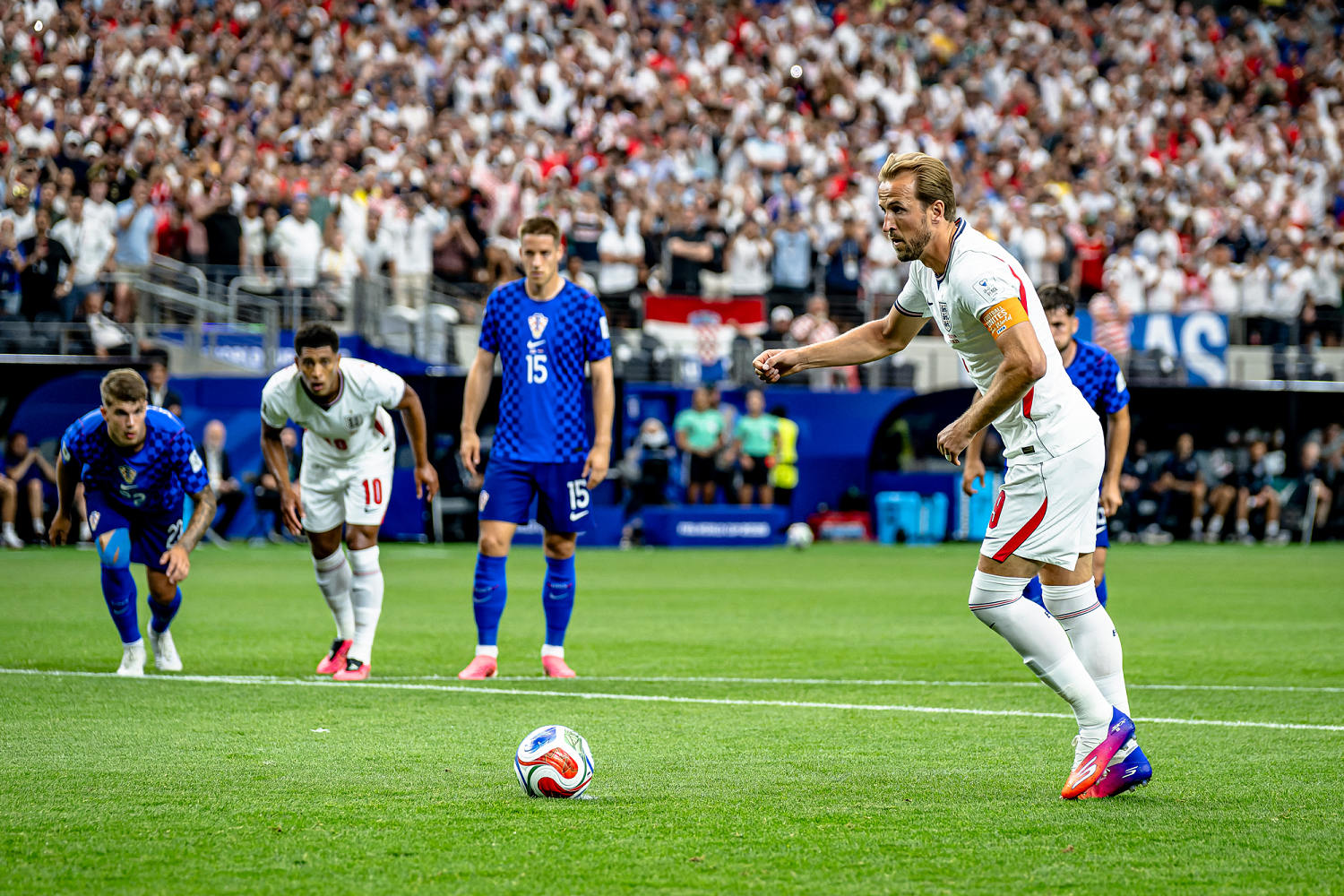
The air inside the Volgograd Arena did not circulate. It hung like wet wool, thick with the scent of cheap beer, flares, and the nervous sweat of 40,000 human beings waiting for a disaster they felt they had already lived through.
To understand English football is to understand a specific kind of hereditary trauma. It is an ambient anxiety passed down from parent to child, codified in the penalty heartbreaks of 1990, 1996, 2004, and 2006. By the summer of 2018, the national team was no longer just a sports franchise. It was a multi-million-pound psychological experiment in how much disappointment a single island could endure before apathy set in.
Then came Tunisia.
On paper, the opening match of a World Cup group stage against a team ranked 21st in the world should be a routine exercise in tactical superiority. The spreadsheets said England should win. The bookmakers said England should win. But spreadsheets do not feel the crushing, invisible weight of forty-four million pairs of eyes watching from pubs, living rooms, and construction sites across a rainy June landscape back home.
Harry Kane stood in the tunnel, adjusting the elastic band around his left bicep. He did not look like a savior. He looked like a man about to clock into a shift at a logistics firm. His jaw was slack, his hair combed back with the severe utility of a schoolboy in a Sunday portrait. Yet, beneath that unremarkable exterior lay the most lethal anatomical mechanism in British sport: an internal thermostat that simply refused to register external pressure.
The whistle blew, and the noise hit like a physical blow.
The Mirage of Control
For twenty minutes, England played with the frantic, beautiful arrogance of youth. They moved the ball with a fluidity that felt almost un-English, a short-passing kaleidoscope designed by Gareth Southgate to purge the ghosts of the past. Raheem Sterling flicked, Dele Alli glided, and John Stones loomed at the back like a cultured central banker.
When the first goal arrived in the 11th minute, it felt like an eviction notice served to decades of doubt. John Stones met a corner with a thunderous header. The Tunisian goalkeeper, Mouez Hassen, made a spectacular, desperate clawing save, but the ball fell into the six-yard box.
Kane was there. He is always there.
It is a geometric oddity of his career that the ball seems drawn to him like iron filings to a magnet, but it is not luck; it is a profound, microscopic understanding of spatial decay. He knew where the rebound would land before Stones even leaped. A simple, cushioned side-foot into the net. 1-0.
In London, beer cups flew into the sky, painting the ceilings of fan zones with sticky rivers of lager. The narrative was written. England was back. The golden generation had arrived, wrapped in waistcoat-wearing modesty.
But English football is a tragedy that requires hope to function. Without the hope, the eventual collapse carries no artistic merit.
The shift happened quietly. Tunisia, bloodied but stubborn, began to realize that England’s beautiful passing carousel lacked a killer instinct in the final third. Jesse Lingard hit the post. Sterling missed from three yards. The air grew heavier. The midges—millions of tiny, biting insects that swarmed the stadium like a biblical plague—began to coat the players' skin. Harry Kane was seen swatting at his own eyelids, his face covered in bug spray that offered no protection against the humidity or the bugs.
Then came the 33rd minute.
Kyle Walker, playing out of position as a central defender, turned his head to track a cross. His arm trailed behind him, a loose appendage in a crowded penalty area. It caught Fakhreddine Ben Youssef across the face. It was soft. It was clumsy. It was completely unnecessary.
The referee pointed to the spot. Ferjani Sassi stepped up, rolled the ball past Jordan Pickford’s outstretched fingers, and celebrated with a backflip that felt like a knife turning in the collective gut of an entire nation.
1-1.
The stadium transformed. The Tunisian fans, thousands of whom had crossed the Mediterranean to be there, created a wall of whistling that frayed the nerves of England’s young midfield. You could see the precise moment the old paralysis crept back into the players' legs. The passes became shorter, safer, and entirely devoid of imagination. The ghost of Euro 2016—the humiliating defeat to Iceland—began to pace the touchline.
The Clock as a Weapon
Time in a football match is elastic. When you are winning, ninety minutes expires in the blink of an eye. When you are drawing a game you must win, each tick of the stadium clock feels like a heavy stone dropped into your pockets.
By the 70th minute, the match had degenerated into an agonizing exercise in frustration. Tunisia had dropped eleven men into a low block, creating a human wall twenty yards from their own goal line. To break down a low block requires patience, but patience is the first thing that evaporates when panic arrives.
Southgate made his changes. Marcus Rashford came on, his boots flashing like orange sparks, but the red wall held. Kieran Trippier swung cross after cross into the box, each one met by a Tunisian head or cleared with a desperate, lunging boot.
Consider the reality of that pitch in the 89th minute. The temperature was still hovering near thirty degrees. The players' shirts were soaked through, sticking to their ribs. Every muscle group was screaming for oxygen. In the stands, the English journalists were already typing their obituaries for the tournament, sharpening the knives for the tactical post-mortems that would fill the back pages the following morning. "Same Old England," the headlines would read. "Incapable of Involving Kane."
Kane had touched the ball fewer times than almost any other player on the pitch. He had been wrestled to the ground during three separate corner kicks—crimes ignored by the referee that would have resulted in arrests on any high street in Britain—but he did not scream. He did not gesture wildly to the officials. He simply stood up, wiped the dirt from his knees, and went back to his spot.
Ninety minutes expired. The fourth official held up the board: four minutes of added time.
Four minutes to save a campaign before it had even begun. Four minutes to prevent a summer from turning into a four-week funeral march.
The Anatomy of a Ninety-First Minute
A corner kick in injury time is not a tactical set-piece. It is an act of faith.
Kieran Trippier stood over the ball on the right flank. He took a long breath, his chest rising and falling against the white fabric of his jersey. In the box, nine English shirts mingled with eleven red Tunisian shirts in a desperate, chaotic scrum.
Trippier kicked. The ball traveled in a high, looping arc toward the near post.
Harry Maguire, a man whose physical presence can best be described as a walking monolith, rose above three defenders. He didn't try to score; he couldn't. Instead, he used his neck muscles to cushion the ball, nodding it back across the face of the goal toward the back post.
If you watch the footage in slow motion, there is a fraction of a second where the entire stadium goes silent. The ball is hanging in mid-air, three feet off the grass, spinning slowly. Two Tunisian defenders are looking up, their bodies twisted into awkward shapes, their brains trying to calculate the trajectory.
Kane didn't look. He didn't need to calculation.
He had already drifted away from his marker, dropping two yards backward into a pocket of space that didn't exist a second prior. It was an act of pure positional theft.
The ball arrived at his forehead. Most strikers would have tried to tear the net off with raw power, a reaction that almost always sends the ball into the row Z of the stands. Kane didn't. He used the soft, flat side of his skull to guide the ball with the delicate precision of a pool player using a cue. He put it down, into the microscopic gap between the goalkeeper's hip and the near post.
The net rippled.
For a moment, Kane didn't run. He stood still, his arms flung wide, his mouth open in a primal, guttural roar that was picked up by the microphones behind the goal. Then the red shirts hit him, burying him beneath a mountain of white jerseys, while Southgate leapt on the touchline with the unhinged joy of a man who had just escaped a firing squad.
The Aftermath of an Ordinary Miracle
The match ended two minutes later. England had won 2-1.
In the cold light of statistics, it was three points in Group G. It was two goals for a striker who was expected to score them anyway. It was a standard victory against a smaller footballing nation.
But sport is not played in the cold light of statistics. It is played in the dark, messy corners of human emotion.
When Kane walked off that pitch, his face was swollen from midge bites, his jersey was torn at the shoulder from where he had been dragged down in the penalty box, and his eyes looked entirely hollowed out by exhaustion. He had saved them. Not with a ninety-yard run or a bicycle kick from thirty yards out, but with the brutal, unglamorous persistence of a man who refused to let the weight of history break his posture.
The tournament would go on. There would be larger victories, more beautiful goals, and eventually, the inevitable return of the penalty shootout drama that has defined the English game for half a century. But everything that happened later—the flags on cars, the packed beer gardens, the brief, beautiful illusion that a country could find its soul in eleven men chasing a piece of leather—started in that ninety-first minute in Volgograd.
It started because a man from Walthamstow stood at the back post, ignored the ghosts of thirty years of failure, and simply did his job.