Domestic passenger traffic in India stood at 340 million in FY26, yet Indian carriers already post 88.2% passenger load factors and 12 to 14 daily aircraft utilization hours.
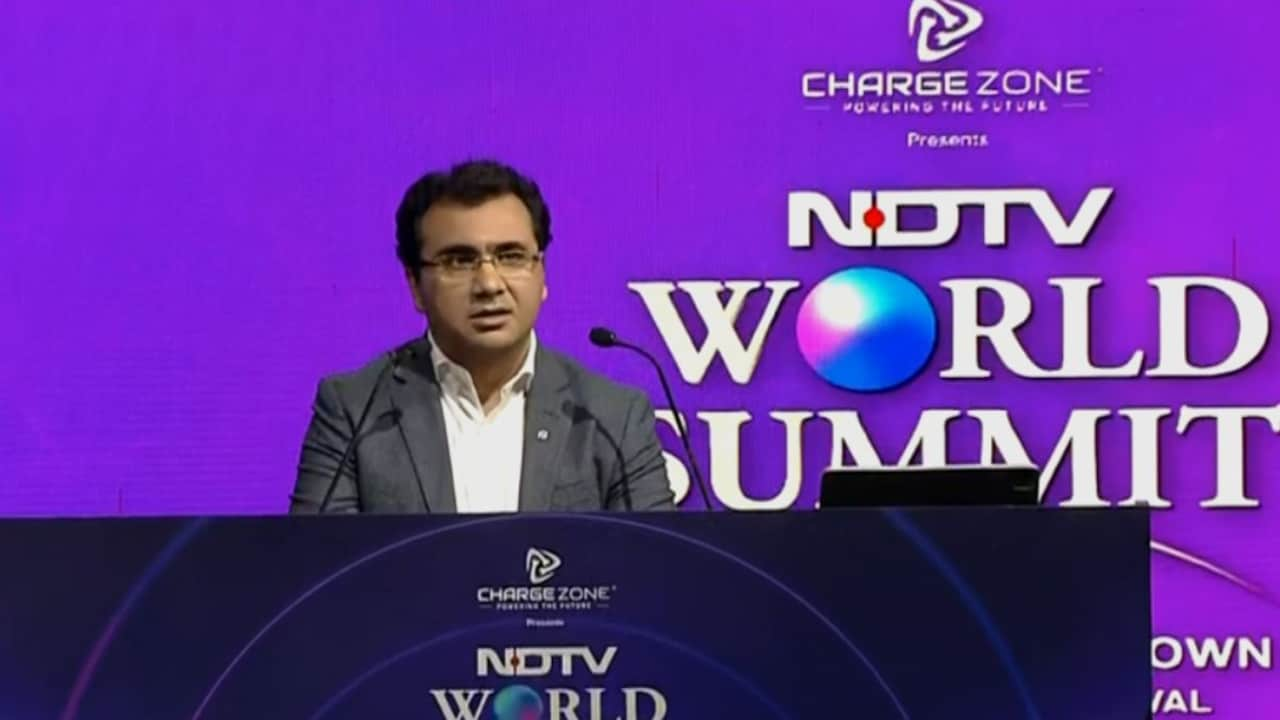
Surface-level profiles of Vikram Rai, CEO of GE Aerospace South Asia, treat his appearance at the NDTV World Summit 2026 as a routine executive cameo. That framing misses the structural mechanics connecting propulsion supply chains, defense localization, and aftermarket economics. An analytical reading of Rai's role and GE Aerospace's October 2026 disclosures requires separating verified operational figures from long-range projections and mapping the causal loops that govern Indian aerospace scaling.
Who Vikram Rai Is and What His Role Entails
Vikram Rai leads GE Aerospace's commercial and strategic footprint in South Asia as CEO for South Asia, operating across commercial aviation, defense propulsion, precision manufacturing in Pune, and engineering in Bengaluru. His background spans commercial and defense aviation roles, including prior tenure with Rolls-Royce in South Asia and early work on airport communication, navigation, and surveillance systems with HBE-Aviosec.
At the NDTV World Summit 2026, Rai's participation matters because executive bandwidth in propulsion is tightly coupled to multi-decade fleet and manufacturing commitments. Selling jet engines is an upfront transaction; supporting a multi-decade fleet requires aligning engine deliveries, component machining, maintenance capacity, and sovereign industrial policy.
The Three Pillars of GE Aerospace's India Strategy
Rather than viewing GE Aerospace's India footprint as an isolated sales push, the company's October 2026 announcements—coinciding with an Ernst & Young economic impact assessment—cluster into three interdependent pillars:
- Fleet expansion and aftermarket capture: Over 1,400 commercial engines and more than 200 defense engines were operating in India, alongside over 3,200 GE Aerospace and partner engines on order as of 2026, including IndiGo's July 2026 memorandum of understanding with CFM International for more than 1,000 LEAP-1A engines across 510 Airbus A320neo-family aircraft.
- Localized component manufacturing and supplier scaling: GE Aerospace reported roughly $200 million in Indian supply chain spend in 2025, with plans to nearly double annual in-country supplier spend to around $400 million by 2030 across a network that includes 17 major suppliers (such as Tata Group, Mahindra, Hindustan Aeronautics Limited, and Godrej) and over 2,000 local suppliers, backed by Pune facility investments and an apprenticeship pipeline that has graduated roughly 5,000 production associates since 2015.
- Engineering and digital capability centers: Bengaluru operations house engineering talent development, academic research partnerships, and digital technology teams building predictive maintenance and inspection tools such as Analytics-Based Maintenance (ABM.ai) and the Blade Inspection Tool (BIT).
Cause-and-Effect Mechanics Behind the Numbers
Standard coverage lists headline statistics in isolation. Looking at the causal chain shows why each metric exists and where pressure points emerge.
High aircraft utilization (12 to 14 hours per day) and high load factors (88.2%) reflect strong demand relative to existing seat capacity. High utilization accelerates flight cycles and thermal stress on hot-section engine components. More cycles per month shorten intervals between shop visits, which directly expands demand for maintenance, repair, and overhaul (MRO) capacity—an opportunity tied to roughly 1,500 new aircraft on order with Indian carriers and valued in the EY report at more than $5.5 billion for India's MRO sector.
When an airline orders hundreds of narrowbody aircraft—such as the 510 A320neo-family jets linked to IndiGo's LEAP-1A engine agreement—engine deliveries and MRO support become inseparable. If local MRO slots lag fleet additions, airlines face higher turnaround times and spare-engine allocation constraints, explaining why engine agreements increasingly pair propulsion supply with local MRO support.
The first constraint in scaling in-country sourcing from roughly $200 million to nearly $400 million by 2030 is metallurgical and precision-machining qualification. Aerospace parts require tight tolerances, traceable materials, and regulatory certifications that take years to audit. Doubling spend does not happen overnight; it requires expanding qualified tier-one and tier-two capacity while keeping scrap and yield rates tight.
The second constraint is workforce and infrastructure pacing. Training 400 to 500 apprentices annually in Pune builds a baseline of skilled technicians, yet scaling output alongside airport expansion—projected by government estimates to rise from 163 airports toward more than 350 by 2047 as domestic traffic is projected to reach 1.1 billion by 2040—depends on broader grid, logistics, and supplier execution.
Separating Known Facts from Educated Hypotheses
A rigorous evaluation must keep verified figures distinct from projections and strategic inferences:
- Known facts: Domestic commercial airlines generated roughly $19 billion in revenue in FY26 across an aviation ecosystem estimated to support 370,000 direct jobs. GE Aerospace announced plans to nearly double its annual India supply chain spend from roughly $200 million in 2025 toward $400 million by 2030. IndiGo announced a July 2026 MoU with CFM International for more than 1,000 LEAP-1A engines for 510 A320neo-family aircraft.
- Official projections: Government of India estimates project domestic passenger traffic reaching 1.1 billion by 2040 (up from 340 million in FY26) and airport count expanding past 350 by 2047, while industry estimates cited in the report point to 3,300 additional aircraft—or 6,600 engines—for India and South Asia by 2044 and over $5.5 billion in MRO opportunity.
- Educated hypotheses: Sustained high utilization and rapid fleet additions will likely keep aftermarket and MRO bottlenecks front and center for Indian carriers through the late 2020s, making local turnaround speed a decisive competitive variable alongside initial engine price.
Practical Framework for Evaluating Aerospace Localization Claims
To assess whether an executive summit appearance or localization pledge translates into real industrial depth rather than marketing rhetoric, apply a four-step audit:
- Verify baseline versus target: Check the starting dollar or unit baseline (such as $200 million in 2025) and the exact horizon (such as 2030) rather than reading percentage or multiple claims in isolation.
- Separate assembly from complex value-add: Distinguish basic kitting or general support from high-precision component machining, defense engine manufacturing, and certified MRO work.
- Check aftermarket alignment: Confirm whether engine and aircraft backlog growth is matched by local maintenance capacity, spare parts pooling, and digital diagnostics.
- Identify dependency risks: Note that execution depends on airframe delivery schedules, supplier qualification speed, and broader aviation infrastructure growth.
Limitations of This Analysis
Exact contract pricing, proprietary supplier margins, and internal delivery schedules for specific engine lots are not public in full detail. Furthermore, long-term traffic forecasts out to 2040 and infrastructure targets out to 2047 carry macro, regulatory, and supply-chain execution risks that can shift timelines.
Strategic Play
Track three concrete execution markers over the next 24 months rather than summit headlines: quarterly progress on in-country supplier spend toward the $400 million 2030 target, tangible milestones on local engine MRO buildouts tied to major narrowbody orders, and expansion of qualified precision-machining output across Pune and partner facilities—because whoever controls turnaround reliability and qualified local supply in high-utilization fleets captures the durable economic value of India's aviation expansion.