The global energy map just got shredded. If you've looked at a gas station sign lately, you know something's broken, but the real story isn't just about high prices. It's about a massive, violent shift in where the world gets its fuel. As of April 2026, the United States is set to hit an all-time record for crude oil exports, and it's happening because the Middle East is essentially closed for business.
The war involving Iran has done more than just spike prices. It’s triggered a desperate, global race for supplies. When the Strait of Hormuz effectively shut down in March, 20% of the world's oil supply didn't just get delayed—it got stranded. Now, the Atlantic Basin is the only place left to turn.
The math of a global supply chokehold
Let's look at the numbers because they're staggering. Before this conflict, the Strait of Hormuz handled about 15 million barrels per day (mb/d) of crude. By mid-March 2026, production from Kuwait, Iraq, Saudi Arabia, and the UAE dropped by a combined 10 million barrels per day. That’s a hole in the market you can't just patch with a few extra rigs.
You might think Saudi Arabia or the UAE could just use pipelines to bypass the mess. They’ve tried. But the reality is bleak. Saudi Arabia’s East-West pipeline can only redirect about 2.5 mb/d of spare capacity. The UAE adds maybe another 0.5 mb/d. That leaves 85% of their typical volume stuck behind a combat zone.
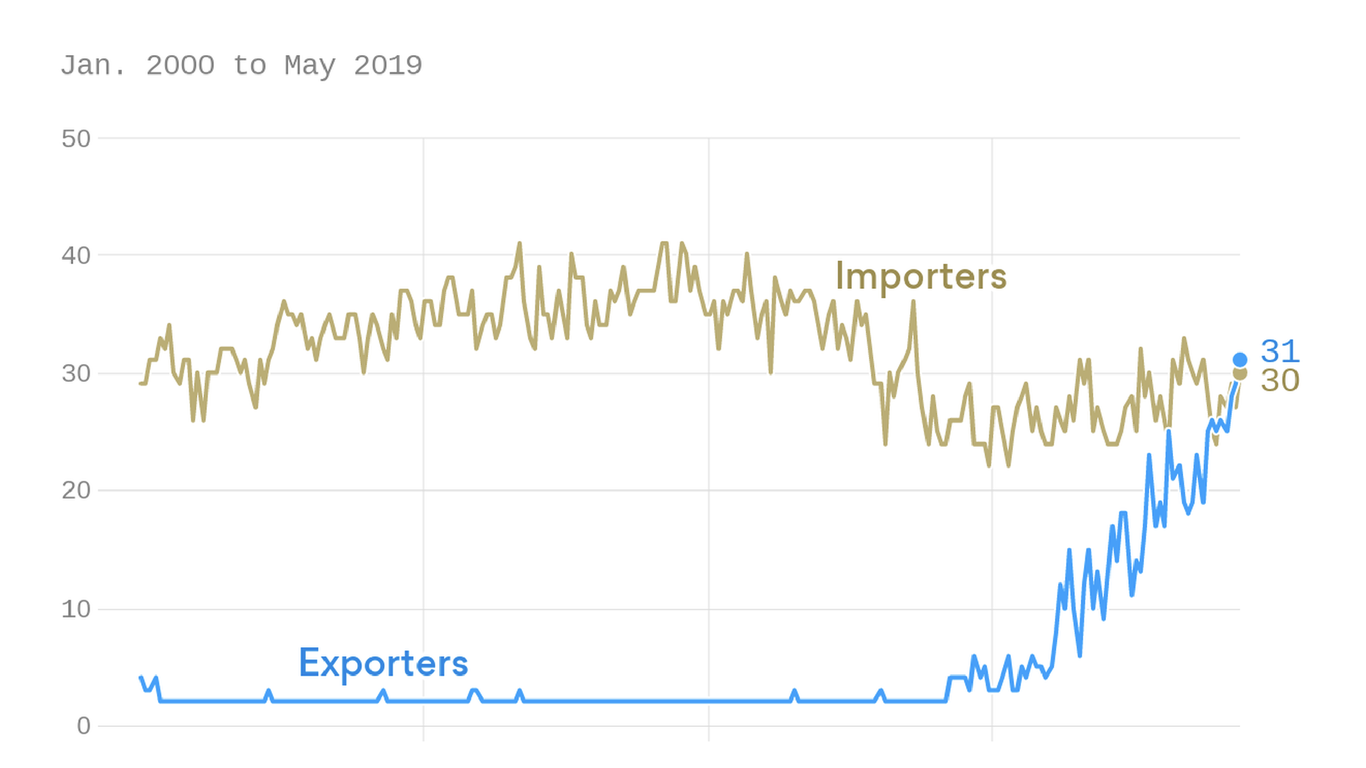
While the Middle East struggles to find a way out, US exporters are stepping into the vacuum. In February 2026, US oil exports were already valued at $7.9 billion. By the time April's data is fully tallied, analysts expect the volume of Atlantic Basin barrels heading to Europe and Asia to hit levels we’ve never seen. It’s not just "growth"—it’s a total redirection of the planet’s energy flow.
Why the Permian Basin is the world's safety net
I’ve spent years tracking how shale changed the game, but 2026 is the ultimate stress test. The Permian Basin in West Texas and New Mexico is carrying the weight of the world right now. In 2025, the US set an annual production record of 13.6 million barrels per day. About 48% of that came from the Permian alone.
What’s wild is that at the start of this year, the EIA was actually forecasting a slight dip in production for 2026 because prices were expected to stay low—around $52 per barrel. Then the war happened. Now, with Brent crude screaming past **$120 per barrel**, every capped well is being looked at as a gold mine.
- Efficiency is the secret weapon: Even when rig counts were falling in 2025, producers were squeezing more oil out of every hole. New wells are producing roughly 2.9 million b/d.
- Breakeven reality: Most Permian operators need about $61–$62 per barrel to break even. At $120, the incentive to pump every possible drop isn't just business—it’s a frenzy.
- The Gulf factor: Offshore projects like Whale and Shenandoah came online just in time, pushing Gulf of Mexico production toward a record 2.0 million b/d this year.
The desperate scramble for Asian markets
China, India, Japan, and South Korea used to get 75% of their oil from the Gulf. When Iran hit Qatar’s Ras Laffan LNG complex in March, it didn't just take out gas; it sent a signal that no energy infrastructure in the region is safe.
I’m seeing reports of "panic buying" in India and Australia, but the real movement is in the tankers. Because the Suez Canal and the Bab-el-Mandeb are becoming no-go zones due to Houthi involvement, ships are taking the long way around the Cape of Good Hope. This adds weeks to travel times and sends shipping insurance through the roof.
The US is the only major producer with the capacity and the "safe" geography to fill the gap. Europe, which was already on edge after a harsh 2025-2026 winter, is now fighting Asia for every spare US cargo. It’s a literal bidding war for energy security.
What this means for your wallet and the world
Don't let the record export numbers fool you into thinking the US is "winning" in a simple sense. Yes, the trade balance looks better, but the domestic impact is brutal. Gasoline prices in the US have been jumping 5 to 10 cents per gallon daily in some regions.
Even more concerning is the "urea crisis." The Middle East produces about 30% of the world's urea for fertilizer. With the Strait of Hormuz blocked, fertilizer prices are skyrocketing. This isn't just an oil story anymore; it’s a food story. Global food prices are forecast to rise by at least 6% this year, and that’s a conservative estimate.
Basically, we're looking at a structural shift. The "geopolitical risk premium" isn't a temporary spike; it’s being baked into the long-term price of everything. Even if the shooting stops tomorrow, the trust is gone. Countries are now moving toward "energy isolationism," trying to lock down every barrel they can from stable, non-combat zones.
How to navigate this shift
If you're an investor or just trying to plan your business expenses for the rest of 2026, you need to stop waiting for "normal" to return.
- Lock in energy costs: If you run a fleet or a manufacturing plant, the volatility isn't going away. Hedge your fuel costs now if you haven't.
- Watch the shipping routes: Keep an eye on the Cape of Good Hope traffic. If those routes stay crowded, the cost of everything imported will keep climbing regardless of the oil price.
- Ignore the "shale is dead" talk: We’ve heard for a decade that US shale is peaking. April’s record exports prove that when the world is in a corner, Texas and New Mexico are the only ones left standing.
The race for supplies is only getting started. If you're relying on global supply chains that pass through the Middle East, it's time to find a Plan B. The US is pumping more than ever, but in a world this thirsty, even records aren't enough to keep the peace.