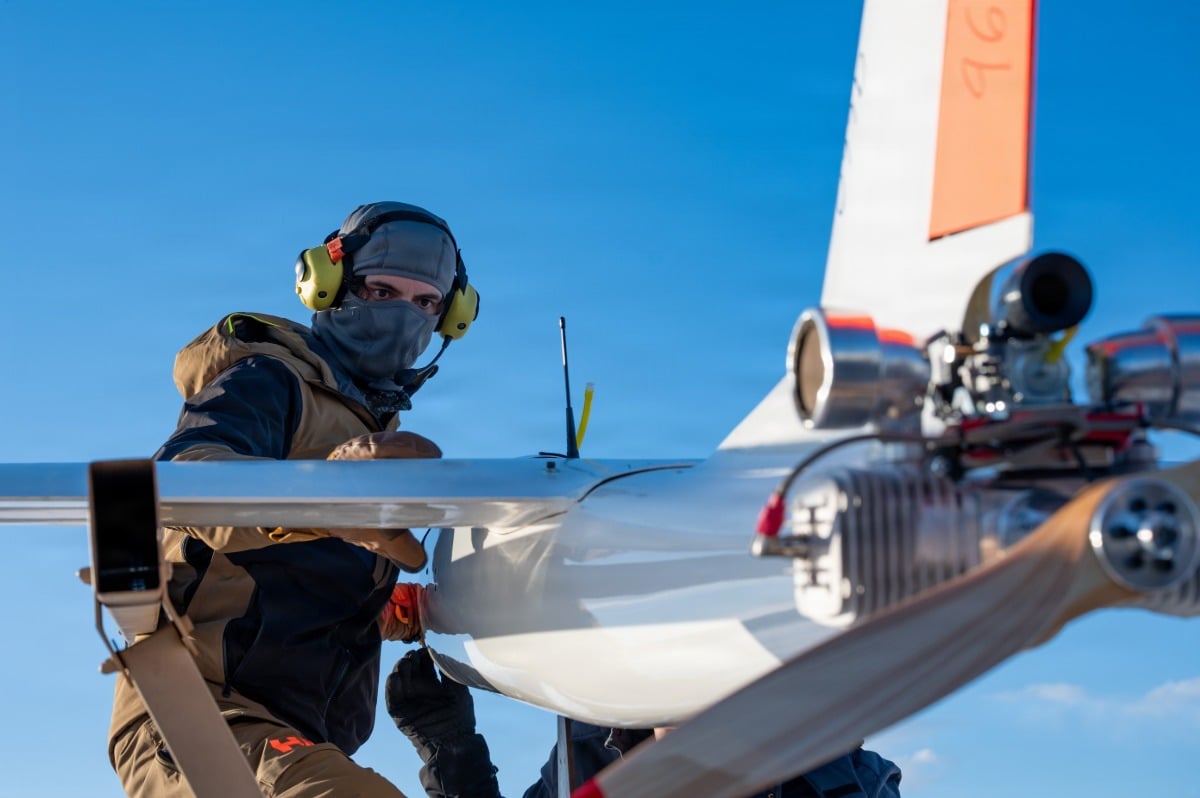
The headlines are celebrating a $67.9 million firm-fixed-price contract awarded to Griffon Aerospace for the procurement of Outlaw Gen 3 unmanned aircraft systems. The prevailing narrative across the defense tech press is predictable. Analysts are applauding the Pentagon for doubling down on "battlefield surveillance," praising the drone’s six-to-eight-hour endurance, and echoing boilerplate press releases about how its small size makes it less susceptible to enemy radar tracking.
It is a comforting story. It is also entirely wrong.
The purchase of these platforms under the banner of modern operational readiness ignores the brutal, bloody reality of contemporary warfare. I have spent years watching the defense establishment dump nine-figure sums into legacy architectures because they fit neatly into outdated procurement models. The Outlaw Gen 3 is not a leap forward. It is an expensive placeholder that fundamentally misunderstands how the sky is being contested right now.
By treating a glorified target drone as a viable asset for modern reconnaissance, the procurement apparatus is preparing for a war that no longer exists.
The Target Drone Illusion
To understand why this contract is a misallocation of capital, look at the DNA of the platform. The Outlaw lineage—stretching from the MQM-170 through the G2—was designed primarily as an aerial target system. It was built to be shot at. Its primary job was to mimic the enemy so that air defense crews could practice their targeting.
Somewhere along the line, the bureaucracy decided that if an aircraft could fly for six hours and carry a basic electro-optical/infrared (EO/IR) pod, it should be re-badged as an Intelligence, Surveillance, and Reconnaissance (ISR) asset.
This is a dangerous compromise. True ISR platforms operating in modern contested airspace require advanced electronic counter-countermeasures (ECCM), frequency-hopping data links, and low-observable signatures engineered from the ground up. Slapping a surveillance camera onto a target drone airframe does not make it a modern scout. It makes it an expensive target that happens to be recording its own shoot-down.
Defenders of the contract argue that the Outlaw’s small radar cross-section provides adequate survivability. This is yesterday’s logic. Modern electronic warfare environment tracking does not rely solely on traditional radar. Passive radio frequency (RF) detection, acoustic arrays, and optical tracking networks are highly effective at spotting fixed-wing, slow-moving prop platforms.
If a drone cruises at less than 100 knots in a straight line with a loud two-stroke engine, a low radar signature is irrelevant. It is loud, it is slow, and it is highly vulnerable to modern air defense networks.
The Cost Efficiency Fallacy
The second major justification for the Griffon Aerospace contract is economic. Compared to a Group 4 or 5 platform like a Reaper, a $68 million contract for a fleet of smaller tactical drones looks like a bargain.
This is a complete misunderstanding of drone economics.
The real metric that matters in active operational theaters is not the acquisition cost per unit; it is the cost per hour of survivable mission delivery. Consider the structural differences in how these systems are deployed and maintained:
| Attribute | Legacy Fixed-Wing Tactical UAS (Outlaw Type) | Modern Dispersed Attritable Systems |
|---|---|---|
| Launch Infrastructure | Pneumatic catapult or prepared runway | Hand-launched, vertical takeoff (VTOL), or zero-footprint |
| Logistical Footprint | Heavy ground control stations, specialized launch trailers | Tablet-based control, ruggedized backpack components |
| Airframe Cost | Medium-to-high six figures per complete system | Low five figures to consumer-adjacent scale |
| Contested Attrition Rate | High risk, catastrophic economic loss per downing | Expected loss, financially sustainable attrition |
Pneumatic catapults and fixed landing gear require dedicated transport vehicles, specialized launch crews, and a secure footprint. In a highly mobile conflict where artillery and loitering munitions can target a launch site within minutes of an RF signature emission, a drone that requires a trailer to get into the air is a liability.
If a deployment requires an entire logistics tail just to get an unarmored, slow-flying vehicle into the sky, you have not bought a nimble asset. You have bought a logistical bottleneck.
What the Defense Establishment Gets Wrong About Attrition
The broader issue here is that the Pentagon remains trapped in a legacy mindset regarding aircraft survivability. The procurement system still treats unmanned platforms like mini-airplanes—exquisite, reusable assets that must be preserved at all costs.
Modern warfare has proven that this paradigm is dead. Airspace is now hyper-contested. The lifespan of a tactical reconnaissance drone on a modern frontline is often measured in days, if not hours.
When you lose a platform that costs hundreds of thousands of dollars and requires a specialized team to operate, it hurts. It drains theater resources and slows down operational momentum. The solution is not to buy slightly upgraded versions of 20-year-old target drone designs. The solution is to pivot entirely to hyper-scalable, attritible, software-defined systems.
The counter-argument from traditionalists is always the same: consumer-grade or low-cost commercial tech lacks the range, payload stability, and pure endurance of a dedicated military fixed-wing asset. They point out that a small quadcopter or tactical VTOL cannot match the eight-hour loiter time of an Outlaw Gen 3.
That is entirely true, and it is completely irrelevant.
Why risk a single, expensive, long-endurance asset when you can deploy twenty overlapping, low-cost VTOL systems for the same financial and logistical cost? If five of those smaller systems are jammed or shot down, the mission continues. The data stream remains intact because the network is decentralized. If an Outlaw Gen 3 gets swatted out of the sky three hours into its mission, 100% of that sector’s organic ISR capability vanishes instantly.
The Real Future of Tactical ISR
The $68 million spent on this contract would have been far more disruptive if it had been directed toward scaling open-architecture software layers that can run on any cheap, locally manufactured airframe. The value in modern drone warfare is not the aluminum, the fiberglass, or the two-stroke engine. The value is the autonomy stack, the jam-resistant mesh networking, and the automated target recognition algorithms.
If the airframe itself is the most expensive component of your tactical drone program, your procurement strategy is fundamentally broken.
The military needs to stop buying proprietary hardware hulls that lock them into specific vendor ecosystems for maintenance, spare parts, and training. They should be buying software that can be flashed onto a rotating inventory of cheap, modular, disposable airframes. When the airframe becomes a commodity, the entire economic calculus of air denial changes. The adversary spends a $100,000 surface-to-air missile to down a $5,000 disposable wing. That is how you win an economic war of attrition. Buying multi-hundred-thousand-dollar target drones to do routine scouting ensures you stay on the wrong side of that ledger.
The Outlaw Gen 3 contract is proof that old habits die hard in Alexandria and Huntsville. It represents a safe, bureaucratic choice that satisfies legacy procurement check-boxes while failing to adapt to the brutal realities of modern electronic warfare and air defense saturation. We are still buying the past, painting it olive drab, and calling it innovation.