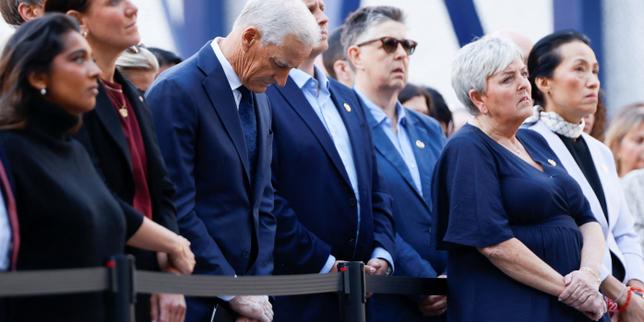
Fifteen years after Anders Behring Breivik carried out the deadliest attack on Norwegian soil since World War II, killing 77 people in Oslo and on the island of Utoya, Norway once again stands united in solemn memory. On July 22, 2011, a car bomb detonated near the prime minister's office, claiming eight lives, before the killer dressed as a police officer traveled to the Workers' Youth League summer camp to murder 69 mostly teenage victims. Today, survivor testimonies and state commemorations attempt to heal a nation's open wound. Yet beneath the official ceremonies lies a troubling reality: the far-right ideology that fueled the massacre has neither retreated nor dissolved. It has simply evolved.
While national political leaders gather to lay wreaths at the Oslo memorial site, security analysts and extremism researchers point to an uncomfortable truth. Norway’s initial response focused heavily on civic unity and open democracy, a deliberate choice framed by then-Prime Minister Jens Stoltenberg as "more democracy, more openness, and more humanity." That stance won international praise. It preserved the country's egalitarian ethos. However, it also allowed systemic security oversights and ideological blind spots to linger far longer than they should have.
The Mirage of the Lone Wolf
In the immediate aftermath of the tragedy, official narratives quickly labeled Breivik a isolated extremist—a bizarre, socially alienated lone actor operating entirely outside traditional organizational structures. That label provided political comfort. It implied that the attack was a black swan event, an unpredictable anomaly impossible to anticipate or prevent.
That diagnosis was fundamentally flawed.
Breivik was never truly alone. He operated within a globalized digital ecosystem that nurtured his radicalization, validated his paranoia, and supplied him with a blueprint for violence. His 1,500-page manifesto was largely a mosaic of copied text, plagiarized directly from online radical forums, anti-Muslim blogs, and Western ethno-nationalist websites. He was not an isolated genius of terror. He was an early adopter of radicalization techniques that have now become standard operating procedure for extremist movements worldwide.
By treating the perpetrator as a solitary lunatic rather than the product of a growing ideological network, Norwegian authorities initially missed the broader threat vector. The infrastructure of hate was not localized to a basement in Oslo; it was distributed across global servers, protected by encrypted platforms, and fueled by mainstream political rhetoric that flirted with xenophobia for electoral gain.
When the Security Apparatus Fails
The physical failure on July 22, 2011, remains one of the most glaring operational breakdowns in modern Scandinavian history. The official Gjørv Report, published a year after the attacks, delivered a scathing assessment of the Norwegian police and intelligence services. The findings were brutal in their simplicity: the police could have stopped the perpetrator earlier, the bomb at the government headquarters could have been prevented through basic traffic enforcement, and the emergency response to Utoya was hindered by communication failures, inadequate equipment, and logistical chaos.
"The attack on the government complex on 22 July could have been prevented," the commission concluded. "The perpetrator could have been stopped earlier on 22 July."
The police helicopter sat grounded due to staff vacations. Officers attempting to reach the island loaded so much heavy gear into a single inflatable boat that its engine flooded, forcing them to commandeer civilian vessels while shots were actively fired just across the water.
These were not merely tactical errors. They revealed a structural mindset conditioned by decades of peace and high institutional trust. Norwegian law enforcement had operated under the assumption that terror was an external threat, something imported from abroad, primarily tied to militant Islamist groups. The idea that a white, native-born Norwegian citizen posed an existential threat to the state was absent from risk assessments.
In the fifteen years since, Norway has overhauled its security infrastructure. The Police Security Service received increased funding, surveillance capabilities were expanded, and inter-agency coordination was reorganized. Yet, structural reforms cannot fix a cultural reluctance to confront internal radicalization.
The Mutation of Far-Right Terror
If the threat model of 2011 was defined by long manifestos and labor-intensive planning, today's threat environment is vastly more liquid and decentralized. The ideology that struck Utoya has not disappeared; it has digitized and gamified.
Consider the line of ideological succession. The attack on a mosque in Christchurch, New Zealand, in 2019 explicitly cited Breivik as an inspiration. Months later, a gunman in El Paso, Texas, targeted the Hispanic community after publishing a manifesto echoing identical conspiracy theories regarding demographic replacement. Later that same year, Philip Manshaus attempted a mass shooting at an Islamic center in Baerum, Norway, after murdering his stepsister. Manshaus, too, had marinated in online forums that celebrated the Utoya killer as a martyr.
The mechanism of radicalization has shifted from static websites to algorithmic rabbit holes.
- Gamification: Terrorist acts are now live-streamed with first-person perspective cameras, designed to mirror video games and maximize viral reach among younger audiences.
- Memetic Warfare: Complex racial theories have been replaced by ironic memes, making extreme content palatable to teenagers under the guise of dark humor.
- Micro-Targeting: Extremist recruiters no longer rely on physical meetups. They engage isolated individuals through gaming channels, message boards, and decentralized messaging apps.
This devolution makes detection vastly more complex for intelligence services. When radicalization occurs in plain sight under layers of internet irony, identifying actionable threats before an individual moves to violence becomes an overwhelming intelligence challenge.
The Cost of Political Timidity
For years following the massacre, a tacit political agreement held in Norway: avoid using the attacks for partisan leverage. While intended to maintain national cohesion, this consensus effectively sanitized the discussion around the ideological roots of the violence.
The Workers' Youth League, the youth wing of the Labour Party targeted on the island, bore the physical and psychological brunt of the attack. For over a decade, its members argued that the country was failing to confront the political substance of Breivik's ideology. They were frequently told that bringing up the perpetrator's political motives threatened national unity or constituted an unfair attack on right-leaning political parties.
That reluctance created a vacuum. By refusing to directly debate and dismantle the specific rhetoric surrounding "great replacement" theories and anti-multiculturalist dog whistles, society allowed those concepts to drift into mainstream discourse.
Political discourse across Europe and North America now regularly incorporates language that directly mirrors the core arguments of the 2011 manifesto. What was once confined to the dark corners of the internet is now echoed by elected officials, media personalities, and political candidates under the banner of border security and cultural preservation.
When mainstream institutions adopt the underlying premises of radical ideologies, the barrier to extremist violence drops significantly.
The Limits of Memorialization
Norway’s public response to the tragedy has been heavily focused on architecture, public art, and educational centers. The national memorial at Utvika, overlooking the island, stands as a striking physical monument to the dead. School curricula across the nation now include mandatory modules on democracy, tolerance, and the events of July 22.
These efforts are necessary, but they are insufficient.
Memorials commemorate the past; they do not automatically safeguard the future. Education programs that present the attack as an isolated historical tragedy fail to prepare young citizens for the subtle, modern forms of radicalization they encounter daily on their personal devices.
Building a resilient society requires active, uncomfortable confrontation with present threats rather than passive remembrance of past losses.
| Metric / Dimension | 2011 Reality | Present Reality |
|---|---|---|
| Primary Communication Vector | Manifestos, static forums, personal blogs | Algorithmic social feeds, encrypted apps, gaming platforms |
| Operational Strategy | Years of individual hoarding and preparation | Fast-tracked radicalization, low-tech, opportunist strikes |
| Institutional Awareness | High focus on foreign/imported threats | Growing recognition of domestic terror, but persistent blind spots |
| Public Discourse | Avoidance of explicit political debate to preserve unity | Polarization, mainstreaming of far-right rhetoric |
Confronting the Reality Ahead
Fifteen years after the smoke cleared over Oslo and the quiet returned to the waters around Utoya, Norway remains one of the safest, most prosperous nations on earth. Its commitment to civil liberties and human rights stands in stark contrast to the authoritarian impulses seen elsewhere.
However, safety is not a static state achieved through good intentions and solemn ceremonies. It requires a continuous, uncompromising assessment of domestic risks. Commemorating the 77 victims of July 22 requires more than lower flags and silent gatherings. It demands a willingness to dismantle the ideological foundations that made their murder possible, to challenge the political rhetoric that excuses extremism, and to reform the security structures that were caught flat-footed.
Until society is willing to confront the ideological supply lines with the same urgency it applies to physical violence, the pledge of "Never again" remains nothing more than a hopeful promise built on fragile ground.