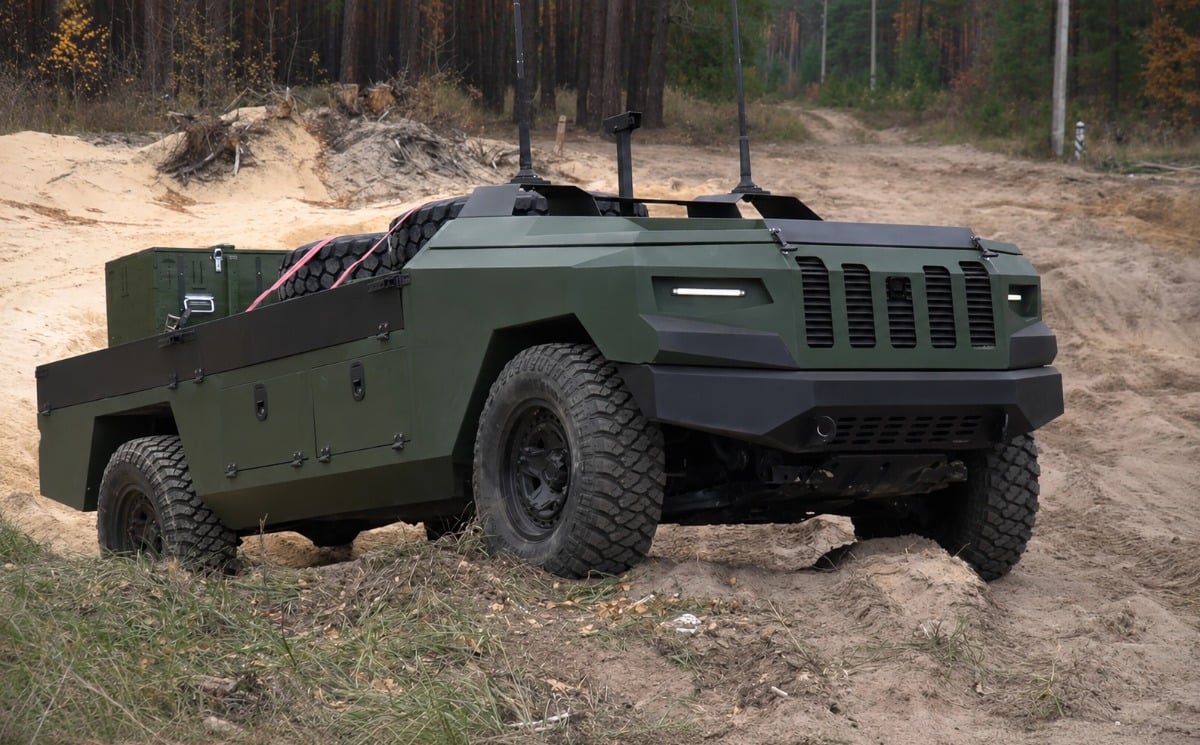
The visual of robotic warfare is usually dominated by explosive first-person-view drones or nimble quadrupeds hunting in trenches. Yet, a far more significant transformation is happening on the muddy, artillery-shattered supply corridors of eastern Ukraine. Armed forces are deploying heavy robot trucks to solve a brutal mathematical equation: how to move metric tons of ammunition, rations, and medical supplies through fields monitored by hundreds of thermal-imaging cameras without sacrificing human drivers. These unmanned ground vehicles (UGVs) are transitioning from experimental prototypes into rugged, everyday logistics workhorses.
Military logistics has always been a meat grinder. In the current conflict, the danger spikes exponentially over the "last mile"—the final, deadliest stretch of dirt road separating a secure supply depot from the forward trenches. Human drivers navigating standard logistics trucks face a barrage of electronic warfare jamming, precision artillery, and swarming loitering munitions. By removing the cabin and the human flesh inside it, these autonomous platforms are fundamentally shifting the risk calculations of frontline replenishment.
The Brutal Mechanics of the Last Mile
To understand why heavy robot trucks are no longer optional, look at the geometry of modern defensive lines. A standard front line is not a static trench; it is a fluid network of dugouts, observation posts, and artillery emplacements. Holding these positions requires constant re-supply.
A single infantry platoon can burn through thousands of rounds of ammunition, dozens of anti-tank missiles, and hundreds of liters of water in a single day of heavy fighting. Traditionally, this material moves via unarmored or lightly armored utility vehicles.
They are loud. They leave massive thermal signatures that Russian reconnaissance drones spot from kilometers away.
When a standard logistics truck is hit, the loss is devastating. You lose the cargo. You lose a vehicle that is difficult to replace. Most critically, you lose a trained soldier whose experience cannot be replicated by a factory line. Unmanned supply platforms change this dynamic by altering three core engineering variables.
Thermal and Acoustic Signature Reduction
Standard combustion engines generate immense heat. Unmanned platforms frequently utilize hybrid-electric or pure electric drivetrains. When running on battery power, these heavy platforms emit almost zero acoustic noise and a negligible thermal footprint, allowing them to slip through night-vision checkpoints undetected.
Profile Lowering
Without the need for a steering wheel, windshield, crumple zones, or a human seating arrangement, the physical height of the vehicle can be slashed by half. A low-profile chassis is significantly harder to target with direct-fire weapons and can easily hide behind low hedgerows or inside shallow craters.
Modular Payload Systems
If an explosive drone hits an unmanned truck, the chassis can often be salvaged. The cargo bed is decoupled from the main mechanical drive, meaning a flat tire or a blown-out cargo rack does not necessitate scrapping the entire powertrain.
The Architecture of Autonomous Logistics
Building a robot truck capable of surviving a modern electronic warfare environment requires a completely different approach than engineering a self-driving car for suburban streets. Silicon Valley relies heavily on stable GPS networks, high-definition digital mapping, and continuous cloud connectivity. On the front line, none of these exist.
The airspace is thick with GPS spoofing signals that convince navigation systems they are orbiting over an airport hundreds of miles away. Radio frequencies are actively jammed to prevent remote operators from steering vehicles via video links. Therefore, the latest generation of Ukrainian heavy robot trucks relies on edge-computed autonomy.
[Sensors: LiDAR / Stereo Cameras]
       │
       ▼
[Onboard AI: Local Terrain Mapping] ◄─── [No GPS Required]
       │
       ▼
[Actuators: Steering / Throttle]
Instead of following a coordinate map, the vehicle uses a combination of optical cameras and solid-state LiDAR (Light Detection and Ranging) to actively "see" the ground three-dimensional space directly in front of it. Onboard computers running localized neural networks analyze the surface texture in real-time. The system differentiates between soft mud that will bog down a ten-ton vehicle, a deep anti-tank crater, and passable terrain.
If the radio link to command is severed entirely, the truck does not stop and wait to be destroyed. It executes an automated return-to-base protocol using inertial navigation systems—internal gyroscopes and accelerometers that calculate movement relative to a known starting point without ever touching a satellite signal.
The Cost Equation and Industrial Scale
This is not a story of boutique military contractors delivering million-dollar vehicles over decade-long development cycles. The Ukrainian defense ecosystem has adapted by utilizing commercial off-the-shelf components mixed with agricultural machinery.
Many of these heavy robot trucks start life as civilian utility platforms, industrial mining buggies, or heavy-duty tractors. Engineering teams strip away the manual controls and retro-fit them with localized drive-by-wire conversion kits. Hydraulic rams are attached to steering columns; digital relays override manual throttles.
This scrap-metal-to-hardware pipeline keeps production costs remarkably low. A single western-designed armored supply vehicle can cost upwards of five hundred thousand dollars. A converted, autonomous agricultural platform costs a fraction of that figure.
If three out of five robot trucks are picked off by kamikaze drones but the remaining two successfully deliver ammunition to an encircled unit, the mission is an economic and tactical success. Attrition warfare demands that the cost of the target be lower than the cost of the weapon used to destroy it. Force multiplication occurs when the enemy spends a ten-thousand-dollar precision missile to neutralize an unmanned frame made of cheap steel and salvaged tractor parts.
Unvetted Risks and the Software Vulnerability
It is easy to overstate the perfection of automated systems. The reality on the ground is messy, mechanical, and prone to catastrophic failure. Heavy robot trucks face environmental enemies that software updates cannot fix: deep, liquid Ukrainian mud known as rasputitsa.
When a ten-ton vehicle loses traction in deep clay, an automated system lacks the human intuition required to rock the chassis backward and forward or lay down branches for traction. It simply spins its wheels until the axles sit flat on the earth, transforming an expensive asset into a stationary target.
Furthermore, relying heavily on computer vision introduces the danger of adversarial deception. A simple canvas sheet painted to mimic an open road can trick an optical sensor into driving off a steep embankment. Dust, thick smoke, and torrential rain degrade LiDAR signals rapidly, forcing the vehicles to drop their speed to a crawl, rendering them vulnerable to mortar fire.
There is also the unresolved question of maintenance in field conditions. A traditional mechanic can fix a broken diesel fuel pump with basic hand tools inside a trench. Fixing a shattered camera array, a desynchronized optical sensor, or a short-circuited motherboard requires specialized diagnostic gear and a dust-free environment. Forward repair units must now include software engineers alongside traditional grease-monkey mechanics.
The Operational Paradigm Shift
The deployment of heavy robot trucks is forcing a rewrite of tactical supply doctrine. For decades, military logistics relied on the concept of convoy operations—massed groups of vehicles moving together under armed escort. Today, a convoy is simply a massive target.
Instead, automated logistics relies on a continuous, decentralized pulse. Rather than sending ten large trucks at dawn, commanders can launch twenty small, unmanned units at irregular intervals throughout the night. They move individually, utilizing distinct paths through the landscape. They do not complain about fatigue. They do not suffer from the psychological terror of incoming artillery. They simply execute repetitive, linear tasks until their mechanical components fail or an enemy shell finds them.
This changes the burden on human infantry. Soldiers no longer need to leave the relative safety of their bunkers to unload supply vehicles under fire. The robot truck arrives at a pre-designated drop point, uses a hydraulic tilt-bed to slide its cargo container directly onto the ground, and immediately begins its return journey without a single human setting foot outside.
The implications extend far beyond eastern Europe. Every major military power is watching this operational testing ground with intense focus. The age of the vulnerable supply column is drawing to an end, replaced by a quiet, grinding network of autonomous steel moving across the mud.