The smell of cardamom and burnt butter hangs thick in the air of an autumn evening in Queens, mixing with the metallic tang of the elevated subway rattling overhead. Just a few hundred miles west, in a manicured suburb of Cincinnati, the scent is entirely different—freshly cut Kentucky bluegrass, cold leather, and the faint, sterile hum of a central air unit keeping an expansive home at a precise sixty-eight degrees.
Two worlds. Two kitchens. Two entirely different definitions of what it means to belong to a country that still cannot decide how to pronounce your name.
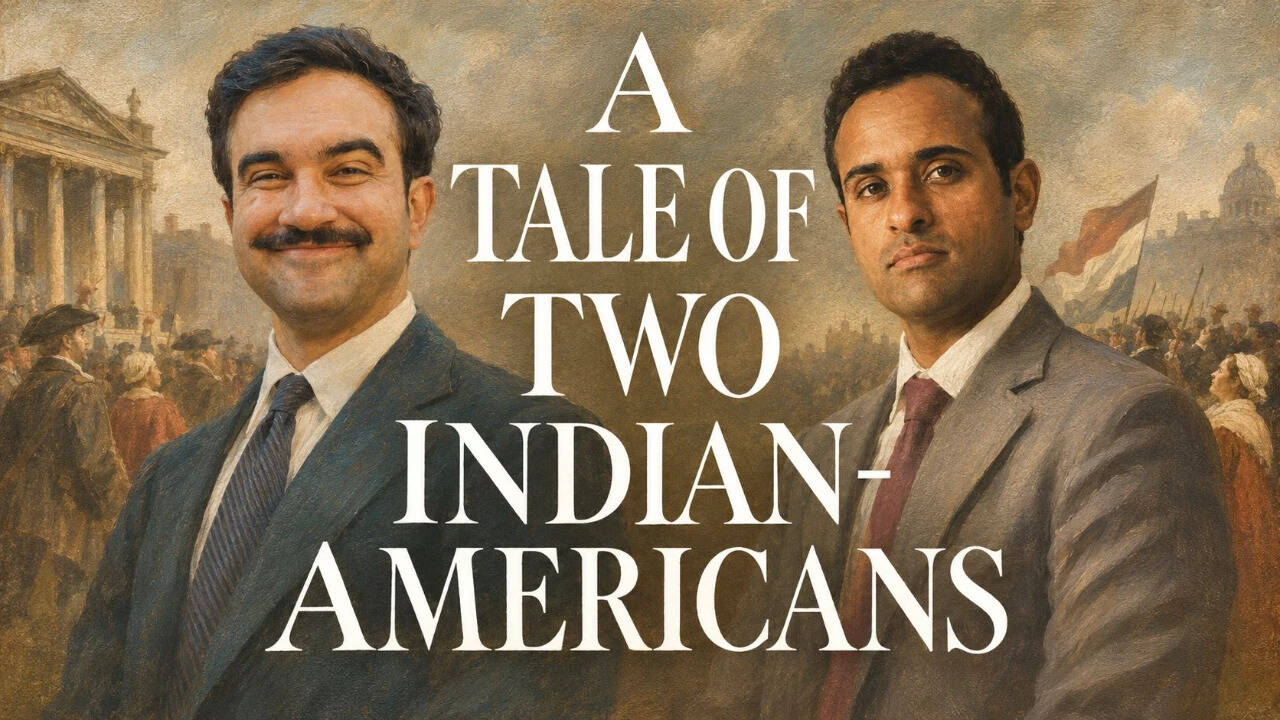
If you have spent any time around South Asian dinner tables over the past few years, you have felt the temperature in the room drop the moment politics enters the conversation. We used to be a reliable, predictable bloc, bound together by the shared trauma of visa queues, the quiet pride of spelling bee victories, and a near-universal reverence for medical degrees. That consensus is dead. In its place stands a jagged fault line, and standing directly on opposite sides of it are two men in their thirties who share an ancestral homeland, an Ivy League pedigree, and a fierce, unapologetic ambition to rewrite the rules of American power.
Vivek Ramaswamy and Zohran Mamdani.
On paper, they are mirror images refracted through the prism of the twenty-first century. Both are the sons of accomplished immigrants who crossed oceans with heavy suitcases and heavier expectations. Both possess a verbal agility that leaves seasoned politicians breathless. Yet, when you listen to them speak, you realize they are not merely arguing over tax rates or foreign policy. They are fighting a proxy war over the immigrant soul. One sees America as a meritocratic fortress that must be defended from internal decay; the other sees it as an unfinished promise that must be dismantled and rebuilt from the basement up.
To understand how we arrived at this rupture, you have to step away from the cable news chyrons and look at the invisible stakes resting on their shoulders.
The Architecture of Two Ambitions
Consider a hypothetical scenario—a thought experiment that plays out in real life every single weekend across America. Imagine a father, let us call him Rajesh, sitting at his kitchen island in New Jersey. He arrived in 1984 with four hundred dollars in his pocket, worked two shifts at a motel while studying for his engineering boards, and eventually built a modest, comfortable life. Rajesh looks at Vivek Ramaswamy, the billionaire biotech entrepreneur and Republican firebrand from Ohio, and sees validation. He sees a man who mastered the system so completely that he can now lecture native-born Americans on the meaning of their own Constitution.
Now, sit across the table from Rajesh’s twenty-six-year-old daughter, Priya, who works as a public defender in Brooklyn. She looks at Zohran Mamdani, the democratic socialist state assemblyman from Astoria, Queens, and sees liberation. She sees a man who refuses to wear the traditional armor of the "model minority," choosing instead to stand on picket lines with yellow-cab drivers starving under predatory medallion debt.
This is not just a generational gap. It is an ideological civil war.
Let us ground this in the verified reality of their biographies, because the soil from which they grew explains the fruit they bear. Ramaswamy was born in Cincinnati in 1985 to Hindu Brahmin parents who emigrated from Kerala, India. His father worked as an engineer and patent attorney at General Electric; his mother was a geriatric psychiatrist. Vivek attended St. Xavier High School, a rigorous Jesuit institution, before heading to Harvard for biology and Yale for law. By his late twenties, he had founded Roivant Sciences, a pharmaceutical company built on buying up discarded drugs from major pharma firms and bringing them to market, amassing a fortune estimated at nearly a billion dollars before he ever stepped onto a presidential debate stage.
Mamdani’s path could not be more distinct, even though it leads through similar corridors of privilege. Born in Kampala, Uganda, in 1991, he is the son of Mahmood Mamdani, a renowned Ugandan-Indian postcolonial scholar at Columbia University, and Mira Nair, the acclaimed Indian filmmaker behind Monsoon Wedding and The Namesake. Zohran spent his early childhood in Uganda and South Africa before his family settled in New York City when he was seven. He graduated from the prestigious Bronx High School of Science and earned a degree in Africana Studies from Bowdoin College. Before winning his seat in the New York State Assembly in 2020—unseating a five-term Democratic incumbent—he worked as a foreclosure prevention housing counselor, sitting across from working-class families in Queens as they wept over eviction notices.
Notice the divergence in their foundational education. Ramaswamy studied the mechanics of biology, finance, and constitutional law—systems of optimization and hierarchy. Mamdani studied the history of colonialism, racial capitalism, and housing displacement—systems of power and resistance.
The Gospel of Individualism vs. The Chorus of Solidarity
When Ramaswamy speaks, his cadence is rapid, percussive, almost rhythmic—a throwback to the days when he performed libertarian-themed rap under the stage name "Da Vek" at Harvard. His message is a radicalized version of the classic immigrant creed: Keep your head down, outwork everyone in the room, and never ask for a handout.
In Ramaswamy’s telling, the greatest threat to the American dream is not structural inequality, but a culture of victimhood that punishes excellence. When he calls for dismantling the Department of Education, gutting the federal bureaucracy, and ending affirmative action, he is speaking a language that resonates deeply with millions of conservative voters—and with a growing slice of affluent Indian-Americans who quietly resent seeing their children face steeper admissions hurdles at elite universities.
There is a seductive clarity to his worldview. If you treat the economy like a purely mathematical equation, then any attempt to tip the scales for the disadvantaged looks like an attack on merit. Ramaswamy positions himself as the ultimate proof that the equation works. His existence is his argument. I am brown, I am Hindu, my parents came here with nothing, and I became a billionaire. Therefore, the system is not broken.
Mamdani hears that exact same biography and arrives at the opposite conclusion.
Walk down Steinway Street in Astoria with Mamdani, and you will not hear lectures about individual grit. You will hear conversations in Urdu, Hindi, Bengali, Arabic, and Spanish about the price of insulin, the reliability of the N train, and the impossibility of affording a two-bedroom apartment on a delivery worker’s wages. For Mamdani, the "model minority" myth is not a badge of honor; it is a wedge used to divide brown and Black working-class communities from one another.
In 2021, Mamdani did something almost unheard of for an elected official in America: he went on a fifteen-day hunger strike alongside members of the New York Taxi Workers Alliance. Many of those drivers were South Asian immigrants—Sikh, Muslim, and Hindu men who had been crushed by a predatory loan system that left them hundreds of thousands of dollars in debt for taxi medallions that had lost most of their value. Mamdani sat in a folding chair outside City Hall, drinking only water, losing weight day by day until the city finally agreed to a debt-relief restructuring plan worth hundreds of millions of dollars.
Think about the visceral contrast between those two images. On one side, a billionaire biotech founder flying on private jets, arguing on national television that climate change is a hoax and that the federal government should be taken apart with a chainsaw. On the other, a state assemblyman starving himself on a Manhattan sidewalk so an aging Punjabi cab driver does not lose his home.
The Invisible Stakes of Representation
We often talk about political representation as if it were a simple matter of demographics—putting a brown face in a high place and calling it progress. Anyone who has actually lived inside an immigrant community knows how naive that is. Representation without alignment feels less like progress and more like a betrayal.
I remember sitting in a cramped living room in Jackson Heights during the 2020 primary, watching neighbors debate whether to support a progressive insurgent or stick with the established machine politician. The older aunties were terrified of the word "socialist." To them, socialism meant the suffocating bureaucracy of 1970s India—the License Raj, where getting a telephone line took seven years and ambition was treated with suspicion. When they hear Mamdani talk about public ownership of utilities or universal rent control, a cold shiver of historical memory runs down their spines. They did not cross an ocean to return to state-controlled scarcity.
Yet, when those very same aunties turn on the television and see Ramaswamy aligned with an American nationalist movement that views non-Christian immigrants with open hostility, they feel a different kind of dread. They see him comfortably sharing stages with figures who openly question whether a Hindu can truly represent a Christian nation. They watch him dismiss systemic racism as a fabrication, even as they remember the post-9/11 years when men wearing turbans or sporting beards were spat on at gas stations and pulled out of airport security lines.
This is the exhausting tightrope of the diaspora. We are constantly asked to choose which part of our history we are willing to forget in order to secure our future.
To understand why both men trigger such fierce loyalty and revulsion, use a simple analogy. Imagine America as a massive, centuries-old house. Ramaswamy looks at the house and says the foundation is flawless, the framing is immaculate, and the only problem is that too many people are crowding onto the porch demanding to be let in without paying rent. Lock the doors, he says, clear out the squatters, and let the people inside build whatever they want. Mamdani looks at the exact same house and sees black mold behind the drywall, lead in the pipes, and a landlord who keeps raising the rent while refusing to fix the boiler. Tear down the rotten walls, he says, put the utilities under tenant control, and make sure everyone in the neighborhood has a roof over their head.
Both men are diagnosing a real sickness in the American body politic. Working-class families are being crushed by stagnant wages and runaway housing costs, just as Mamdani argues. At the same time, bloated institutions have grown unaccountable, performative, and detached from ordinary citizens, just as Ramaswamy contends.
Where they diverge—and where they force the rest of us to choose—is in whom they blame for the pain.
Faith, Identity, and the Weaponization of Belonging
Neither man runs from his heritage, yet each deploys it like a precision instrument tailored to his audience.
Ramaswamy speaks openly about his Hindu faith, framing it through the lens of traditional family values, discipline, and a shared monotheistic-adjacent morality that he argues aligns seamlessly with Judeo-Christian conservatism. When evangelical voters question his religion, he does not flinch or apologize. Instead, he pivots, arguing that a devout Hindu has far more in common with a devout Christian than either does with a secular progressive. It is a brilliant rhetorical maneuver—one that turns a potential political liability into a bridge across the culture war.
Mamdani, a Shia Muslim of Indian descent who grew up in East Africa, embodies a cosmopolitan, global South identity that refuses to fit into neat American boxes. He wears a kurta to legislative sessions and community events not as a costume, but as a normal article of clothing. His politics are explicitly anti-imperialist, fiercely critical of Israeli military actions in Gaza, and deeply rooted in international solidarity. When he launched his campaign for Mayor of New York City, he leaned directly into the city’s working-class multiculturalism, cutting campaign videos in Hindi and Urdu, breaking down the cost of living at halal carts, and speaking directly to immigrant voters who usually feel ignored until two weeks before Election Day.
Let us be candid about something that makes polite commentators uncomfortable: both men benefit enormously from the very systems they critique. Ramaswamy’s massive wealth was generated in the heavily regulated, government-subsidized pharmaceutical sector—an industry propped up by public research funding and federal patent protections. Mamdani’s ability to pursue a career in grassroots activism and low-paying public office was cushioned by a family background of immense cultural and intellectual capital.
Admitting that does not invalidate their convictions. Humans are walking contradictions. We use the tools at our disposal to fight the battles we believe matter. What makes Ramaswamy and Mamdani fascinating is not that they are pure, but that they are entirely unafraid of the friction they create.
The End of the Quiet Immigrant
For decades, the unspoken contract offered to Asian immigrants in America was simple: Be useful, be quiet, and stay out of the crossfire. Become the doctor who saves lives in rural hospitals. Become the software engineer who builds the algorithms in Silicon Valley. Pay your taxes, send your kids to Kumon, and let other people fight over the soul of the republic.
That contract is null and void.
Ramaswamy and Mamdani have both shattered the stereotype of the deferential, risk-averse South Asian technocrat. Whether you find Ramaswamy’s brand of nationalist populism exhilarating or terrifying, you cannot deny that he refuses to ask for permission to speak. Whether you view Mamdani’s democratic socialism as a moral awakening or an economic fantasy, you cannot ignore his willingness to put his own body on the line for the people he represents.
Look at the numbers beneath the noise. According to Pew Research data, Indian-Americans are the highest-earning ethnic group in the United States, with a median household income more than double the national average. Yet behind that gleaming statistic lies a rapidly widening chasm. Nearly ten percent of Indian-Americans live below the poverty line, concentrated heavily in cities like New York, where recent arrivals work as delivery drivers, domestic workers, and bodega clerks without health insurance or legal protections.
Ramaswamy speaks for the boardroom; Mamdani speaks for the breakroom.
As the 2020s roll forward, the collision between these two visions will only grow louder. We are watching the maturation of a diaspora that no longer needs to speak with one voice because it has finally claimed the right to argue with itself in public. No longer content to sit in the audience, the children of immigrants have climbed onto the stage, seized the microphones, and begun shouting at each other over the roar of the crowd.
Picture two doors on the same street in an American city at dusk. Behind one, a young venture capitalist in a tailored blazer checks real-time market tickers on his phone, preparing a speech about deregulation, national sovereignty, and the triumph of the individual will. Behind the other, a tired organizer in a frayed jacket steps out of a basement community center, locking the door behind a dozen immigrants who just learned how to fight an illegal rent hike.
They share the same ancestors, the same skin, and the same fierce certainty that they alone know how to save this country. And as the streetlights flicker on, casting long, competing shadows across the pavement, it becomes clear that America will never look the same—no matter which one of them wins.