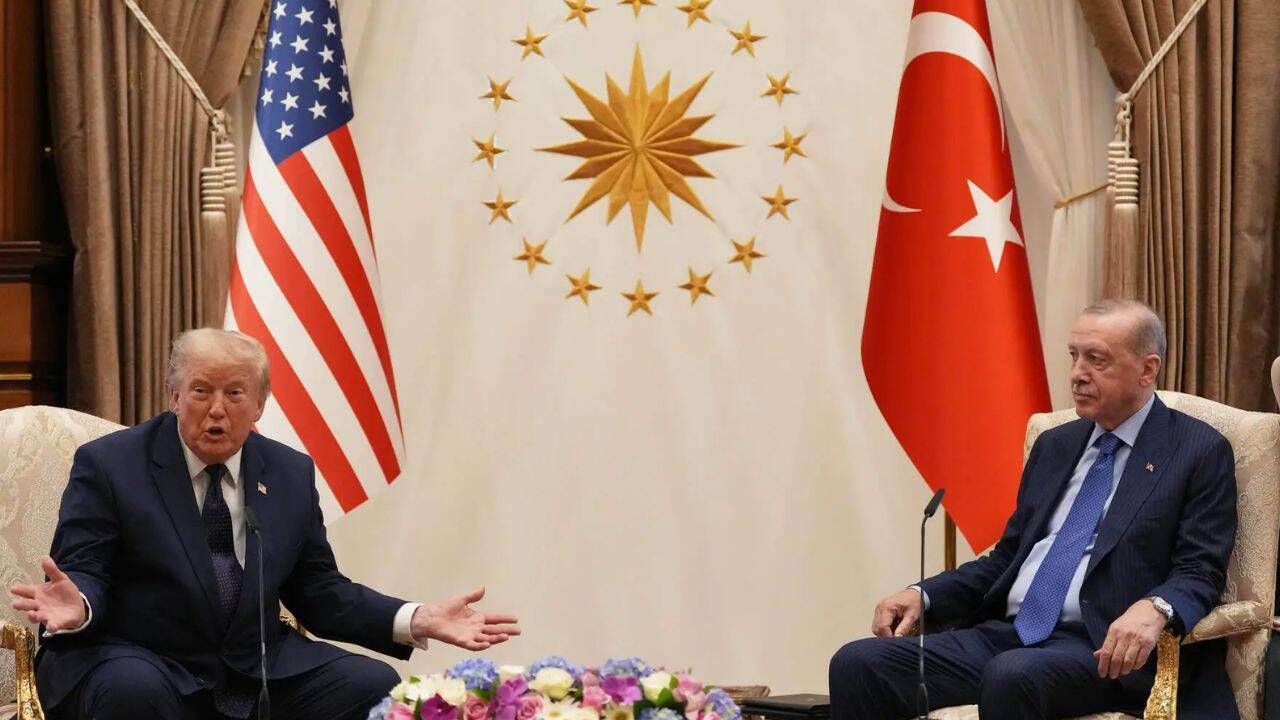
Donald Trump just upended years of American foreign policy with a few casual remarks next to a gold-plated microphone. Sitting beside Turkish President Recep Tayyip Erdogan at the NATO summit in Ankara, Trump dropped a double bombshell. He told reporters that Washington is lifting the Countering America's Adversaries Through Sanctions Act (CAATSA) sanctions slapped on Turkey in 2020. Then came the real kicker. He wants to sell them the F-35 fighter jet.
If your head is spinning, it should be.
This isn't just a minor course correction. It is a complete 180-degree flip from the defense policies of the last six years. Remember, it was Trump himself who booted Turkey from the fifth-generation stealth fighter jet program back in 2019. The reason? Turkey bought the Russian S-400 missile defense system, a piece of military hardware designed specifically to shoot down planes like the F-35. Back then, Washington panicked, fearing the S-400 would suck up stealth data and feed it straight to Moscow.
Now? Trump says he has no concerns about that at all. None.
Instead, Trump praised Erdogan and labeled Turkey as a loyal ally. He openly complained that other traditional European partners have been less reliable. It’s a classic Trump play, transactional, direct, and completely unbothered by institutional precedent. But while Erdogan walked away from the press conference smiling, the reality on the ground is messy, legally complicated, and highly contested by America’s closest allies.
The Sanctions Are Gone, but the Jet Is on Hold
Let's look at what actually happened in Ankara. Trump was unequivocal about the economic penalties. "We're going to be taking the sanctions off," he stated, adding that his cabinet is already grinding through the paperwork to make it happen.
Lifting CAATSA sanctions is a massive win for Turkey's domestic defense industry, which has been squeezed hard since 2020. It reopens the door for major Turkish defense procurement agencies to trade without fear of American financial blacklists. Erdogan is already looking to capitalize on this, publicly pushing for American jet engines to power Turkey’s homegrown KAAN fighter program.
But the F-35 is a much bigger hill to climb.
Turkish F-35 Timeline:
2019: Expelled from program over Russian S-400 purchase.
2020: CAATSA sanctions applied to Turkish defense sector.
2026: Trump announces sanctions lift, signals F-35 return.
When reporters pressed Trump on whether Turkey is officially back in the stealth jet club, he tempered his language just a bit. "It's a decision we're going to make," he said, calling the F-35 the best plane in the world and something they will certainly consider. Erdogan, meanwhile, claimed Trump is a man of his word and expects him to deliver on past private promises.
The Congressional Wall and the S-400 Problem
Here is the snag that Trump didn't mention at the podium. He cannot just snap his fingers and hand over the keys to an F-35 squadron.
A federal law passed by Congress in 2020 explicitly blocks any transfer of the aircraft to Turkey unless the White House certifies that Ankara no longer possesses the Russian S-400 system. Right now, those Russian missiles are still sitting on Turkish soil.
Republican Senator John Cornyn quickly signaled that Congress isn't planning to roll over on this. Lawmakers on Capitol Hill still view the presence of Russian defense systems inside a NATO partner's borders as a massive intelligence vulnerability.
There are quiet rumors that administration officials, including Vice President JD Vance, are hunting for legal loopholes. One option under discussion is moving the S-400 missiles out of Turkey entirely, perhaps relocating them to a neutral third country. But no one has agreed to that yet. Turkey spent billions on those Russian missiles and won't just dump them in a warehouse because Washington changed its mind.
Panic in Jerusalem and Athens
While Ankara celebrates, America's other partners are panicking. The blowback from the region was instant and loud.
Israeli Prime Minister Benjamin Netanyahu didn't mince words during a television interview, warning that putting F-35s back in Turkish hands would destroy the power balance in the Middle East. Netanyahu emphasized that Turkey holds aggressive regional aspirations and explicitly urged Trump not to provide the jets or their advanced engines.
It is the same story in Greece. Athens is deeply alarmed that a modernized Turkish air force could shift the military balance in the Aegean Sea. The Greek government has spent years coordinating with Washington to maintain its own edge, and a sudden influx of stealth tech to their historic rival complicates everything.
Loyalty Over Ledger Lines
Why is Trump doing this now, especially when he's spent the rest of the summit hammering European allies over their defense budgets?
It comes down to Trump’s unique view of global alliances. He doesn't look at NATO as a sacred treaty. He looks at it like a business partnership. Under his intense pressure, NATO allies agreed at last year's Hague summit to a massive 5% GDP defense spending target by 2035. But while countries like Germany and Poland are hustling to meet those goals, others are lagging. Trump even threatened Spain with trade cutoffs for trying to opt out.
In Trump's eyes, Turkey has been a useful partner when it counts. Ankara controls the Bosporus Strait, commands the second-largest standing military in NATO, and has shown a willingness to cut transactional deals that align with Washington's immediate interests.
"I just want loyalty," Trump told reporters in Ankara. For him, Erdogan’s personal rapport and geopolitical cooperation outweigh the technical risks of a Russian radar system.
If you are trying to figure out what happens next, watch the moving trucks. The real tell won't be Trump's rhetoric or Erdogan's smiles. It will be whether Turkey agrees to ship its Russian hardware out of the country. Until those S-400 batteries leave Turkish soil, the F-35 deal stays grounded on Capitol Hill, no matter how badly the guy in the White House wants to make the sale. Keep your eyes on Congress and the upcoming defense authorization bills. That is where the real fight will be won or lost.