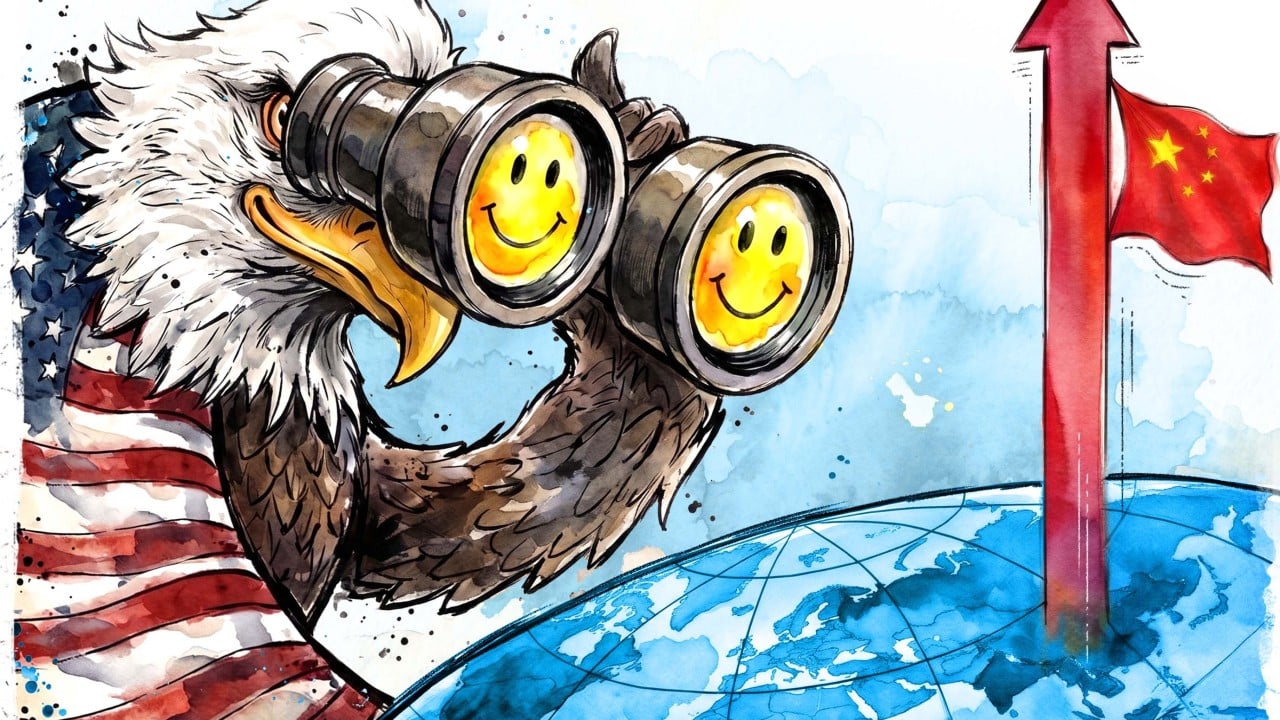
Political pundits love a tidy, terrifying narrative. Right now, the lazy consensus in Washington and Brussels is that Donald Trump’s loud obsession with China—what internet slang has christened "Chinamaxxing"—is accidentally handing Beijing the greatest public relations victory of the twenty-first century.
The theory sounds plausible at a cocktail party. By constantly talking about China’s massive factories, praising Xi Jinping’s iron grip on power, slapping universal tariffs on allies and adversaries alike, and retreating from global institutions, Trump supposedly validates Beijing’s narrative that the American era is over and the Chinese century has begun.
That theory is completely backwards.
Trump is not inflating Beijing’s soft power. He is exposing the structural rot underneath it, stripping away the diplomatic velvet glove that China spent thirty years weaving, and forcing the world to look at the raw, mercantilist steel underneath. If you think free publicity equals soft power, you do not understand how geopolitical influence actually works.
The Fundamental Misunderstanding of Soft Power
Before analyzing what Trump is doing to Beijing’s global standing, we have to fix the broken definition that media commentators keep repeating.
When Harvard political scientist Joseph Nye coined the term soft power in the late 1980s, he did not mean "being talked about constantly" or "looking intimidating." He defined it specifically as the ability to get what you want through attraction rather than coercion or payment. Soft power rests on three pillars: culture, political values, and foreign policies that others view as legitimate and having moral authority.
Read that definition again. Then look at what Trump actually amplifies when he fixates on China.
Trump never praises Chinese culture. He does not promote Chinese cinema, Mandarin language programs, or Beijing’s model of governance as a moral ideal for free societies. Instead, he fixates relentlessly on two things: China’s predatory trade surpluses and Xi Jinping’s ruthless efficiency as an autocrat.
When the President of the United States stands at a podium and calls the leader of the Chinese Communist Party "fierce," "smart," and "the king," Western editorial boards clutch their pearls. They assume this legitimizes authoritarianism. In reality, it does the exact opposite to China’s carefully curated image in the Global South and Europe.
Beijing spends billions of dollars every year through state media outlets like CGTN and Xinhua to convince developing nations that China is a benign, harmonious, non-interfering partner offering "win-win cooperation." Beijing wants to be seen as the gentle giant building bridges and railways out of pure solidarity.
Trump’s rhetoric acts like an acid bath on that branding. By framing Xi exclusively as a ruthless, apex-predator strongman who is actively eating everyone else’s industrial lunch, Trump reinforces the exact fear that keeps European and Asian capitals awake at night. He turns Beijing’s preferred brand—the peaceful, benevolent developer—into a caricature of an unstoppable mercantilist shark.
Notoriety is not attraction. Fear is not soft power.
Why Free Publicity Is Poison for Beijing
I have spent years watching state-backed enterprises and sovereign wealth funds try to buy legitimacy in Western markets. I have seen Chinese tech and manufacturing giants burn hundreds of millions of dollars on Western PR firms, sponsorship deals, and academic grants, only to watch their brand equity evaporate the moment a geopolitical spotlight hits them.
The golden rule of corporate and state influence is simple: quiet integration builds soft power; loud confrontation destroys it.
China’s greatest period of soft power expansion occurred between 2001, when it joined the World Trade Organization, and 2016. During those fifteen years, Beijing operated in the background. Western consumers bought cheap electronics without thinking about supply chains. European leaders signed trade deals without worrying about national security. Hollywood studios self-censored scripts to access the Chinese box office without triggering a domestic backlash in the United States.
Beijing thrived in the shadows of American indifference.
Trump’s "Chinamaxxing"—making China the centerpiece of every economic speech, tariff threat, and foreign policy negotiation—shattered that obscurity forever. You cannot quietly absorb global supply chains when the loudest megaphone on earth is screaming about your trade surplus every single afternoon.
The Tariff Trap and the Myth of the Chinese Savior
The pundit class argues that when Trump threatens tariffs on Mexico, Vietnam, or the European Union, those countries naturally pivot toward Beijing. They point to photo ops of European leaders visiting Beijing or Latin American presidents signing Belt and Road memorandums as proof that Trump is driving the world into China’s arms.
Look past the press releases and examine the balance sheets.
When Washington restricts access to the American consumer market—the only market on earth capable of absorbing massive global trade deficits—where do China’s excess manufactured goods go? They do not disappear. Beijing’s entire economic model relies on state-subsidized overcapacity in steel, solar panels, electric vehicles, and industrial machinery.
When the American door slams shut, that tidal wave of subsidized Chinese exports slams directly into the domestic industries of Brazil, India, Indonesia, Turkey, and Germany.
Let us trace how this plays out in real time:
- Washington raises walls against Chinese goods and pressures third-party countries not to act as backdoors for Chinese transshipment.
- Beijing, facing a stagnant domestic real estate market and weak household consumption, doubles down on manufacturing exports to keep its factories running and prevent domestic unemployment.
- Developing nations that initially cheered Trump’s friction with the West suddenly find their own local steel mills, textile factories, and auto plants being annihilated by cheap Chinese dumping.
- Those exact same nations are forced to slap their own tariffs on Beijing.
This is already happening. Brazil, India, Indonesia, and the European Union have all initiated aggressive anti-dumping investigations and tariffs against Chinese goods. They are not doing it because Washington told them to. They are doing it because Beijing’s economic survival strategy requires hollowing out their manufacturing bases.
Trump’s aggressive posture did not create this dynamic, but his relentless focus on trade imbalances accelerated it. By forcing the global trading system out of equilibrium, he stripped away the illusion that China can replace the United States as the buyer of last resort. China is a seller of last resort. Nobody builds soft power by bankrupting their neighbors’ factories.
Answering the Wrong Question Entirely
If you search online for debates about Trump and Chinese influence, you run into the same recycled questions from anxious commentators:
- Does praising Xi Jinping weaken democratic norms?
- Will America’s retreat from multilateral treaties let China write the rules of the future?
- Is China winning the hearts and minds of the Global South?
Every single one of these questions rests on a flawed premise: that global influence is a zero-sum popularity contest won through polite diplomatic speeches and seats on United Nations committees.
Dismantling the "Vacuum" Myth
The most persistent cliché in foreign policy is that "nature abhors a vacuum." When Trump pulls the United States out of the Paris Climate Accord, the World Health Organization, or regional trade frameworks, commentators immediately declare that China will step into the void and assume global leadership.
Imagine a scenario where the largest donor and security guarantor walks away from a global organization, leaving the second-largest economy in charge. Does that second economy suddenly inherit the trust and prestige of the first?
No. It inherits the bill, the blame, and the scrutiny.
Leadership in international institutions is expensive and thankless. The United States maintained its post-1945 soft power not simply by attending summits, but by underwriting global security, keeping maritime shipping lanes open with the U.S. Navy, and running massive, persistent trade deficits that allowed export-driven economies in Asia and Europe to get rich.
Beijing refuses to do any of those things. China does not police the Red Sea when Houthi missiles attack commercial shipping—even when the ships carry Chinese cargo. China does not open its capital account or let the renminbi float freely so other nations can use it as a reliable reserve currency. And China certainly does not run trade deficits to enrich developing economies.
When Trump steps back and forces the world to look at Beijing as the supposed alternative leader, China’s refusal to bear the actual costs of leadership becomes glaringly obvious. You cannot claim the crown while refusing to pay the royal expenses. Trump’s withdrawal does not crown Beijing; it exposes Beijing as a free rider that wants the prestige of a superpower with the obligations of a developing nation.
The Strongman Fallacy
Another major misreading involves Trump’s habit of complimenting authoritarian leaders. Critics argue that when an American president calls Xi Jinping "brilliant" for ruling 1.4 billion people with an iron fist, it validates the Chinese Communist Party’s governance model over messy Western democracy.
Look at how Trump uses those compliments. They are never standalone endorsements; they are always setups for a contrast.
When Trump says Xi is smart and tough, his very next sentence is invariably an attack on American politicians as "stupid" or "weak" for letting China take advantage of the United States. The compliment is a rhetorical weapon aimed at his domestic political rivals, not an endorsement of Leninist statecraft.
More importantly, look at the actual signal it sends to foreign elites. Foreign leaders do not listen to Trump’s rallies and think, "Wow, the American president likes Xi, therefore we should adopt Chinese censorship and state surveillance." They listen to Trump and realize that the United States is now led by a transactional realist who respects raw leverage and despises sentimental alliances.
That realization does not make foreign capitals fall in love with Beijing. It makes them terrified of being caught in the crossfire between two ruthless giants. Fear breeds hedging, militarization, and transactional diplomacy—none of which constitute Chinese soft power.
The Real Threat Nobody Is Talking About
If we stop obsessing over whether Trump’s rhetoric makes China look cool or powerful, we can focus on the actual strategic shift happening beneath the surface. The danger is not that Beijing is winning hearts and minds. The danger is that the entire architecture of global influence is shifting from soft power to hard dependency.
Soft power is about attraction. Hard dependency is about chokepoints.
While Western journalists debate whether TikTok videos or Trump’s speeches are boosting China’s image, Beijing has quietly locked down the physical supply chains of the twenty-first century:
- Critical Minerals: China refines roughly 60 percent of the world’s lithium, over 70 percent of its cobalt, and nearly 90 percent of its rare earth elements.
- Active Pharmaceutical Ingredients: Massive percentages of the precursor chemicals required to make basic antibiotics and blood pressure medications in the West originate in Chinese factories.
- Legacy Semiconductors and Battery Components: Even when high-end chips are designed in California and fabricated in Taiwan, the packaging, testing, and lower-tier industrial chips rely heavily on mainland infrastructure.
Trump’s "Chinamaxxing"—his relentless focus on reshoring, tariffs, and economic nationalism—is one of the few political forces disruptive enough to break the West’s decades-long addiction to these chokepoints.
For thirty years, bipartisan consensus in Washington assumed that integrating China into the global economy would naturally liberalize Beijing and make war unthinkable. That consensus failed completely. Beijing took the capital, took the intellectual property, locked down the supply chains, and grew more authoritarian at home and more aggressive abroad.
It took a blunt, erratic, unorthodox disruptor to shatter the polite fiction of "engagement." By turning China into an existential economic obsession, Trump forced corporate boardrooms from Frankfurt to Tokyo to finally price in geopolitical risk. Companies are not moving factories to India, Vietnam, and Mexico because of a white paper from a Washington think tank; they are moving them because they know a single truth-social post or executive order can wipe out their profit margins overnight.
The Downsides of the Wrecking Ball
Intellectual honesty requires admitting where this contrarian reality breaks down. Just because Trump is destroying China’s soft power does not mean his approach is without massive, self-inflicted wounds for the United States.
You cannot swing a wrecking ball at the global trading system without hitting your own house.
First, indiscriminate tariffs alienate necessary partners. Defeating Beijing’s supply chain monopolies requires a united front of industrialized democracies. When Washington threatens tariffs on Japan, South Korea, and the European Union at the same time it targets China, it breeds resentment and fragmentation. Allies do not pivot into Beijing’s loving embrace, as the pundits claim, but they do become far less willing to coordinate export controls on advanced semiconductor equipment or share intelligence on Chinese industrial espionage.
Second, rhetorical admiration for autocrats corrodes America’s own moral brand. Trump may not be boosting China’s soft power, but he is undeniably burning through America’s. The United States’ greatest historical advantage over the Soviet Union—and over China today—was never just its military or its GDP. It was the universal appeal of individual liberty, the rule of law, and predictable democratic institutions. When Washington treats alliances like protection rackets and speaks of autocrats with envy, it lowers the United States down into the mud alongside Beijing.
Beijing cannot win a soft power competition against the American ideal. It can only win a cynicism competition where every superpower looks equally selfish, predatory, and untrustworthy. That is the real risk of Trump’s style: not that he elevates China, but that he normalizes a world where soft power ceases to exist for anyone.
How Strategists and Investors Should Actually Play This
If you are running a business, managing capital, or analyzing geopolitical risk, stop reading op-eds about "soft power." That metric is dead weight. Base your decisions on the actual mechanics of this confrontation:
- Ignore Diplomatic Photo Ops; Track Tariff Schedules and Export Controls. When a European or Latin American leader visits Beijing and signs a "strategic partnership," ignore the headlines. Look at whether they are simultaneously raising anti-dumping duties on Chinese EVs, steel, or chemicals. Actions on customs forms tell the truth; banquet toasts are theater.
- Treat "Friend-Shoring" Hub Countries as Temporary Arbitrage. Moving supply chains from Shenzhen to Monterrey or Haiphong is not a permanent escape from Washington’s crosshairs. As long as those factories rely on Chinese raw materials and intermediate components, they remain exposed to secondary tariffs and rules-of-origin crackdowns. True resilience requires localizing the upstream inputs, not just moving the final assembly line.
- Bet Against Chinese Consumer Soft Power Abroad. Despite global hits like Black Myth: Wukong or the temporary dominance of apps like TikTok and Temu, Chinese consumer brands face a structural ceiling in Western and allied markets. Geopolitical friction ensures that any Chinese platform or brand that achieves massive scale will inevitably trigger regulatory scrutiny, data localization mandates, or outright bans. Price that ceiling into any long-term valuation.
- Separate Rhetoric from Leverage. Do not confuse Trump’s praise for Xi Jinping with softness on Beijing. In transactional politics, flattery is a prelude to a demand. Expect maximum pressure on trade deficits, currency manipulation, and intellectual property, paired with sudden, unexpected bilateral deal-making that completely bypasses traditional multilateral frameworks.
The Verdict on Beijing’s Global Image
Soft power requires mystery, aspiration, and trust. You cannot project moral authority while your domestic economy is suffocating under deflation, your youth unemployment is high enough that your government stopped publishing the real numbers, and your neighbors are building military alliances specifically to contain your territorial claims.
Trump’s constant, loud fixation on China did not invent Beijing’s vulnerabilities, nor did it magically bestow prestige upon the Chinese Communist Party. Instead, it dragged Beijing out of the comfortable shadows of globalization and placed it under a harsh, unforgiving spotlight.
The world is finally seeing China clearly: not as an inevitable, benevolent successor to the American order, but as an aging, export-addicted manufacturing giant locked in a bare-knuckle brawl for economic survival. Pundits can call that "Chinamaxxing" all they want. In the real world, it is the end of Beijing's charm offensive.