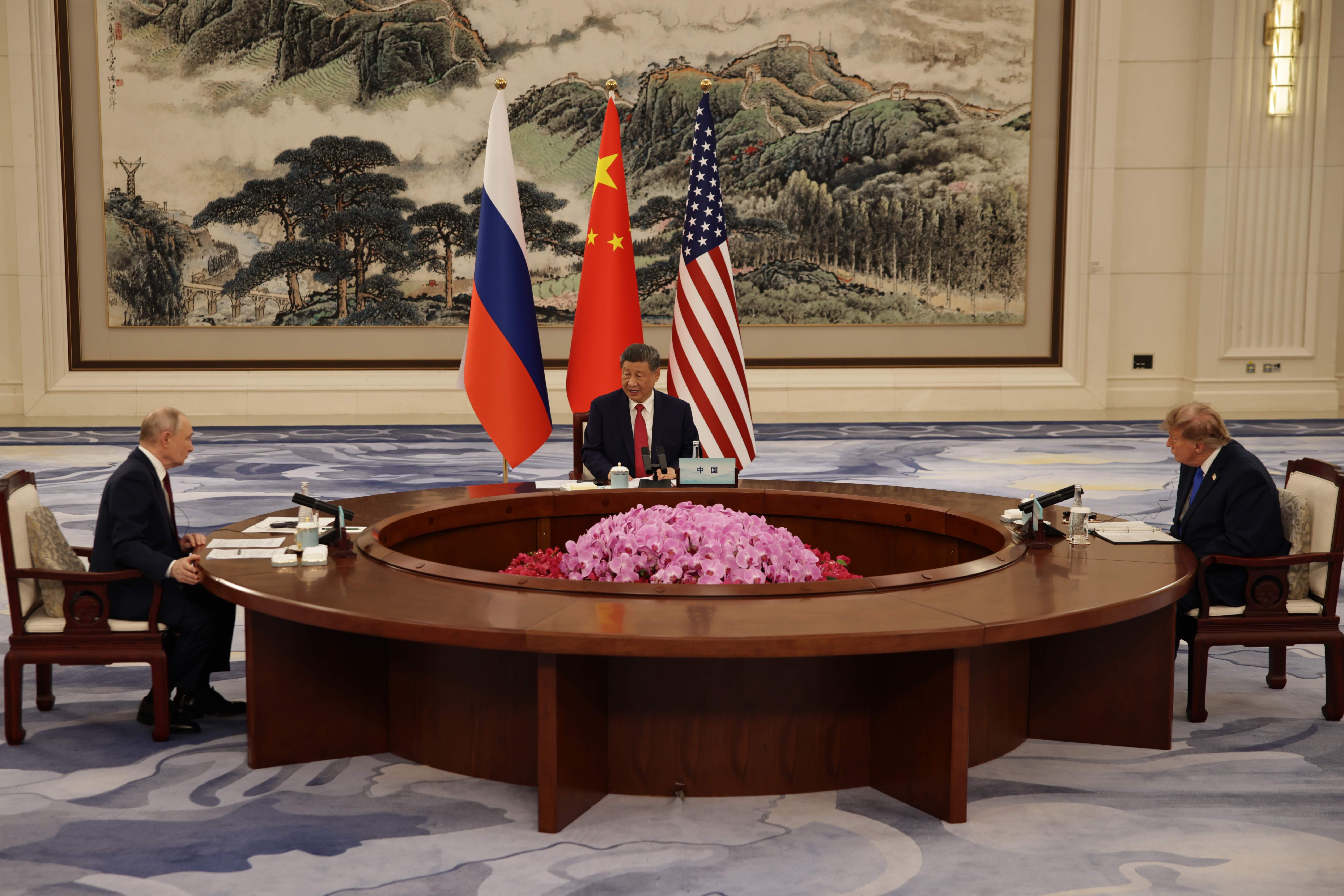
Trilateral understandings among Donald Trump, Xi Jinping, and Vladimir Putin regarding crude oil supply and nuclear risk reduction represent a structural shift from multilateral institutionalism to bilateral-led tripolar risk management. When the world’s largest net energy producer-consumer triad coordinates on petroleum price bands and strategic stability, the mechanism is not ideological alignment; it is mutual cost-function optimization under conditions of high systemic fragility. Standard diplomatic reporting treats these accords as isolated summits or personality-driven breakthroughs. In operational reality, they function as coupled control loops designed to prevent two distinct tail risks: an inflationary energy shock that destabilizes domestic political coalitions, and an inadvertent nuclear escalation triggered by asymmetric conventional conflict or hypersonic delivery compression.
To evaluate the durability and market impact of any agreement involving Washington, Beijing, and Moscow, analysts must separate rhetorical commitments from binding structural incentives. Without a clear map of the underlying payoff matrices, observers misread tactical pauses as permanent strategic realignments. Meanwhile, you can explore related developments here: The Mechanics of Bill 43 and Municipal Infrastructure Preemption in Alberta.
The Dual-Track Payoff Matrix
Any trilateral stabilization framework involving the United States, China, and Russia rests on an asymmetric exchange of vulnerabilities. Each state enters the negotiation with a distinct primary constraint and a specific instrument of coercion.
- The United States optimizes for domestic macroeconomic stability—specifically suppressing headline inflation through stable crude oil prices—while preserving extended nuclear deterrence for allies in Europe and the Indo-Pacific. Washington’s primary instrument is financial and technological access, alongside swing production capacity in the Permian Basin and strategic petroleum reserve management.
- China optimizes for uninterrupted seaborne energy imports and industrial input cost predictability while rapidly expanding its nuclear warhead inventory to achieve a credible second-strike posture against the United States. Beijing’s primary instrument is demand-side monopsony power in global crude markets and diplomatic restraint over Moscow’s tactical nuclear signaling.
- Russia optimizes for fiscal solvency through hydrocarbon export revenues and the preservation of nuclear parity as its primary remaining superpower credential. Moscow’s primary instrument is supply-side disruption—via OPEC+ production quotas or transit chokepoints—and doctrinal ambiguity regarding non-strategic nuclear weapons.
These three optimization functions intersect at a precise equilibrium point. High oil prices transfer wealth to Moscow and strain Beijing’s manufacturing margins alongside Washington’s consumer price index. Conversely, an unconstrained nuclear arms race forces all three powers into unsustainable capital expenditures while compressing decision-making windows during crises. To understand the bigger picture, we recommend the excellent analysis by The New York Times.
Mechanics of Coordinated Petroleum Price Bands
When Washington, Beijing, and Moscow reach an implicit or explicit understanding on oil markets, they are attempting to engineer an informal price collar without triggering antitrust or sovereign cartel vulnerabilities. Standard market commentary often attributes price stability to single announcements, missing the multi-stage physical and financial transmission mechanisms required to hold Brent and West Texas Intermediate within a targeted range.
The operational logic of a tripolar oil stabilization pact relies on three interlocking levers:
- Spare Capacity Signaling and Quota Discipline: Russia coordinates with OPEC+ partners to calibrate physical barrel removals, while the United States adjusts regulatory posture and pipeline permitting to signal medium-term supply elasticity. The objective is to prevent speculative long positions from driving crude above the pain threshold for Western consumers and Chinese refiners.
- Strategic Inventory Synchronization: China’s state-owned enterprises manage massive onshore storage capacity, functioning as a counter-cyclical buffer. By agreeing to moderate reserve accumulation during tight physical markets and accelerate buying during price troughs, Beijing dampens volatility alongside the U.S. Department of Energy’s Strategic Petroleum Reserve operations.
- Sanctions Enforcement Calibration: A critical variable in any Washington-Moscow-Beijing energy understanding is the selective enforcement of price caps, maritime insurance restrictions, and secondary financial sanctions on shadow-fleet tankers. Relaxing enforcement velocity allows discounted Russian Urals and ESPO grades to flow smoothly into Asian refineries, displacing Middle Eastern crude that can then satisfy European and Atlantic Basin demand without bidding up global benchmarks.
This arrangement contains an inherent structural flaw: the free-rider incentive. If Brent crude stabilizes within a mutually acceptable band—for instance, between $65 and $80 per barrel—each actor faces immediate domestic pressure to defect. U.S. shale producers maximize output regardless of diplomatic signaling; Russian fiscal authorities require higher ruble-denominated oil revenues to fund state expenditures; and Chinese independent refiners exploit arbitrage windows whenever sanctioned barrels trade at steep discounts. The mechanism holds only so long as the cost of a price spike—recession in the West, industrial contraction in China—or a price collapse—fiscal crisis in Russia, capital destruction in U.S. shale—exceeds the short-term gains of cheating.
Nuclear Risk Reduction Architecture
Parallel agreements on nuclear risks address a fundamentally different class of hazard. While oil markets operate on continuous price discovery and physical inventory flows, nuclear deterrence operates on binary thresholds, ambiguity, and launch-on-warning postures. Traditional Cold War arms control treaties relied on bilateral parity between Washington and Moscow, verified through intrusive on-site inspections and data exchanges. That bilateral framework is obsolete because China’s nuclear modernization has created a three-body problem.
In a two-player nuclear game, mutual assured destruction (MAD) achieves stability when both sides possess survivable second-strike forces. In a three-player game, mathematical stability breaks down. If the United States sizes its arsenal to deter both Russia and China simultaneously, Moscow perceives a threat to its own second-strike survivability and responds by expanding warhead counts or deploying novel delivery systems. If Washington caps its forces to reassure Moscow, Beijing perceives an opportunity to achieve parity, prompting Washington to abandon caps.
To manage this tripolar instability without spending a decade negotiating a comprehensive, Senate-ratifiable treaty, leaders rely on operational risk-reduction protocols rather than warhead ceilings:
- Crisis Communication Hardening: Establishing dedicated, redundant, direct military-to-military communication channels designed to survive initial cyber or anti-satellite degradation. The goal is to prevent tactical miscalculation during conventional friction in Eastern Europe, the Taiwan Strait, or the South China Sea from escalating to strategic nuclear alert levels.
- Launch Notification Regimes: Expanding bilateral ballistic missile launch notification agreements into a trilateral framework covering hypersonic glide vehicles, fractional orbital bombardment tests, and large-scale strategic exercises. Early warning radar systems struggle to distinguish between a conventional hypersonic test and a nuclear first strike during the boost phase; pre-notification removes the primary trigger for accidental launch-on-warning retaliation.
- Artificial Intelligence and Command-and-Control Firewalls: Establishing mutual red lines prohibiting the delegation of nuclear launch authority to autonomous AI decision-support systems. As sensor fusion accelerates battlefield timelines, human-in-the-loop verification becomes the sole circuit breaker against algorithmic escalation.
- Non-Strategic Nuclear Weapons Restraint: Separating tactical nuclear warheads from forward-deployed delivery systems during peacetime, verified through national technical means (reconnaissance satellites and signals intelligence) rather than ground inspections.
The Linkage Trap Between Energy and Strategic Stability
A major analytical error in evaluating these summits is treating oil agreements and nuclear protocols as independent tracks. In practice, they are tightly coupled through economic statecraft and asymmetric leverage.
Consider the transmission channel between energy revenue and strategic posture. Russia’s capacity to fund long-range precision strike systems, hypersonic missiles, and nuclear modernization is directly proportional to its net hydrocarbon export surplus. When Washington and Beijing cooperate to stabilize global oil prices at moderate levels, they inadvertently cap Moscow’s fiscal upside. To compensate for constrained economic leverage, Russian strategic doctrine historically lowers the threshold for nuclear signaling, using coercive nuclear posturing to extract geopolitical concessions that its conventional economy cannot buy.
Conversely, if Washington uses financial sanctions to strangle Russian oil exports entirely, Moscow lacks the economic incentive to participate in nuclear risk-reduction dialogues, viewing strategic instability as its only remaining bargaining chip. Similarly, China links its willingness to restrain Moscow’s nuclear rhetoric and participate in missile launch notifications to U.S. restraint on semiconductor export controls, tariff regimes, and Taiwan arms sales.
This cross-domain linkage creates a fragile equilibrium. A breakdown in crude oil price discipline—triggered by an exogenous supply shock in the Middle East or a unilateral tariff hike—immediately degrades compliance on nuclear transparency. The agreements function less like permanent treaties and more like continuous algorithmic rebalancing across disparate domains.
Verification Deficits and Operational Vulnerabilities
Every trilateral understanding built on executive agreements rather than ratified treaties suffers from severe verification and durability deficits. Practitioners managing geopolitical risk or institutional capital must account for four specific failure modes:
- Absence of On-Site Verification: National technical means can detect silo construction, submarine deployments, and tanker movements, but satellites cannot count multiple independently targetable reentry vehicles (MIRVs) inside a missile shroud or verify the true ownership of shell-company crude cargoes. Without physical inspection regimes, worst-case intelligence assumptions inevitably dominate defense planning in the Pentagon, the PLA Rocket Force, and the Russian Strategic Rocket Forces.
- Executive Turnover Asymmetry: The institutional half-life of agreements differs sharply across the three capitals. Xi Jinping and Vladimir Putin operate on multi-decade authoritarian planning horizons, whereas U.S. executive agreements face reversal every four years—or immediate invalidation by congressional sanctions legislation. Beijing and Moscow consistently discount long-term U.S. commitments, front-loading their demands for immediate tangible concessions while deferring their own compliance.
- Sub-State and Proxy Spoilers: Trilateral coordination at the head-of-state level cannot fully control autonomous actors within each sphere of influence. Regional conflicts involving non-state militias, cybercriminal syndicates, or third-party oil producers can disrupt physical shipping lanes or trigger crisis alerts independently of decisions made in Washington, Beijing, or Moscow.
- Doctrinal Asymmetry on No-First-Use: China maintains a formal No-First-Use (NFU) policy, whereas both the United States and Russia retain the option of nuclear first use under extreme conventional threats. Bridging this doctrinal divide requires complex assurances regarding conventional counterforce capabilities—such as U.S. long-range precision conventional missiles and ballistic missile defenses—that neither Washington nor Moscow is prepared to abandon.
Strategic Execution for Institutional Decision-Makers
Relying on headline announcements of trilateral harmony leads to severe misallocation of capital and flawed risk modeling. Institutional operators, energy traders, and defense strategists must treat these agreements as temporary volatility-suppression mechanisms rather than structural resolutions of great-power competition.
Execute the following operational adjustments based on this framework:
- Price Energy Exposure to the Collar Boundaries, Not the Midpoint: Structure commodity hedges assuming an implicit sovereign price floor near $60 per barrel (where U.S. shale capex contracts and Russian fiscal deficits force aggressive OPEC+ cuts) and a ceiling near $85 per barrel (where Washington releases strategic reserves and relaxes sanctions enforcement to curb inflation). Fade extreme breakout narratives unless accompanied by physical destruction of export infrastructure.
- Monitor Verification Proxies Over Diplomatic Communiqués: Track tangible compliance indicators rather than summit statements. On the nuclear track, monitor the resumption of routine bilateral consultative commission meetings, adherence to pre-launch notification windows for ICBM and SLBM tests, and the absence of forward-deployed non-strategic warheads in Belarus or Kaliningrad. On the energy track, monitor maritime insurance compliance rates and Chinese state-owned refinery crude import quotas.
- Hedge Against Cross-Domain Contagion: Build explicit correlation triggers into geopolitical risk models. Treat any escalation in U.S.-China technology export controls or secondary financial sanctions on Chinese banks as an immediate leading indicator of degraded nuclear crisis-communication compliance and heightened maritime chokepoint risk. Maintain liquidity buffers and asymmetric tail-risk hedges ahead of scheduled sovereign debt rollovers and major military exercise cycles in the Western Pacific and Eastern Europe.