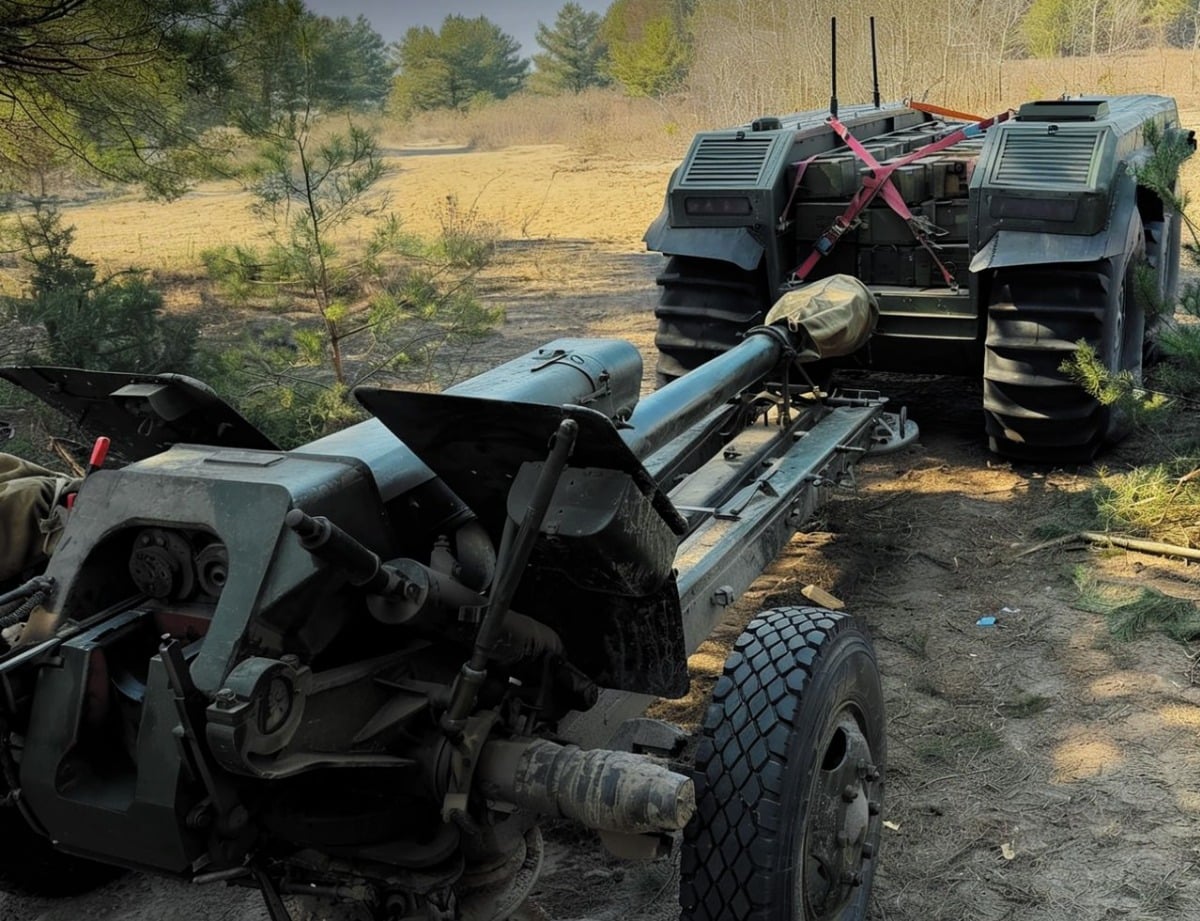
Towing a 3.2-tonne howitzer across a smooth test track proves exactly one thing. It proves that electric motors have torque.
We already knew electric motors have torque. High-school physics established that over a century ago.
Yet defense contractors still parade these parlor tricks as monumental breakthroughs. Every few months, another press release boasts that an uncrewed ground vehicle pulled a piece of heavy artillery, an armored truck, or a static cargo load down a paved access road. Defense analysts clap on cue. The headline gets written. Investors nod along.
It is military marketing at its most cynical.
If you have spent five minutes in tactical logistics, you know the truth. The bottleneck for autonomous battlefield resupply has never been straight-line towing capacity. It is everything else.
The Physics Lie Behind Mass Numbers
When a vehicle manufacturer brags about a 3.2-tonne towing limit, they are tricking non-engineers with rolling resistance.
On flat, compacted soil or concrete, rolling resistance coefficients stay remarkably low. Pulling a three-ton piece of wheeled artillery on a flat surface requires barely a fraction of that weight in force. A small human team can push a heavy artillery piece if the tire pressure is right and the asphalt is flat.
Now put that same 3.2-tonne howitzer in knee-deep mud, loose gravel, or a rutted dirt trail after forty-eight hours of continuous rain.
The physics change instantly. Rolling resistance skyrockets. The drawbar pull needed to extract a bogged artillery piece scales exponentially. To drag three tonnes of dead weight through real terrain, your towing rig needs raw mass, heavy traction, and high thermal tolerance.
Small and medium autonomous vehicles lack the mass to maintain traction against a stuck load. When a three-ton gun digs into soil, a two-ton vehicle does not pull it forward. The towing rig simply spins its tracks, burns its driveline, and sits there digging its own grave.
The Autonomous Towing Trap
Let us address the actual operational problem that PR departments pretend does not exist.
Towing towed artillery is an obsolete concept for autonomous platforms. Modern artillery units survive by fire-and-move tactics. They shoot, hook up, and displace before counter-battery radar pinpoints their location and returns devastating fire.
Hooking up a towed howitzer is not an automated task. It requires human soldiers to:
- Manually align the pintle hitch.
- Drop the lunette onto the hook.
- Connect hydraulic and air braking lines.
- Secure safety chains and pin the assembly.
- Raise the spades and stow the trail legs.
An uncrewed vehicle cannot perform these steps on its own. A crew of human gunners must physically stand beside the vehicle, handle the heavy iron, attach the lines, and manually lock everything in place.
If human soldiers must stay attached to the gun to hook it up, unhook it, deploy the trail legs, and reload the breech, what exactly was saved by removing the driver from the truck?
You did not automate the artillery battery. You simply forced the crew to walk through artillery fire zones while an expensive autonomous vehicle drives thirty yards ahead of them.
Tactical Mobility Ratios Are Broken
Defense acquisition officers love buying multi-role platforms. They want one vehicle that can scout, transport casualties, carry ammunition, and tow heavy guns.
It sounds economical on paper. In practice, it produces platforms optimized for nothing.
An autonomous vehicle sized to tow heavy artillery must carry massive battery packs or heavy hybrid powerplants to generate sustained drawbar pull. That means extra weight, larger ground footprints, and high heat signatures.
Yet, when that same vehicle is assigned to light reconnaissance or infantry resupply, all that excess weight becomes a massive liability. It sinks in soft soil. It draws infrared detection from miles away. It consumes power reserves just moving its own oversized chassis.
Real battlefield logistics requires specialized, disposable simplicity, not over-engineered jack-of-all-trades platforms that try to behave like tractor trailers.
The Recovery Paradox Defense Chiefs Ignore
What happens when an autonomous towing platform breaks down or gets hit in the forward edge of the battle area?
In a conventional unit, a crew chief diagnoses a broken axle or thrown track, hooks a recovery cable from a secondary truck, and pulls the vehicle out.
When a heavy autonomous vehicle fails while towing a three-ton howitzer, you now have two dead pieces of critical hardware blocking a tactical bottleneck. Recovering an autonomous vehicle requires specialized winches, high-capacity haulers, and human mechanics exposed in the open.
By making the prime mover autonomous without making the recovery infrastructure autonomous, you increase operational risk rather than reducing it. You trade one driver's safety for an entire recovery team's exposure.
What Real Autonomous Logistics Looks Like
Stop evaluating autonomous platforms by how much dead weight they can drag across a proving ground. Start evaluating them on the metrics that decide combat survival:
- Thermal and Acoustic Signatures: Can the unit move supplies without glowing on an enemy thermographic camera or broadcasting its position across acoustic sensors?
- Extreme Terrain Degradation: Does the propulsion system handle extreme lateral slopes and deep mud without shedding tracks or overheating motors?
- Attrition Economics: Is the platform cheap enough to lose without bankrupting the procurement budget?
- Manual Override Simplicity: Can a tired, cold soldier operate the platform under zero-light conditions with basic controls when software systems glitch?
Towing a static howitzer proves a test platform has electric motors and a frame that does not snap in half. It tells us nothing about whether the platform can survive three days of electronic warfare jamming, mud saturation, and direct artillery threat.
Until defense contractors start testing these platforms in realistic, degraded environments with non-cooperative loads, these milestone announcements remain what they have always been: marketing collateral for contract renewals.


:max_bytes(150000):strip_icc():focal(749x0:751x2)/Arnold-Schwarzenegger-Joseph-Baena-032926-a90f8d3315fc44a6aebc6d7bb44bda01.jpg)