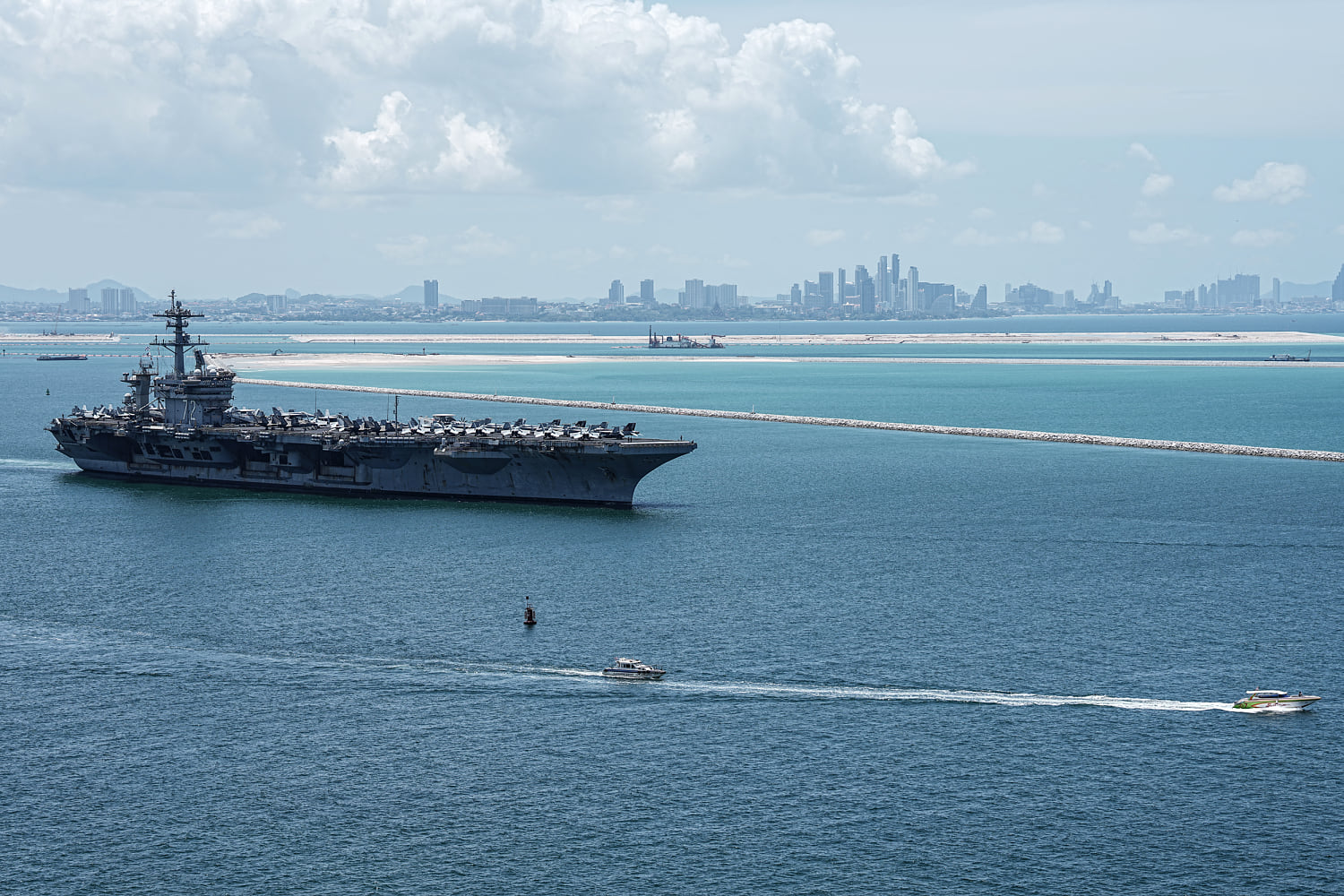
We love the sentimentality. The media treats a three hundred day carrier deployment like a Hallmark movie with nuclear reactors. Families crying on the pier, yellow ribbons tied around ancient oaks, sailors kissing the tarmac. It plays well on the evening news. It feeds the narrative of relentless American grit sailing over the horizon to keep the sea lanes open.
It is also an admission of systemic failure disguised as heroism.
When the USS Abraham Lincoln limped back to port after shattering modern endurance records, Washington pundits clapped like seals. They called it a testament to resilience. They praised the sailors for eating expired rations, fixing cracked piping with duct tape, and running a flight deck on four hours of sleep for ten months straight.
I have watched logistics chains up close. I have seen what happens when people mistake institutional dysfunction for character building. Praising a crew for surviving three hundred days at sea is like praising a marathon runner who finishes the race with two broken ankles and internal bleeding. Sure, they crossed the finish line. But the coaching staff belongs in prison for letting them start.
Let us strip away the patriotic gloss and look at the brutal mechanical reality of what happened out there in the blue water.
The Myth of Operational Agility
The lazy consensus in defense journalism is that extended deployments prove the unmatched flexibility of American naval power. The argument goes like this: when tensions flare in the Middle East or the Western Pacific, you need hulls on station, and if that means stretching a six month deployment to ten or eleven months, well, that is what flexible deterrence looks like.
That is not flexibility. That is mathematical bankruptcy.
If you have to stretch a ship past its designed maintenance cycle by fifty percent just to maintain a continuous presence in a single theater, your force structure is too small for your commitments. It is a shell game. You are robbing tomorrow to pay for yesterday. Every extra week a Nimitz-class carrier spends churning salt water without dry-dock maintenance is a compounding tax on its hull, its mechanical systems, and its human capital.
Naval architecture does not care about your geopolitical signaling. Saltwater corrodes high-tensile steel whether a senator is reading a statement about deterrence or not. Steam turbines fatigue. Electrical generators burn out their windings.
When you keep a carrier at sea for three hundred days, you are not projecting strength. You are advertising to every adversary on the planet that your bench is empty. You are showing them that you cannot rotate your forces because your maintenance yards are jammed with backlogged hulls waiting for dry docks that lack the workforce to fix them.
The Human Cost of Maritime Fatigue
We talk endlessly about hardware tonnage, missile cell counts, and sortie generation rates. We rarely talk about cognitive degradation.
Put a twenty-two-year-old electronics technician in a gray steel box with no natural light, recirculated air that tastes like copper, and a twelve-hour workday for three hundred consecutive days. Tell me how fast their reaction times are when an incoming threat vector lights up the combat information center. Tell me how sharp their judgment is when they are evaluating radar contacts on month nine of sleep deprivation.
Fatigue is a safety hazard that does not show up on a spreadsheet until something breaks. Maintenance errors skyrocket on extended deployments. Not because sailors are incompetent, but because biology has limits that no amount of mandatory motivational briefs can override. When exhaustion becomes the baseline operational state, preventive maintenance turns into pencil-whipping. You do not fix the valve; you sign off that you checked the valve because you need four hours of rack time before your next watch.
I have seen organizations run on pure adrenaline before. It works until it catastrophically stops working.
When we celebrate three hundred days at sea, we are normalizing a culture of operational abuse. We are telling young recruits that their physical and mental health are disposable line items in a global posture sheet. Then we act surprised when retention plummets, when suicide rates among surface fleet sailors trigger emergency task forces, and when experienced technicians leave the service the second their enlistment contract expires to work simpler, better-paying jobs in the private sector.
The Fleet Architecture Fallacy
The deeper problem here is a failure of imagination at the strategic level. The Pentagon is still fighting the last war, or rather, trying to maintain the illusion of a global empire with a fleet scaled for an entirely different century.
Building supercarriers is a point of national pride. But a hundred-thousand-ton nuclear carrier is a strategic monoculture. When you have only eleven of them, and half are in deep maintenance or training pipelines, keeping one deployed for nearly a year is what happens when your entire doctrine relies on putting all your eggs in one floating, multi-billion-dollar basket.
If a single ship has to stay deployed that long to cover a gap, it means your operational tempo is fundamentally unsustainable. It means your strategic calculus is built on sand.
Unconventional thinkers have been shouting this from the sidelines for years: distribute the lethality. Smaller, more numerous surface combatants. Unmanned surface vessels. Long-range anti-ship missile batteries on mobile land platforms. A networked mosaic of smaller assets is infinitely harder to target and doesn't require dragging a floating city across oceans for ten months just to show the flag.
Instead, we double down on the antique model. We pat ourselves on the back because a crew managed to hold together a deteriorating floating fortress through sheer stubbornness.
What Actually Needs to Change
Stop calling it resilience. Call it what it is: a symptom of strategic drift.
If leadership wants a sustainable maritime strategy, they need to implement hard caps on deployment lengths, regardless of what crises are bubbling up in the news cycle. If a hull must come home at six months, it comes home at six months. If that leaves a coverage gap in a specific region, let allies step up, or let the local posture adjust. Forcing a crew to absorb the consequences of poor long-term procurement and under-resourced shipyards is institutional cowardice.
Furthermore, defense contractors and naval shipyards need to be held to performance standards that actually reflect urgency. The reason ships stay out too long is that the ships meant to relieve them are stuck in maintenance purgatory for years at a time. Fix the industrial base, or accept that the fleet is shrinking in capability even if the hull count looks stable on paper.
The sailors of the USS Abraham Lincoln did their job. They executed their orders with professionalism under conditions that would break most people. They deserve every minute of the leave they are taking right now.
But the system that put them out there for three hundred days does not deserve applause. It deserves an immediate, unsparing audit.
Until we stop confusing endurance with effectiveness, we will keep celebrating the symptoms of our decline while pretending they are victories.